CLAT 2027 Exam — Exam Date, Eligibility, Syllabus, Application & Preparation Guide
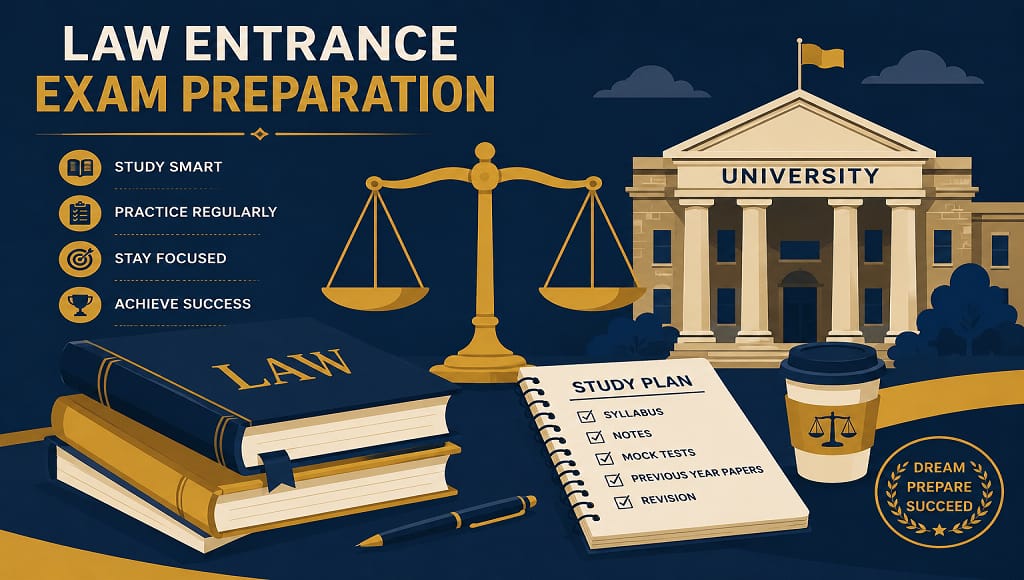
If a career in law genuinely interests you, the CLAT 2027 exam is likely the single most important date on your calendar right now. Registration is already open, and understanding exactly what this exam demands, early, gives you a real head start over aspirants who wait until the last few months.
So, in this guide, we will walk through everything the CLAT 2027 exam involves, from eligibility and dates to syllabus, application steps, and a genuinely practical preparation roadmap you can start following today.
CLAT 2027 Exam — Quick Overview
| Detail | Information |
| Full Form | Common Law Admission Test |
| Conducting Body | Consortium of National Law Universities |
| Notification Released | July 22, 2026 |
| Registration Window | August 3 – October 31, 2026 |
| Exam Date | December 6, 2026 (2:00 PM – 4:00 PM) |
| Mode | Offline (Pen and Paper) |
| Total NLUs Covered | 26 (NLU Delhi conducts AILET separately) |
CLAT 2027 Important Dates
Naturally, missing a single deadline in this process can genuinely cost you an entire admission cycle, so it helps to keep this schedule visible somewhere you check often.
| Event | Date |
| Notification Released | July 22, 2026 |
| Registration Opens | August 3, 2026 |
| Last Date to Register | October 31, 2026 |
| CLAT 2027 Exam | December 6, 2026 |
| Public Feedback Window (Expert Committee) | Till August 31, 2026 |
What Is the CLAT 2027 Exam and Why It Matters
Simply put, CLAT stands for the Common Law Admission Test, and it is conducted by the Consortium of National Law Universities for admission to undergraduate and postgraduate law programmes, along with select recruitment opportunities in a few public sector undertakings.
According to Wikipedia’s overview of the exam, CLAT has genuinely become the primary gateway into India’s premier law schools since its introduction, and its scores are now accepted well beyond the NLU network, including several respected private law institutions.
Consequently, clearing this exam does not just open one door; it opens access to India’s strongest legal education ecosystem, along with the internships and placements that come with it.
Courses Offered Through CLAT
Undergraduate Programmes
Through CLAT, you can pursue BA LLB (Hons.), BBA LLB, B.Com LLB, B.Sc LLB, and BSW LLB, depending on which combination genuinely interests you alongside law.
Postgraduate Programmes
Graduates with an existing LLB degree can also use CLAT PG scores to pursue an LLM at participating NLUs.
CLAT 2027 Eligibility Criteria
Educational Qualification
For undergraduate programmes, candidates must have passed, or be appearing in, Class 12 or an equivalent examination from a recognised board. Notably, this exam remains open to students from any stream, so Science and Commerce students are just as eligible as Arts students.
Minimum Marks Requirement
| Category | Required Marks |
| General / OBC | 45% |
| SC / ST | 40% |
Age Limit
Currently, there is genuinely no upper age limit prescribed for CLAT, which means the exam remains accessible even to candidates considering law as a slightly later career shift.
CLAT 2027 Application Process — Step by Step
- Step 1: Register on the official Consortium website using a valid mobile number and email ID
- Step 2: Verify your registered mobile number through OTP
- Step 3: Log in and fill in personal, academic, and communication details accurately
- Step 4: Upload the required documents, including your photograph and signature
- Step 5: Select your preferred NLUs in order of priority
- Step 6: Pay the application fee online and submit the form
| Category | Application Fee |
| General / OBC / PWD / NRI / OCI | Rs. 4,000 |
| SC / ST / EWS | Rs. 3,500 |
It is worth double-checking every field before final submission, since certain details cannot be edited once the application fee has been paid.
CLAT 2027 Exam Pattern
| Particulars | Details |
| Mode | Offline |
| Duration | 120 minutes |
| Total Questions | 120 |
| Total Marks | 120 |
| Negative Marking | -0.25 per wrong answer |
Importantly, the CLAT 2027 exam relies heavily on passage-based multiple-choice questions, meaning it tests comprehension and reasoning far more than direct memorisation.
CLAT 2027 Syllabus and Section-Wise Weightage
| Section | Expected Questions | Weightage Level |
| English Language | 22-26 | Moderate-High |
| Current Affairs & GK | 28-32 | Highest |
| Legal Reasoning | 28-32 | Highest |
| Logical Reasoning | 22-26 | Moderate-High |
| Quantitative Techniques | 10-14 | Lower |
English Language
Focus areas include reading comprehension, vocabulary in context, inference-based questions, grammar, and identifying an author’s tone within a passage.
Current Affairs and General Knowledge
This section covers national and international affairs, government policies, sports, awards, economic developments, and science and technology news.
Legal Reasoning
Expect questions on legal principles, constitutional concepts, rights and duties, and contemporary legal issues, generally presented through short passages rather than direct fact recall.
Logical Reasoning
This tests your ability to identify arguments, assumptions, conclusions, and apply critical, structured reasoning to unfamiliar scenarios.
Quantitative Techniques
Though it carries the smallest weightage, this section covers percentages, ratios and proportions, averages, profit and loss, and data interpretation.
How to Prepare for the CLAT 2027 Exam — Practical Study Plan
For Beginners
Start by building a genuine daily reading habit, improving vocabulary gradually, following current affairs consistently, and learning basic legal reasoning concepts without rushing.
For Intermediate Preparation
Once fundamentals feel comfortable, move toward sectional tests, weekly revision cycles, and previous year question practice, while specifically strengthening your weaker sections.
For Advanced Preparation
In the final stretch, prioritise regular full-length mock tests, sharpen your time management under exam conditions, and review every mistake carefully rather than simply repeating practice sets.
Month-Wise CLAT 2027 Preparation Roadmap
- First 3 months: Build fundamentals, develop reading habits, and start a current affairs base
- Next 3 months: Strengthen concepts, begin sectional tests, and introduce your first mock exams
- Final months before the exam: Shift to intensive practice with regular full-length mocks and comprehensive revision
- Last 60 days: Focus on full-length mocks, current affairs revision, and a detailed error-log review
If you are still deciding whether Arts is genuinely the right stream to pursue law through, our Arts Courses After 12th guide covers BA LLB alongside several other options in detail.
National Law Universities Accepting CLAT Scores
Top NLUs
These include NLSIU Bengaluru, NALSAR Hyderabad, WBNUJS Kolkata, NLIU Bhopal, and GNLU Gandhinagar, all of which remain highly competitive.
Other Participating NLUs
Beyond the top-tier institutions, MNLU Mumbai, HNLU Raipur, RGNUL Patiala, NUALS Kochi, and CNLU Patna also accept CLAT scores, offering genuinely strong alternatives with somewhat less intense competition.
Altogether, more than 3,000 seats are available across participating NLUs, with category-based and several state-domicile reservations in place.
CLAT vs AILET vs Other Law Entrance Exams
| Factor | CLAT | AILET | Private Law Exams |
| Conducted By | Consortium of NLUs | NLU Delhi | Individual universities |
| Institutes Covered | 26 NLUs + private colleges | NLU Delhi only | Specific university only |
| Competition Level | Very high | Extremely high | Varies, generally lower |
For most aspirants, CLAT genuinely offers the broadest reach, since a single exam attempt opens the door to 26 different NLUs simultaneously.
What’s New for CLAT 2027 — Expert Committee Reforms
Interestingly, the Consortium has formed an Expert Committee to review and potentially reform both the UG and PG exam formats. A report has already been published for public feedback, with submissions open until August 31, 2026. While the CLAT 2027 syllabus and pattern remain unchanged this year, aspirants should genuinely stay alert, since meaningful changes could apply from CLAT 2028 onward.
Best Books and Resources for CLAT Preparation
| Section | Recommended Resource Type |
| English | Vocabulary-building books and daily editorial reading |
| Current Affairs | Monthly current affairs compilations |
| Legal Reasoning | Comprehensive legal reasoning guides |
| Logical Reasoning | Analytical reasoning practice books |
| Quantitative Techniques | Standard aptitude practice books |
Meanwhile, if a broader comparison across streams would genuinely help your decision, our Science Courses After 12th article and Best Commerce Courses After 12th guide are both worth reviewing alongside this one.
Why Previous Year Question Papers Genuinely Matter
Practising previous year papers helps you understand real exam trends, question patterns, difficulty level, and frequently tested concepts far better than any single guidebook. Ideally, solve them under timed conditions, review every mistake carefully, and track which concepts keep recurring, since CLAT increasingly favours comprehension-based and analytical questions over rote memorisation.
Career Opportunities After CLAT
- Corporate law and litigation practice
- Judiciary services, through further competitive examinations
- Civil services, particularly leveraging a strong legal and constitutional foundation
- Legal journalism and public policy roles
- Legal consultancy and compliance roles across industries
Building strong communication and analytical skills alongside your CLAT preparation genuinely helps too, and our Career Skills for Students guide covers several complementary skills worth developing in parallel.
Common Mistakes CLAT Aspirants Make
- Ignoring current affairs preparation until the final few months
- Delaying mock tests instead of practising under real exam conditions early
- Reading too many different books instead of revising a focused set thoroughly
- Following a poor or inconsistent revision strategy
- Underestimating Quantitative Techniques simply because it carries lower weightage
- Registering at the very last moment and risking portal congestion
Final Pre-Exam Checklist
- Admit card downloaded and printed well in advance
- All required documents organised and easily accessible
- Recent mock test performance reviewed for weak areas
- Exam-day logistics, including travel and reporting time, planned ahead
- A calm, well-rested mindset going into exam day
If you are still exploring options beyond law entirely, our Top Courses After 12th guide covers Science, Commerce, and Arts paths side by side for a fuller comparison.
Frequently Asked Questions — CLAT 2027 Exam
What is the eligibility criteria for CLAT 2027?
Candidates must have passed, or be appearing in, Class 12 from any stream, with a minimum of 45% marks for General/OBC candidates and 40% for SC/ST candidates.
Can Science stream students apply for CLAT?
Yes, absolutely. CLAT is genuinely open to students from any stream, including Science and Commerce, not just Arts.
What is the CLAT 2027 application fee?
The fee is Rs. 4,000 for General, OBC, PWD, NRI, and OCI candidates, and Rs. 3,500 for SC, ST, and EWS candidates.
What is the difference between CLAT and AILET?
CLAT covers 26 NLUs through a single exam, while AILET is a separate exam conducted specifically by NLU Delhi for its own admissions.
What is the last date to register for CLAT 2027?
Registration closes on October 31, 2026, so it is genuinely wise to complete your application well before that deadline.
How many questions come from each section?
Current Affairs and Legal Reasoning carry the highest weightage with 28-32 questions each, followed by English and Logical Reasoning with 22-26 questions, and Quantitative Techniques with 10-14 questions.
Do I need prior legal knowledge for the Legal Reasoning section?
No, prior legal knowledge is not required. The section tests reasoning ability using given legal principles, not memorised legal facts.
Can I prepare for CLAT without coaching?
Yes, many students successfully self-prepare using structured study plans, quality books, and consistent mock test practice, though coaching can help with structure and mentorship for some learners.
Are puzzles or seating arrangement questions asked in CLAT?
Generally, no. CLAT's Logical Reasoning section focuses more on argument-based and passage-based reasoning rather than traditional puzzle formats.
Is there negative marking in CLAT 2027?
Yes, 0.25 marks are deducted for every incorrect answer, so informed guessing matters more than random attempts.
How many total seats are available through CLAT?
More than 3,000 seats are available across all participating NLUs, spread across general, category-based, and state-domicile reservations.
Can I change my NLU preferences after submitting the application?
Generally, once fees are paid, certain fields become non-editable, so it is best to finalise your preferences carefully before final submission.
Conclusion
Ultimately, the CLAT 2027 exam represents a genuinely significant opportunity for students who see themselves in a legal career, regardless of which stream they came from. With registration already open and the exam scheduled for December 6, 2026, there is real value in starting your preparation early rather than waiting.
So, build your study plan around the section weightages covered here, stay consistent with mock tests and current affairs, and register well before the October 31 deadline to avoid unnecessary last-minute stress.
For more exam updates and career guidance, visit Insight Study Hub.





Post Comment