Science Courses After 12th 2026 — Engineering, Medical & Non-NEET/JEE Options
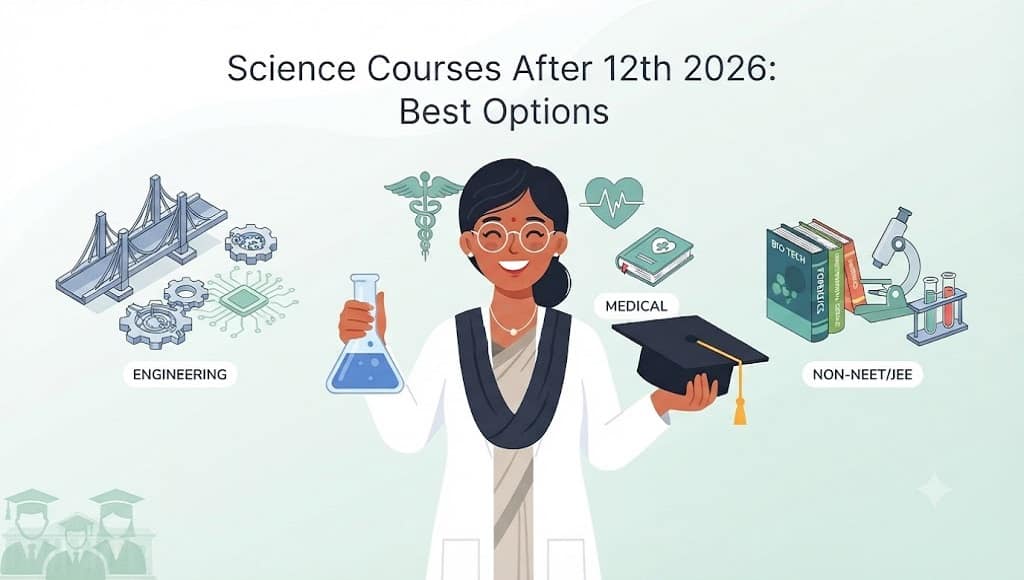
Right after Class 12 results, students searching for science courses after 12th often feel genuinely overwhelmed, and honestly, that reaction makes sense. Between engineering, medicine, pure sciences, and a growing list of newer fields, Science genuinely offers more choice than any other stream, which is exactly why narrowing it down feels so difficult.
So, in this guide, we will walk through the best science courses after 12th in 2026, organised by PCM, PCB, and non-entrance-exam paths, along with fees, salary expectations, and a practical way to actually decide between them.
Science Courses After 12th 2026 — Quick Overview
| Stream | Popular Paths | Entrance Exam | Typical Duration |
| PCM | Engineering, Architecture, Defence | JEE Main/Advanced, CUET, NDA | 4 years |
| PCB | Medicine, Dental, Nursing, Pharmacy | NEET, CUET | 4-5.5 years |
| PCMB | Both PCM and PCB options combined | JEE or NEET, or neither | Varies |
| Any Science Stream | BCA, B.Sc, B.Voc, Diploma | Mostly merit-based | 1-3 years |
Naturally, PCMB students genuinely enjoy the widest flexibility, since they remain eligible for both engineering and medical entrance exams, while PCM and PCB students each have a slightly narrower, more specialised set of options.
Top Science Courses After 12th (PCM) — Engineering and Technology
B.Tech / B.E. — Engineering
This remains the most popular choice among PCM students, and specialisations like Computer Science, AI & ML, Electrical, Mechanical, and Electronics & Communication continue to dominate placement statistics year after year.
B.Sc. Computer Science / IT
For students who want a technology-focused career without the broader engineering curriculum, this offers a more focused, often shorter, alternative.
B.Arch — Architecture
Blending mathematics, design, and physics, architecture genuinely suits PCM students with a creative streak alongside strong technical thinking.
Merchant Navy and Marine Engineering
Interestingly, this remains an underrated option, offering strong international salaries and, admittedly, a genuinely unconventional lifestyle compared to a typical desk job.
Defence — NDA and Indian Air Force Technical Entry
For PCM students drawn to discipline and service, defence entries through NDA or technical branches of the armed forces remain a respected, stable path.
Top Science Courses After 12th (PCB) — Medical and Healthcare
MBBS — Medical
Unsurprisingly, MBBS remains the most sought-after PCB course, though admission depends entirely on your NTA NEET UG score, which makes it genuinely one of the most competitive entrance processes in India.
BDS — Dental
For students who want a medical career with a slightly shorter, more focused curriculum, dentistry offers a genuinely strong alternative to MBBS.
BAMS, BHMS, and BUMS
Ayurveda, Homeopathy, and Unani medicine continue to see steady demand in India, and these degrees offer a genuinely respected, alternative medical career path.
B.Sc. Nursing
Nursing remains one of the most stable, globally portable healthcare careers available. For a deeper look at related, NEET-free healthcare options, our Paramedical Courses After 12th guide covers this territory in detail.
BPT — Physiotherapy
Physiotherapy has genuinely expanded well beyond hospitals into sports medicine and private practice, offering considerable career flexibility.
B.Pharm — Pharmacy
Pharmacy graduates find opportunities across manufacturing, retail, research, and increasingly, the fast-growing pharmaceutical export sector.
Best Science Courses After 12th Without NEET or JEE
Contrary to popular assumption, you genuinely do not need to clear NEET or JEE to build a strong science career. Several accessible, merit-based options exist.
- Sc. Pure Sciences — Physics, Chemistry, Maths, or Biology, ideal for research-minded students
- BCA — Computer Applications, a practical alternative to B.Tech for IT-focused careers
- Sc. Agriculture — genuinely growing in relevance given India’s focus on sustainable farming
- Sc. Biotechnology / Microbiology — strong scope in pharma, research, and food technology
- Forensic Science — a genuinely fascinating, less crowded field with steady government demand
- Aviation and Pilot Training — a high-investment but high-reward alternative career path
Professional Courses Open to Science Students — CA, CS, CMA
Interestingly, science students are not locked out of commerce-adjacent professional qualifications either. CA, CS, and CMA are all open to PCM and PCB students alike, and this combination of scientific rigour with financial expertise can genuinely be a strong differentiator in certain career paths, such as fintech or healthcare finance.
Short-Term and Diploma Courses After 12th Science
If a full degree feels like too long a commitment right now, polytechnic diplomas, ITI courses, and certificate programmes in IT, Data Science, or AI offer a faster, more affordable entry point. Our Best Short Term Courses After 12th article covers several practical options worth comparing.
Degree vs Diploma vs B.Voc — What Should You Opt For?
| Factor | Degree (B.Tech/B.Sc) | Diploma / B.Voc |
| Duration | 3-4 years | 1-3 years |
| Focus | Broad theoretical and practical foundation | Highly practical, skill-specific training |
| Best For | Students planning long-term specialisation or higher studies | Students wanting faster, job-ready entry |
Government vs Private Colleges — Which Is Better?
| Factor | Government Colleges | Private Colleges |
| Fees | Significantly lower | Considerably higher |
| Placement Support | Varies, often strong at top institutes | Generally structured, varies by college |
| Best For | Budget-conscious, merit-focused students | Students prioritising infrastructure and flexibility |
Salary Scope — Which Science Course Pays Best?
| Course | Year 1-2 | Year 5 | Year 10 |
| B.Tech (CSE/AI-ML) | Rs. 4-8 LPA | Rs. 10-18 LPA | Rs. 20 LPA+ |
| MBBS | Rs. 6-8 LPA | Rs. 12-20 LPA | Rs. 25 LPA+ |
| B.Sc. Nursing | Rs. 2.5-4 LPA | Rs. 6-9 LPA | Rs. 12 LPA+ |
| BCA | Rs. 3-5 LPA | Rs. 8-12 LPA | Rs. 15 LPA+ |
| B.Pharm | Rs. 2.5-4 LPA | Rs. 6-10 LPA | Rs. 14 LPA+ |
As expected, salary growth generally accelerates significantly after the five-year mark, once genuine specialisation and experience start compounding.
Future Job Market 2026-2035 — What’s Rising, What’s Shrinking
Looking ahead, fields grounded in STEM (Science, Technology, Engineering, and Mathematics) continue to expand rapidly, particularly AI-ML, biotechnology, renewable energy, and healthcare technology. Meanwhile, purely routine, low-skill technical roles are genuinely shrinking as automation advances, which makes continuous upskilling increasingly important, regardless of which course you eventually choose.
A Realistic Example — Comparing Two Common Paths
To make this more concrete, consider two PCM students with similar Class 12 marks. The first pursues a core mechanical engineering degree at a mid-tier private college, while the second chooses a B.Sc. in Computer Science with a self-taught focus on web development alongside coursework. Five years later, the second student, despite a comparatively ‘less prestigious’ degree on paper, often earns a higher starting salary, simply because tech-focused roles currently see stronger demand relative to traditional core engineering positions.
This is not to suggest core engineering is a poor choice; rather, it illustrates that the specific specialisation within a science course after 12th often matters just as much as the broad category itself. Consequently, it genuinely pays to research current industry demand for your specific specialisation, not just the general field.
Balancing Passion With Practicality
It is worth acknowledging that choosing between passion and practicality is rarely simple. A student genuinely passionate about pure physics research, for instance, may face a longer, less certain path compared to a peer choosing a more commercially in-demand field like data science. That said, neither choice is inherently wrong.
Instead, it helps to ask a slightly different question: can you sustain genuine motivation through years of study in this field, even during the harder stretches? If the honest answer is yes, then passion-driven choices often pay off in the long run, since sustained effort tends to outperform short-term practicality over a full career.
How to Choose the Right Science Course After 12th
- Weigh genuine interest against realistic job market demand, not just current popularity
- Be honest about your budget, since private medical and engineering fees can be substantial
- Decide early whether you are genuinely prepared for JEE/NEET-level competition, or whether a non-entrance route suits you better
- Talk to people already working in your shortlisted fields before committing fully
If you are still comparing Science against other streams entirely, our Top Courses After 12th guide and Best Commerce Courses After 12th article are both worth reviewing for a broader comparison.
Common Mistakes Students Make While Choosing a Science Course
- Relying solely on salary figures without considering genuine interest or aptitude
- Following parental mandates blindly, rather than having an honest conversation about options
- Underestimating just how competitive JEE and NEET genuinely are before committing years to coaching
- Choosing an overly specialised B.Voc programme without confirming real industry demand
- Ignoring skill complementarity, such as pairing a technical degree with communication or digital skills
In fact, complementary digital skills genuinely matter across nearly every science career today, as covered in our Computer Courses After 10th guide, which is worth exploring even if your main path lies elsewhere.
FAQs — Best Science Courses After 12th 2026
What should I do after 12th Science if my JEE rank is low?
Consider BCA, B.Sc. in a specialised science subject, or private engineering colleges with management quota seats, all of which remain genuinely viable paths without a top JEE rank.
Can PCM students pursue medical courses?
Generally, no, since most medical courses require Biology as a core subject. That said, PCM students remain eligible for a wide range of engineering, technology, and non-medical science paths instead.
Which science course has the highest salary potential?
MBBS and specialised B.Tech fields like AI-ML or Data Science currently offer the highest long-term salary potential, though both require significant upfront competition or investment.
Is engineering still worth pursuing in 2026?
Yes, genuinely so, particularly in specialisations like AI-ML, Computer Science, and renewable energy, though traditional core branches have seen comparatively slower salary growth in recent years.
What is the safest science career option?
Nursing and pharmacy are often considered the safest, since they combine steady demand, moderate entry competition, and genuinely strong job security across both government and private sectors.
Can PCB students pursue non-medical careers?
Absolutely. PCB students can pursue B.Sc. programmes, BCA, biotechnology, forensic science, or even commerce-adjacent professional courses like CA, without needing to rely on NEET at all.
Is B.Voc a good option after 12th Science?
Yes, for students who prefer a more practical, hands-on approach and want to enter the workforce faster, though it is worth confirming genuine industry demand for that specific specialisation first.
Final Thoughts
Ultimately, science courses after 12th offer more genuine variety than any other stream, from the well-trodden paths of engineering and medicine to newer, equally rewarding options like biotechnology, forensic science, and data-driven fields. Rather than defaulting to whatever is currently trending, take the time to weigh your genuine interest, realistic budget, and appetite for competitive entrance exams.
So, research thoroughly, talk to people already working in your shortlisted fields, and remember that a thoughtful, well-researched decision today will shape a far more confident, fulfilling career path in the years ahead.
For more career guidance and course comparisons, visit Insight Study Hub.








1 comment