Best Arts Courses After 12th 2026 — Full List, Fees, Salary & Career Scope
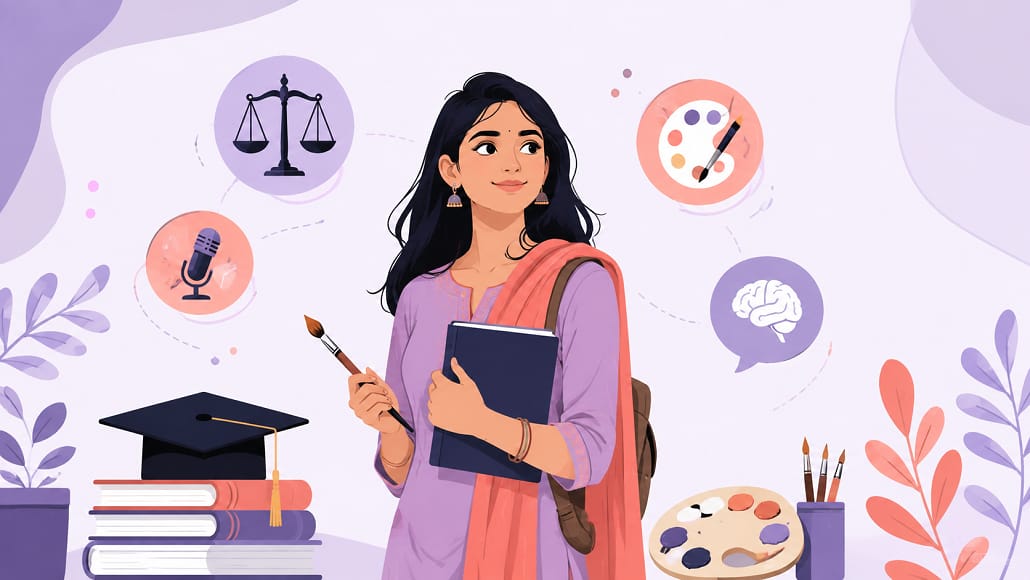
If someone has ever told you that arts courses after 12th lead nowhere, they are working from outdated information. Today, arts graduates run design studios, argue cases in court, anchor news bulletins, run digital marketing agencies, and counsel patients through mental health struggles. The stream never lacked scope; it simply lacked good information.
So, in this guide, we will walk through the best arts courses after 12th in 2026, along with realistic fees, salary expectations, and a genuinely practical framework for choosing between them, rather than picking whatever sounds impressive at a family gathering.
Why Arts Is a Genuinely Strong Choice After 12th
Unlike Science, where your options narrow fairly quickly toward medicine or engineering, arts genuinely keeps multiple doors open at once. Most arts courses after 12th do not require Mathematics, which removes a significant barrier for students who struggled with the subject in school.
According to Wikipedia’s overview of the Bachelor of Arts degree, this qualification traditionally emphasises broad, liberal education across humanities and social sciences, which is precisely why it adapts so naturally to fields as varied as law, design, and psychology.
Additionally, emerging fields like UI/UX design, digital marketing, and data-adjacent analytics have created genuinely new, well-paying territory for arts graduates that simply did not exist a decade ago.
Best Arts Courses After 12th 2026 — Quick Overview
| Course | Duration | Entrance Exam | Approx. Starting Salary |
| BA (Various Specialisations) | 3 years | Mostly merit-based, CUET at central universities | Rs. 2.5 – 4 LPA |
| BA LLB | 5 years | CLAT, LSAT India | Rs. 4 – 8 LPA |
| BJMC | 3 years | Merit-based, some entrance exams | Rs. 3 – 5 LPA |
| B.Des / BFA | 4 years | NID DAT, UCEED, institute-specific | Rs. 3.5 – 6 LPA |
| BBA | 3 years | Merit-based, CUET | Rs. 3 – 5 LPA |
| BHM | 3-4 years | NCHMCT-JEE | Rs. 2.5 – 4 LPA |
Naturally, professional courses like law and design demand more competitive entrance exams, while general BA programmes remain the most accessible entry point for most students.
Traditional Degree Courses
BA With Multiple Specialisations
This remains the most common choice among arts students, largely because it offers genuine flexibility. Within a BA, you can specialise in psychology, history, political science, sociology, economics, or literature, and each path opens meaningfully different career doors.
BA LLB — Integrated Law
For students genuinely drawn to the legal profession, this five-year integrated programme combines a BA with an LLB, saving time compared to pursuing them separately. Admission typically depends on CLAT (Common Law Admission Test), which is genuinely competitive but well worth preparing for if law is your goal.
BSW — Bachelor of Social Work
Often overlooked, this course genuinely suits students interested in community development, NGO work, and social welfare administration, and demand for trained social workers continues to grow steadily.
High-Demand Professional and Creative Courses
BJMC — Journalism and Mass Communication
If you enjoy storytelling, current affairs, and communication, this course opens doors into print, broadcast, and digital journalism, along with public relations and corporate communications.
B.Des and BFA — Design and Fine Arts
Design has genuinely become one of the fastest-growing fields for arts graduates, spanning fashion, graphic, interior, and product design, with strong demand from both Indian and international brands.
BBA — Business Administration
For students who lean toward management and leadership rather than pure creativity, BBA offers a genuinely practical business foundation, often serving as a stepping stone toward an MBA later.
BHM — Hotel Management
Hospitality has expanded well beyond hotels into aviation, cruise lines, and event management, and BHM graduates consistently find diverse, people-facing career opportunities.
Foreign Languages and Translation Studies
With India’s growing trade and outsourcing ties globally, fluency in French, German, Japanese, or Spanish genuinely opens doors into translation, embassy work, and international business roles.
Modern and High-Growth Courses Worth Watching in 2026
- Digital Marketing — SEO, social media, and performance marketing skills that pair well with any BA specialisation
- UI/UX and Product Design — increasingly hires arts graduates who understand human behaviour and visual communication
- Event Management — corporate events, weddings, and brand activations, often project-based income
- Content Writing and Copywriting — a genuinely accessible entry point into the creator economy
- Interior Design — steady demand from both residential and commercial clients
If you are also comparing this against other streams before finalising your decision, our Top Courses After 12th guide covers Science and Commerce options side by side for a fuller picture.
Arts Courses Fees Structure 2026
| Course | Government/Public College | Private College |
| BA (General) | Rs. 5,000 – Rs. 20,000/year | Rs. 30,000 – Rs. 1 lakh/year |
| BA LLB | Rs. 15,000 – Rs. 50,000/year | Rs. 1 – 3 lakh/year |
| BJMC | Rs. 10,000 – Rs. 40,000/year | Rs. 50,000 – Rs. 1.5 lakh/year |
| B.Des | Rs. 20,000 – Rs. 60,000/year | Rs. 1.5 – 3.5 lakh/year |
| BHM | Rs. 15,000 – Rs. 40,000/year | Rs. 60,000 – Rs. 1.5 lakh/year |
Career Scope and Salary After Arts Courses
| Course | Career Roles | Starting Salary | Mid-Level Salary |
| BA Psychology | Counsellor, HR Associate, Researcher | Rs. 2.5 – 4 LPA | Rs. 6 – 10 LPA |
| BA LLB | Lawyer, Legal Advisor, Corporate Counsel | Rs. 4 – 8 LPA | Rs. 12 – 20 LPA |
| BJMC | Journalist, Content Strategist, PR Executive | Rs. 3 – 5 LPA | Rs. 7 – 12 LPA |
| B.Des | UI/UX Designer, Fashion Designer | Rs. 3.5 – 6 LPA | Rs. 8 – 15 LPA |
| Digital Marketing | SEO Executive, Social Media Manager | Rs. 2.5 – 4 LPA | Rs. 7 – 12 LPA |
As expected, salary growth accelerates meaningfully once genuine specialisation and a strong portfolio or track record start compounding, typically after three to five years.
Pros and Cons of Choosing Arts After 12th
| Advantages | Trade-offs |
| No Maths required for most courses | Some fields have lower entry-level pay than engineering |
| Wide variety of specialisations available | Success often depends heavily on skill and portfolio |
| Strong scope in law, design, and psychology | Requires proactive networking and internships |
| Multiple government job pathways available | Can face outdated social stigma from relatives |
Entrance Exams for Arts Courses After 12th
- CLAT and LSAT India — for BA LLB and other law programmes
- CUET UG — for general BA admissions at central and several state universities
- NID DAT and UCEED — for design programmes
- NCHMCT-JEE — for Bachelor of Hotel Management
Government Jobs After 12th Arts — An Underrated Path
Arts graduates are genuinely well-positioned for government careers, especially through UPSC Civil Services, which remains accessible to any graduate, regardless of stream. You can review eligibility details directly on the UPSC official website. Beyond IAS, options like SSC CGL and IBPS PO offer competitive entry-level salaries, typically between Rs. 25,000 and Rs. 42,000 per month, with clear promotion pathways over time.
BA vs BBA vs BJMC — Which Is Right for You?
| Factor | BA | BBA | BJMC |
| Focus | Broad humanities and social sciences | Business and management fundamentals | Media, communication, journalism |
| Flexibility | Highest, keeps multiple doors open | Moderate, business-focused track | Moderate, media-focused track |
| Best For | Students still exploring specific interests | Students aiming at management roles | Students drawn to storytelling and media |
Step-by-Step: How to Choose the Right Arts Course
- Step 1: List two or three subjects you genuinely enjoyed in Class 11 and 12, not just scored well in
- Step 2: Research realistic salary ranges for your shortlisted fields, rather than relying on assumptions
- Step 3: Check whether your shortlisted course requires a competitive entrance exam, and assess your readiness honestly
- Step 4: Talk to at least one person already working in that field before finalising your decision
- Step 5: Consider a backup option, particularly if you are targeting a highly competitive field like law or design
For students who also want a faster, more affordable alternative alongside a full degree, our Best Short Term Courses After 12th article covers several practical options worth layering on top of any arts specialisation.
Quick Decision Checklist
- Have you identified subjects you genuinely enjoy, not just ones that sound impressive?
- Have you checked the entrance exam requirements for your shortlisted courses?
- Have you compared realistic starting salaries rather than assuming figures?
- Have you spoken with someone currently working in your target field?
- Do you have a reasonable backup plan in case your first choice does not work out?
Common Mistakes Students Make While Choosing Arts Courses
- Following peer pressure or family expectations instead of genuine personal interest
- Assuming arts automatically means low scope, without researching current salary data
- Ignoring entrance exam preparation for law or design until it is far too late
- Ignoring newer, high-growth fields like digital marketing simply because they feel less traditional
- Choosing a course purely because a friend is also joining it
If a NEET-free healthcare-adjacent path interests you instead, our Paramedical Courses After 12th guide and our Science Courses After 12th article are worth exploring as well, particularly if you remain genuinely undecided between streams.
A Real-World Example — Two Students, Two Paths
Consider two students who finished 12th Arts with similar marks. The first pursued a general BA in Political Science, unsure of her next step, and eventually cleared UPSC after two attempts, now working as a state civil servant. The second chose BJMC, interned at a digital news outlet during college, and now works as a content strategist earning considerably more than the national average for fresh graduates in his field.
Neither path was inherently better than the other. What mattered was that each student chose a direction aligned with genuine interest, then invested consistently in building relevant experience alongside their degree, rather than waiting until graduation to start planning.
Frequently Asked Questions — Arts Courses After 12th 2026
What are the best Arts courses without Mathematics?
Nearly all arts courses, including BA, BA LLB, BJMC, BSW, and BHM, do not require Mathematics, making arts genuinely accessible for students who avoided the subject.
Can an Arts student prepare for CA?
Yes. The Chartered Accountancy course is open to students from any stream, including Arts, though it does require strong numerical aptitude and dedicated preparation.
Is CUET compulsory for all Arts admissions in India?
Not entirely. Several central universities require CUET UG scores, but many state and private colleges continue to admit students based on Class 12 marks directly.
How can Arts students get a government job?
Arts graduates are broadly eligible for UPSC Civil Services, SSC CGL, IBPS PO, and various state PSC examinations, since most government exams do not restrict eligibility by undergraduate stream.
BA vs BBA — which is better?
BA suits students who want flexibility and are still exploring specific interests, while BBA suits those clearly aiming at management or corporate leadership roles.
Are there good Arts courses specifically for girls?
There are no gender-specific restrictions in arts education. Every course listed here, from law to design, is equally open and suitable, with the right choice depending purely on individual interest.
What is the scope of the Arts stream in India in 2026?
Genuinely strong, particularly in law, design, psychology, digital marketing, and civil services, all of which continue to see steady or growing demand.
Are there free or government-sponsored Arts courses available?
Yes, several state government colleges offer heavily subsidised or near-free BA programmes, and various scholarship schemes further reduce costs for eligible students.
How long does a typical Arts degree take to complete?
A standard BA takes three years, while integrated programmes like BA LLB take five years, and design or hotel management courses typically take three to four years.
Is Arts a good choice for students aiming at civil services?
Yes, genuinely one of the best choices. Arts subjects like Political Science, History, Sociology, and Public Administration align closely with the UPSC syllabus, giving Arts graduates a natural advantage.
Can Arts students switch to a technical or business career later?
Yes. Many Arts graduates successfully transition into digital marketing, UX research, HR analytics, or business roles by adding relevant certifications or an MBA after their undergraduate degree.
What is the average starting salary after a general BA degree?
Starting salaries for a general BA graduate typically range between Rs. 2.5 LPA and Rs. 4 LPA, though this varies considerably based on specialisation and additional skills.
Conclusion
Ultimately, arts courses after 12th offer genuinely more depth and opportunity than most families realise, spanning law, design, psychology, journalism, and rapidly growing digital fields. The stream was never the limitation; unclear planning was.
So, take the time to identify what genuinely interests you, research realistic salary expectations, and prepare early for any competitive entrance exam your chosen path requires. A well-researched decision today will shape a far more confident and rewarding career ahead.
For more career guidance and course comparisons, visit InsightStudyHub.com.







2 comments