Career Skills for Students in India 2026 — Top 10 You Must Learn
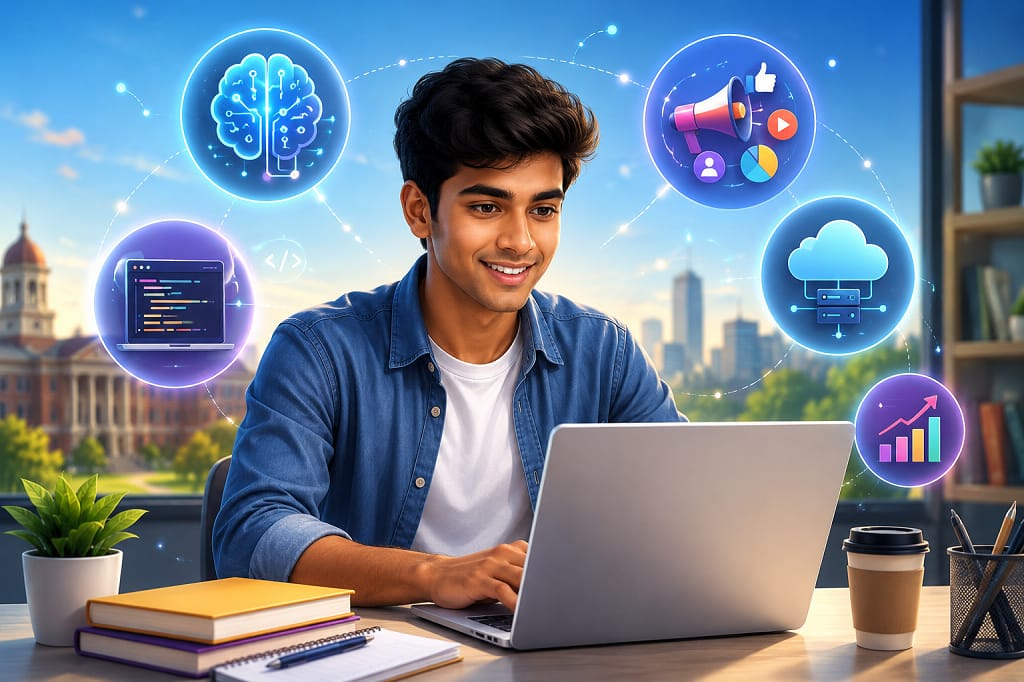
If you are a student in India right now, here is something worth knowing: the job market in 2026 does not care as much about your degree as it cares about what you can actually do. According to the India Skills Report 2026, 80% of employers now value practical skills and certifications above formal degrees when hiring. Furthermore, the World Economic Forum and LinkedIn predict that AI will reshape 65% of jobs by 2026 — making the right career skills more valuable than ever before.
The good news is that most of these skills are learnable online, many for free, and moreover, several within months. Therefore, this guide covers the top 10 career skills every student in India should develop in 2026 — with salary benchmarks, free learning resources, and a stream-wise guide to help you decide where to start.
Also read: Top Courses After 12th — Best Career Paths for Students
Why Career Skills Matter More Than Degrees in 2026
Skill Development vs Academic Knowledge
The shift happening in India’s job market right now is not subtle — it is structural. In fact, companies across technology, finance, marketing, and manufacturing are actively hiring candidates who demonstrate capability, not just credentials. As a result, academic qualifications alone are no longer enough to guarantee employment.
| Factor | Degree Only | Degree + Skills |
|---|---|---|
| Job readiness | Low | High |
| Starting salary | Rs. 3–5 LPA | Rs. 8–35 LPA |
| Hiring speed | Slow | Fast |
| Future relevance | Decreasing | Increasing |
Moreover, the government is backing this shift with serious investment. The Union Cabinet approved the Skill India Programme with a Rs. 8,800 crore outlay through 2025–26 — establishing 50 Future Skills Centres, 50,000 Atal Tinkering Labs, and 10 International Academies. Consequently, students who build skills alongside their education are positioning themselves for a fundamentally different — and better — career outcome.
Top 10 Career Skills for Students in India 2026
1. Artificial Intelligence and Machine Learning
If there is one skill that defines the career landscape in 2026, it is AI. India’s AI market is projected to reach $17 billion by 2027, growing at a staggering 25 to 35% CAGR. Furthermore, NASSCOM reports a 51% demand-supply gap — with over 2,90,000 AI job postings recorded in 2025 alone. In other words, there are far more jobs than qualified candidates, making this the single highest-opportunity skill available to students today.
- Starting salary: Rs. 15–35 LPA for freshers
- Tools to learn: Python, TensorFlow, scikit-learn, ChatGPT API
- Free resources: Google AI courses, Coursera (audit), NPTEL IIT courses, IndiaAI Mission
- Best for: Engineering and Science students — though anyone can start with Python basics
Where to begin: Start with Python programming — it is the foundation of all AI/ML work. Once comfortable with basic Python, move to data manipulation with Pandas, then simple machine learning with scikit-learn.
2. Data Analytics and Data Science
Data is the oil of the 21st century — and data analysts are the engineers who refine it. The India Decoding Jobs Report 2026 places data analytics at the top of hiring demands across banking, e-commerce, healthcare, and consulting sectors. Additionally, data skills are accessible to students from all academic backgrounds — you do not need an engineering degree to become a strong data analyst.
- Starting salary: Rs. 8–20 LPA
- Tools: Excel, SQL, Python, Tableau, Power BI
- Certifications: Google Data Analytics Certificate, IBM Data Science Professional Certificate
- Best for: All streams — Science, Commerce, and Arts students can all build data skills
Pro Tip: Start with Excel and SQL — these two tools alone make you immediately employable in analyst roles at startups and mid-size companies. Add Python and Tableau later for senior roles.
3. Cybersecurity
Every organisation that operates online needs cybersecurity professionals — and India currently has a massive shortage of them. The NIIT India Skills Gap Report 2026 highlights cybersecurity as one of the fastest growing demand areas. Moreover, with the rise of digital payments, cloud infrastructure, and government digitisation, this demand will only accelerate.
- Starting salary: Rs. 6–18 LPA
- Skills to develop: Ethical hacking, network security, cloud security, vulnerability assessment
- Certifications: CEH (Certified Ethical Hacker), CompTIA Security+, CISSP
- Best for: CS/IT students primarily, though motivated students from other streams can also enter via certifications
4. Cloud Computing and DevOps
Nearly every major Indian company — from Infosys and TCS to Zomato and Paytm — now runs on cloud infrastructure. Consequently, professionals who understand AWS, Azure, or Google Cloud are in constant demand. Additionally, cloud certifications are among the most respected credentials in the tech industry — adding an average 20% salary premium over non-certified peers.
- Starting salary: Rs. 8–22 LPA
- Platforms: Amazon Web Services (AWS), Microsoft Azure, Google Cloud Platform
- Certifications: AWS Solutions Architect, Google Cloud Professional, Azure Administrator
- Best for: CS/IT students — also valuable for working professionals in any tech role
5. Full Stack Web Development
Web development remains one of the most consistently in-demand technical skills in India. Furthermore, full stack developers — who can build both the frontend (what users see) and backend (how data is processed) — command significantly higher salaries than specialists in either area alone.
- Starting salary: Rs. 6–18 LPA
- Skills: HTML, CSS, JavaScript, React (frontend), Node.js, databases (backend)
- Free resources: freeCodeCamp, The Odin Project, MDN Web Docs
- Best for: CS/IT students and anyone willing to invest 6 to 9 months of focused learning
Real example: Many self-taught web developers in India land their first job within 8 to 12 months of starting from zero — using entirely free resources like freeCodeCamp.
6. Digital Marketing and SEO
Digital marketing is the one career skill that opens doors across every industry. Whether you want to work at a startup, a large corporation, or build your own freelance business, digital marketing skills are directly monetisable. Moreover, the barrier to entry is low — no engineering background required — making it ideal for students from any stream.
- Starting salary: Rs. 4–12 LPA (freelance income can be significantly higher)
- Skills: Search Engine Optimisation (SEO), social media marketing, content marketing, Google Ads, email marketing
- Free certifications: Google Digital Garage, HubSpot Academy, Meta Blueprint
- Best for: All streams — particularly valuable for Commerce and Arts students
7. UI/UX Design
User experience design has emerged as one of the most creative and high-paying non-engineering roles in India’s tech sector. In fact, strong UI/UX designers are often paid on par with software engineers — because poor design directly costs companies revenue. Additionally, you do not need a design degree to become a UX designer — portfolio and skills matter more than formal credentials in this field.
- Starting salary: Rs. 5–15 LPA
- Tools: Figma (industry standard), Adobe XD, Canva
- Free resources: Google UX Design Certificate (Coursera), YouTube tutorials, Figma Community
- Best for: All streams — particularly students with creative interests
8. Financial Literacy and Financial Modelling
For Commerce students especially, financial modelling is the skill that separates average analysts from those earning Rs. 15 LPA at their first job. However, financial literacy — understanding how money works, how to read a balance sheet, and how to analyse investment options — is valuable for students across all streams. Consequently, this is one skill that directly improves both your career and your personal financial decisions.
- Starting salary: Rs. 5–15 LPA
- Skills: Excel financial modelling, accounting fundamentals, DCF valuation, investment analysis
- Certifications: CFA Level 1, CFI Financial Modelling & Valuation Analyst (FMVA)
- Best for: Commerce students primarily — also highly valuable for MBA aspirants
9. Communication and Emotional Intelligence
Here is a truth that most career guides gloss over: technical skills get you the interview, but communication skills get you the job — and keep you in it. Moreover, as AI tools automate more routine tasks, the skills that remain uniquely human — empathy, clear communication, conflict resolution, and leadership — become more valuable, not less.
- Why every employer wants this: Communication failures cost companies millions — and every team needs people who can articulate ideas clearly
- How to improve: Join a debate club, practice public speaking through Toastmasters, write regularly
- Free tools: Toastmasters International (free local chapters), YouTube channels on public speaking
- Best for: Every student — all streams, all career paths
10. Critical Thinking and Problem Solving
The final skill on this list is arguably the most future-proof of all. As AI handles more data processing, code writing, and routine analysis, employers increasingly value people who can ask the right questions, identify root causes, and design non-obvious solutions. Furthermore, critical thinking is the meta-skill that makes every other skill on this list more effective.
- How to develop: Work through real-world case studies, practice structured thinking frameworks, engage with complex problems through debates and competitions
- Why it is future-proof: AI can process information — but it cannot yet replace human judgment in ambiguous, high-stakes situations
- Best for: All students — this skill compounds every other career skill you build
Also read Best Stream After 10th for AI Jobs India 2026
Career Skills 2026 — Complete Summary Table
| Skill | Type | Starting Salary | Best For |
|---|---|---|---|
| AI & ML | Technical | Rs. 15–35 LPA | Engineering/Science |
| Data Analytics | Technical | Rs. 8–20 LPA | All streams |
| Cybersecurity | Technical | Rs. 6–18 LPA | CS/IT students |
| Cloud Computing | Technical | Rs. 8–22 LPA | CS/IT students |
| Web Development | Technical | Rs. 6–18 LPA | CS/IT students |
| Digital Marketing | Non-Technical | Rs. 4–12 LPA | All streams |
| UI/UX Design | Technical | Rs. 5–15 LPA | All streams |
| Financial Modelling | Non-Technical | Rs. 5–15 LPA | Commerce students |
| Communication & EQ | Soft Skill | — | All students |
| Critical Thinking | Soft Skill | — | All students |
Which Career Skills Should You Learn Based on Your Stream?
Not every skill suits every student equally. Therefore, here is a practical stream-wise guide to help you prioritise:
| Stream | Top 3 Skills to Learn First |
|---|---|
| Science — PCM | AI/ML, Web Development, Cloud Computing |
| Science — PCB | Data Analytics, Digital Marketing, Communication |
| Commerce | Financial Modelling, Digital Marketing, Data Analytics |
| Arts/Humanities | Communication, Digital Marketing, UI/UX Design |
How to Start Learning Career Skills in 2026 — Practical Guide
Free Resources for Indian Students
The best part about career skills in 2026 is that the learning resources are largely free. Here is where to start:
- NPTEL — free courses from IIT and IISc faculty, across technology and management
- Coursera and edX — audit hundreds of courses for free from global universities
- YouTube — genuinely excellent free tutorials for every skill on this list
- Google Career Certificates — industry-recognised credentials in IT, data, UX, and digital marketing
- IndiaAI Mission — government-backed free AI courses supporting 8,000 undergraduate students
Tips to Master Skills Quickly
Learning a skill is one thing — becoming employable with it is another. Consequently, follow these principles to accelerate your journey:
- Start one skill at a time — scattered learning produces shallow results; depth beats breadth
- Build projects — a portfolio of real work matters more to employers than certificates alone
- Pursue internships — practical experience converts skill into career opportunity faster than any certification
- Use GitHub and LinkedIn — showcase your work publicly; recruiters actively look for candidates with visible portfolios
- Certifications add value — industry-recognised certifications from Google, AWS, and IBM add an average 20% salary premium
IT vs Non-IT Skills — Which Path to Choose?
| Factor | IT Skills | Non-IT Skills |
|---|---|---|
| Starting salary | Higher — Rs. 6–35 LPA | Moderate — Rs. 4–15 LPA |
| Learning time | 6–12 months | 3–6 months |
| Stream preference | CS/IT background helpful | Any stream |
| Job market demand | Very high | High |
Both paths are valid. Moreover, the most competitive candidates in 2026 combine one technical skill with one communication or business skill — making them valuable across multiple role types.
Frequently Asked Questions
Can arts students learn technical career skills?
Absolutely. Digital marketing, UI/UX design, and data analytics with Excel and SQL are all accessible to Arts students without any engineering background. In fact, many top digital marketers and UX designers in India come from non-technical backgrounds. Therefore, stream is never a barrier to building these skills.
How long does it take to learn these skills?
Most skills on this list become job-ready within 3 to 12 months of focused daily learning. Digital marketing and UI/UX design take 3 to 6 months. Web development and data analytics take 6 to 9 months. AI/ML typically requires 9 to 12 months for a solid foundation.
Are free online certifications valuable for Indian jobs?
Yes — particularly certifications from Google, IBM, Meta, and AWS. These carry genuine industry recognition and moreover, many Indian recruiters at startups and mid-size companies actively look for them. However, pairing certifications with a real portfolio project significantly increases their value.
Which skill has the highest salary in India in 2026?
AI and Machine Learning leads with starting salaries of Rs. 15 to 35 LPA for freshers with strong skills. Cloud Computing and Cybersecurity follow with Rs. 8 to 22 LPA. However, salary ultimately depends on the quality of your skills and portfolio — not just the field.
Can I learn these skills while studying in school or college?
Yes — and starting early is a significant advantage. Many students begin with free YouTube tutorials and NPTEL courses during their Class 11 or 12 years, and enter college with a portfolio that immediately differentiates them from peers.
What is the Skill India Programme 2026?
The Skill India Programme 2026 is a government initiative with Rs. 8,800 crore in funding to develop practical skills among Indian students and workers. It includes 50 Future Skills Centres by NSDC, 50,000 Atal Tinkering Labs, and 10 International Academies — providing access to skill training across India.
Should I focus on soft skills or technical skills first?
Start with one technical skill relevant to your stream — it builds your core employability. Then develop communication and critical thinking alongside it. In practice, employers value candidates who combine both: technical ability to do the work and soft skills to communicate it effectively.
Conclusion — Your Career Skills 2026 Action Plan
The career skills that matter in India in 2026 are clearly identifiable, largely learnable for free, and achievable within months for motivated students. First, identify your stream from the stream-wise table above and pick one primary skill to focus on. Next, find free resources — NPTEL, Google Career Certificates, or freeCodeCamp — and commit to one hour of learning daily. Meanwhile, start building a simple portfolio project so you have something to show recruiters beyond certificates.
Finally, do not wait until graduation to start — the students securing the best internships and first jobs in 2026 are those who started building skills in Class 11 or their first year of college. Moreover, combining one strong technical skill with solid communication ability puts you ahead of the vast majority of graduates entering the market.
For more career guidance and education updates, visit InsightStudyHub.com.
Also read: CUET UG 2026 Result — Expected Date, Scorecard Download & Guide
Also read: JEE Advanced 2026 Result — Scorecard, AIR Rank & What to Do Next
Useful free resources:
-
- nptel.ac.in — Free IIT courses for Indian students
- coursera.org — Audit courses from global universities free of cost








4 comments