Computer Courses After 10th 2026 — List, Fees, Duration & Job Options

Right after Class 10 results, a growing number of students are actively searching for computer courses after 10th, and honestly, this makes a lot of sense. You do not need to wait for 12th, or even a full degree, to start building genuinely useful, job-ready computer skills.
So, in this guide, we will walk through the best computer courses after 10th in 2026, along with their fees, duration, and the real job options they actually lead to, so you can pick one with confidence rather than guessing.
Why Start Computer Courses Right After 10th
Nowadays, almost every job, from a small retail shop to a government office, expects at least basic computer literacy. Starting early, therefore, gives you a genuine head start, since you build practical skills alongside your regular studies rather than scrambling to learn them later.
According to Wikipedia’s overview of computer literacy, basic digital competency is increasingly considered as fundamental to employability as reading and writing, which is precisely why these courses hold real value even at a young age.
Computer Courses After 10th 2026 — Quick Overview
| Course | Duration | Eligibility | Approx. Fees |
| Basic Computer Course | 1-3 months | 10th pass | Rs. 1,000 – Rs. 5,000 |
| CCC (NIELIT) | 3 months | 10th pass | Rs. 500 – Rs. 1,000 |
| DCA (Diploma in Computer Applications) | 6-12 months | 10th pass | Rs. 5,000 – Rs. 30,000 |
| ITI COPA | 1 year | 10th pass | Rs. 3,000 – Rs. 15,000 |
| Polytechnic Diploma (Computer Science) | 3 years | 10th pass | Rs. 20,000 – Rs. 80,000/year |
Naturally, shorter courses cost less and get you employable faster, while longer diploma routes cost more but open doors to deeper technical roles later on.
Basic and Foundational Computer Courses After 10th
Basic Computer Course (MS Office, Internet, Email)
This is genuinely the simplest starting point, covering MS Word, Excel, PowerPoint, internet basics, and email. Even a short course like this can meaningfully improve your employability for entry-level office roles.
CCC (Course on Computer Concepts)
Offered through NIELIT (National Institute of Electronics and Information Technology), the CCC certificate is specifically valuable because many government job notifications explicitly list it as a required or preferred qualification, at a genuinely affordable cost.
NIELIT O Level and A Level
For students wanting a more advanced, recognised qualification, NIELIT’s O Level and A Level programmes go considerably deeper into programming and IT fundamentals, and they are widely accepted as equivalent to certain diploma-level qualifications.
Diploma-Level Computer Courses After 10th
Diploma in Computer Applications (DCA)
Arguably the most popular computer course after 10th, DCA typically runs for six months to a year and covers MS Office, internet tools, basic programming, and database fundamentals. Consequently, it works well both as a standalone qualification and as a stepping stone toward BCA later.
ITI Computer Operator and Programming Assistant (COPA)
COPA is a one-year ITI trade that blends computer operation with basic programming concepts. For a broader look at how this compares with other ITI trades, our ITI Courses List After 10th article breaks down fees and salary expectations trade by trade.
Polytechnic Diploma in Computer Science and Engineering
For students genuinely committed to a longer-term technical career, this three-year diploma goes considerably deeper into programming, networking, and systems design, and it also allows lateral entry into a B.Tech degree later.
Diploma in Computer Hardware and Networking
Meanwhile, if software does not excite you as much as physical systems do, this diploma focuses on hardware assembly, troubleshooting, and network setup, which remains a consistently in-demand, hands-on skill.
Job-Oriented Short-Term Computer Courses (2-6 Months)
If you want to start earning sooner rather than later, several short, genuinely practical courses can get you job-ready in just a few months.
- Tally with GST — accounting and billing roles, especially valuable for commerce-inclined students
- MS Office and Typing — a small investment that meaningfully improves office job prospects
- Web Designing (Basic HTML/CSS) — an accessible entry point into the web development field
- Graphic Design Basics — useful for freelancing alongside a regular job
- Certificate in Programming Languages — a taste of coding before committing to a longer course
High-Salary Tech Paths Worth Planning Toward
While these are not immediate 10th-level options, it genuinely helps to know where a strong foundation can eventually lead. Fields like cybersecurity, full-stack development, and AI/ML offer considerably higher salaries later on, but they generally require completing 12th and a relevant diploma or degree first. In other words, think of your 10th-level computer course as the first rung of a much longer, well-paying ladder.
Computer Courses After 10th — Fees Comparison
| Course | Government Institute Fees | Private Institute Fees |
| Basic Computer Course | Rs. 500 – Rs. 1,500 | Rs. 1,500 – Rs. 5,000 |
| CCC (NIELIT) | Rs. 500 – Rs. 1,000 | Rs. 1,000 – Rs. 2,000 (with coaching) |
| DCA | Rs. 5,000 – Rs. 15,000 | Rs. 10,000 – Rs. 30,000 |
| ITI COPA | Rs. 3,000 – Rs. 8,000 | Rs. 8,000 – Rs. 15,000 |
As expected, government institutes remain considerably cheaper across every course level, though private institutes sometimes offer more flexible batch timings and additional placement support.
Job Roles and Salary After Computer Courses
| Course | Career Roles | Approx. Starting Salary |
| Basic Computer Course | Data Entry Operator, Office Assistant | Rs. 1.2 – 2 LPA |
| CCC | Government Clerical Roles, Data Entry | Rs. 1.5 – 2.5 LPA |
| DCA | Computer Operator, IT Support Assistant | Rs. 1.8 – 3 LPA |
| ITI COPA | Computer Operator, Junior Programmer Assistant | Rs. 1.2 – 2.5 LPA |
| Tally with GST | Accounts Executive, Billing Officer | Rs. 1.8 – 3 LPA |
DCA vs COPA vs CCC — Which One Should You Choose?
| Factor | DCA | ITI COPA | CCC |
| Duration | 6-12 months | 1 year | 3 months |
| Focus | Broad computer applications | Computer operation + basic programming | Basic digital literacy |
| Best For | Students wanting an all-round IT foundation | Students wanting a formal, government-recognised trade | Students specifically targeting government jobs |
Ultimately, if you are unsure, DCA genuinely offers the best balance of depth and flexibility, while CCC is the fastest, cheapest route if your only goal is meeting a government job eligibility requirement.
Government Recognition — Why NIELIT and CCC Matter for Govt Jobs
It is worth emphasising that many state and central government job notifications explicitly require a CCC certificate or an equivalent computer qualification. Consequently, even if you eventually pursue a diploma or degree, having a CCC certificate early on keeps your government job eligibility genuinely intact.
How to Choose the Right Computer Course After 10th
- If your goal is a government job, start with CCC, since it is inexpensive and widely accepted
- If you want a broad, practical IT foundation, DCA is generally the safest, most flexible choice
- If you prefer a formal, recognised trade certificate, ITI COPA is worth considering
- If quick employment is your priority, a short-term course like Tally or MS Office is the fastest route
- If you are already planning a long-term tech career, a polytechnic diploma sets you up for lateral entry into a degree later
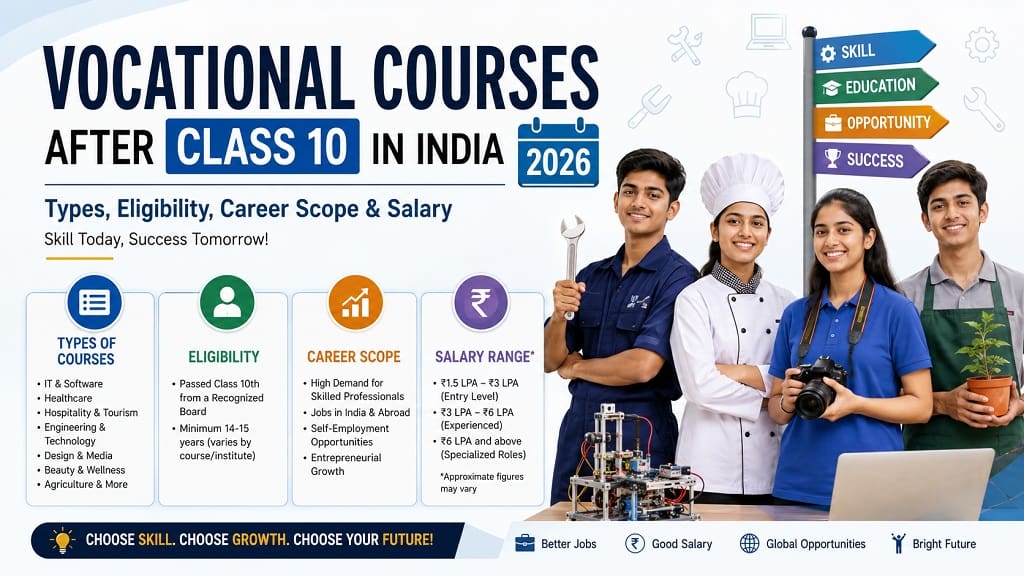
If you are still exploring broader options beyond computer courses specifically, our Best Stream After 10th guide and Vocational Courses After Class 10 article both cover a wider range of paths worth comparing.
How to Verify a Good Institute Before Enrolling
Since the quality of a computer course after 10th depends heavily on the institute itself, it genuinely pays to check a few things before paying any fees. Otherwise, it becomes easy to end up with a certificate that carries little real weight with employers.
- Confirm whether the institute is NIELIT-affiliated, government-recognised, or accredited by a known board
- Ask about the actual computer-to-student ratio during practical sessions, not just theory classes
- Check whether previous students have genuinely found jobs after completing the course
- Look for a syllabus that includes hands-on practice, not just PowerPoint-style theory lectures
- Compare fees across two or three nearby institutes before committing, since prices can vary significantly for the same course
A little research upfront, in other words, can save both money and time later, especially if your main goal is genuine employability rather than just a certificate on paper.
Common Mistakes Students Make While Choosing a Computer Course
- Enrolling in a course without checking whether it is recognised for government job eligibility
- Ignoring typing speed practice, even though many clerical jobs specifically require 30-40 WPM
- Choosing based purely on course duration rather than actual career relevance
- Not verifying whether the institute is NIELIT-affiliated or otherwise properly accredited
- Assuming a short certificate alone guarantees a job, without building any practical, hands-on skill
Interestingly, this same foundation-first approach applies well beyond computer courses too, as covered in our Career Options After 10th for Girls guide, where practical, job-ready skills consistently outperform purely theoretical choices.
FAQs — Computer Courses After 10th 2026
What is the fee for a DCA course?
DCA fees generally range from Rs. 5,000 to Rs. 30,000, depending on whether you choose a government or private institute.
Is a CCC certificate required for government jobs?
For many government positions, yes, a CCC certificate or equivalent computer qualification is either mandatory or strongly preferred, so it is genuinely worth obtaining early.
Which is better, COPA or DCA?
COPA offers a more formal, government-recognised trade certificate with a strong operational focus, while DCA provides a broader, more flexible foundation across computer applications generally.
What typing speed is required for government jobs?
Most government clerical roles require a minimum typing speed of 30 to 40 words per minute, so it is worth practising this specifically, regardless of which course you choose.
What salary can I expect after a computer course?
Starting salaries typically range from Rs. 1.2 LPA to Rs. 3 LPA, depending on the specific course and role, with figures generally improving after a year or two of practical experience.
Are there free computer courses after 10th?
Yes, several state skill development missions and NIELIT centres offer free or heavily subsidised basic computer courses, so it is worth checking your state's official skill development portal.
Can I do a computer course after 10th in just 3 months?
Yes, courses like CCC and basic computer literacy programmes are specifically designed to be completed within about three months.
Final Thoughts
Ultimately, computer courses after 10th offer a genuinely practical, affordable way to build real employability early, whether your goal is a quick government job, a broader IT foundation, or a long-term technical career. Rather than waiting for 12th to start building these skills, an early, well-chosen computer course can meaningfully shape your options in the years ahead.
So, take the time to match the course to your actual goal, whether that is speed, government eligibility, or long-term depth, and remember that consistent, hands-on practice matters just as much as the certificate itself.
For more career guidance and course comparisons, visit Insightstudyhub.com.









1 comment