NEET UG 2026 State Quota Counselling — 85% Seats, Eligibility & State-Wise Guide
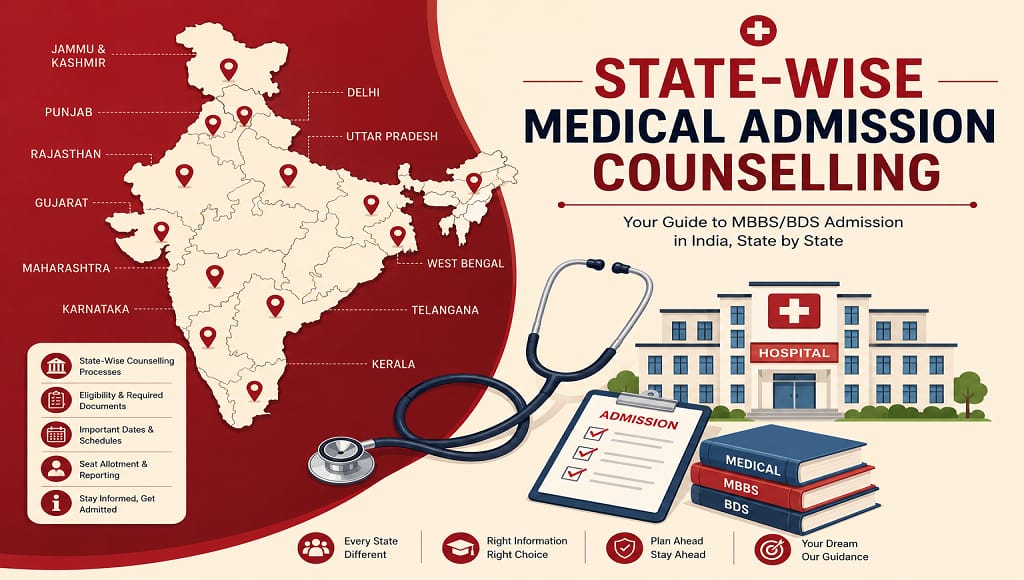
Most NEET aspirants focus entirely on MCC’s All India Quota counselling, without realising it covers just 15% of seats. The real decision-maker for the vast majority of candidates is NEET state quota counselling, which allocates the remaining 85%, and it genuinely deserves just as much attention.
So, in this guide, we will walk through exactly how NEET state quota counselling works in 2026, including eligibility, domicile rules, the full schedule, and a practical, state-wise registration process, since Round 1 has already begun.
NEET State Quota Counselling 2026 — Quick Overview
| Detail | Information |
| Seats Covered | 85% of government MBBS/BDS seats, plus most private seats |
| Conducted By | Individual state counselling authorities |
| States and UTs Participating | 28 states plus major Union Territories |
| Round 1 Dates | August 13 – August 22, 2026 |
| Academic Session Begins | September 8, 2026 |
AIQ vs State Quota — What’s the Real Difference?
Understanding this distinction genuinely matters before you register anywhere. The Medical Counselling Committee (MCC) conducts counselling for the 15% All India Quota, along with 100% seats at AIIMS, JIPMER, BHU, and other central institutions. Everything else runs through NEET state quota counselling instead.
| Factor | AIQ (15%) | State Quota (85%) |
| Conducted By | MCC (central body) | Individual state authorities |
| Eligibility Basis | NEET rank only | NEET rank plus domicile/residency |
| Coverage | Central institutions, deemed seats | State govt and most private colleges |
Why State Counselling Matters So Much
Simply put, state quota counselling governs the overwhelming majority of your realistic admission chances. Since it covers 85% of government seats and nearly all private college seats within a state, ignoring it in favour of AIQ alone genuinely limits your options unnecessarily.
Open States vs Closed States for NEET Counselling
Open States
These states allow non-domicile candidates to apply for certain seats, typically private or management quota seats, even without local residency.
Closed States
In contrast, closed states restrict their 85% government quota strictly to candidates who meet the state’s domicile requirements, leaving little to no room for outside applicants.
Who Can Apply for NEET State Quota Counselling?
- You must have qualified NEET UG 2026 with a valid rank
- Domicile or residency proof is generally required for the 85% government quota seats
- Private, management, or NRI quota seats may remain open to non-domicile candidates, depending on the state
NEET State Quota Counselling — Full Schedule 2026
Naturally, this process runs on a state-specific calendar, though the broad MCC-notified framework provides useful reference points.
| Round | Dates |
| State Quota Round 1 | August 13 – August 22, 2026 |
| Last Date for Joining | August 28, 2026 |
| Round 2 | August 31 – September 8, 2026 |
| Round 3 | September 16 – September 26, 2026 |
| Stray Vacancy Round | October 3 – October 5, 2026 |
It is worth noting that exact dates for each individual state are notified progressively by that state’s own authority, so it genuinely helps to check your specific state’s portal rather than relying solely on this general framework.
Domicile Eligibility — Why It’s Not Just About Your NEET Rank
Each state sets its own domicile, residence, nativity, or parental-service rules, which means two candidates with identical NEET ranks can face completely different odds depending purely on where they are eligible to apply.
Interestingly, the legal landscape here has shifted recently too. In January 2025, the Supreme Court ruled domicile-based reservation unconstitutional for postgraduate medical courses, while explicitly upholding its continued validity for MBBS admissions. Later, in September 2025, a bench led by Chief Justice B R Gavai upheld Telangana’s requirement of four years of local study or residence as constitutionally valid, reinforcing that states genuinely retain meaningful authority over domicile rules at the undergraduate level.
Can You Apply for Both AIQ and State Quota?
Yes, genuinely so, provided you meet the eligibility criteria for each. In fact, applying to both simultaneously is one of the smartest ways to increase your overall chances, since a seat missed in one process does not affect your standing in the other.
For a full breakdown of the AIQ side of this process, our MCC NEET UG Counselling Schedule guide covers registration, choice filling, and fee details in depth.
Seat Reservation and Seat Matrix in State Quota Counselling
Within the 85% state quota, seats are further divided according to category-wise reservations, including SC, ST, OBC, EWS, and PwD, following each state’s specific reservation policy. Consequently, your effective competition depends not just on your overall rank, but on your rank within your specific category and state.
State-Wise Counselling Authorities — Where to Apply
| State | Counselling Authority | Portal Type |
| Karnataka | Karnataka Examinations Authority (KEA) | State medical admission portal |
| Maharashtra | State CET Cell | State medical admission portal |
| West Bengal | WBMCC | State medical admission portal |
| Tamil Nadu | Directorate of Medical Education (DME) | State medical admission portal |
| Uttar Pradesh | UP DGME | State medical admission portal |
Since every state runs its own independent portal, it is genuinely worth bookmarking your specific state authority’s official website rather than searching for it repeatedly during a busy counselling window.
How to Register for State Quota Counselling — Step by Step
- Step 1: Visit your specific state’s official counselling website
- Step 2: Complete online registration using your NEET roll number and basic details
- Step 3: Fill in the counselling application form accurately
- Step 4: Upload required documents in the specified format
- Step 5: Pay the registration and security deposit fee
- Step 6: Fill and lock your college and course choices carefully
- Step 7: Check the seat allotment result once released
- Step 8: Complete document verification at the designated centre
- Step 9: Report to your allotted college within the given deadline
NEET State Quota Counselling Fees
Registration fees and security deposits vary meaningfully by state and category, though most states charge a modest non-refundable registration fee alongside a larger, refundable security deposit that is returned if you do not ultimately accept a seat.
Documents Required for State Quota Counselling
- NEET UG admit card and scorecard or rank card
- Class 10 and Class 12 mark sheets and passing certificates
- State domicile or residency certificate
- Caste, category, or EWS certificate, if applicable
- Valid photo ID proof, such as Aadhaar, PAN, or passport
If you have not yet reviewed how many total seats exist this year across different states, our NEET UG 2026 MBBS Seat Matrix guide breaks this down in detail.
Private Colleges and Deemed Universities Within State Quota
Private medical colleges within a state generally fill their seats through the same state counselling process, though fee structures and, in some states, domicile requirements can differ meaningfully from government colleges. Deemed universities, on the other hand, typically fall under AIQ-style counselling rather than individual state processes.
Researching Colleges Before Choice Filling
- Check college rankings and overall reputation within your target specialisation
- Verify accreditation and university affiliations before finalising a choice
- Assess infrastructure, hostel facilities, and campus safety
- Research faculty quality and curriculum depth where information is available
- Consider clinical exposure and internship opportunities, since these genuinely shape early career quality
Creating a Priority List and Locking Choices Wisely
Rather than listing only your most ambitious choices, a realistic priority list mixes a few aspirational options at the top with genuinely achievable mid-range and safer choices further down. This approach meaningfully reduces the risk of ending up with no allotment at all.
Participating in Mop-Up and Stray Vacancy Rounds
If earlier rounds do not work out, do not lose hope. Most states conduct additional mop-up and stray vacancy rounds specifically to fill seats left vacant after Round 1 and Round 2, often with relaxed eligibility conditions.
Financial Planning for State Quota Admission
Before locking any choice, it genuinely helps to compare government versus private college fees carefully, since the difference across a full MBBS course can be substantial. Our Paramedical Courses After 12th guide is also worth reviewing as a lower-cost, faster backup path if the financial commitment of MBBS feels genuinely out of reach right now.
Common Mistakes Candidates Make
- Assuming domicile eligibility is automatic simply based on current residence
- Missing state-specific registration deadlines while focused only on the AIQ timeline
- Overlooking states with a minimum years-of-study or residence-duration requirement
- Not researching a college properly before locking a choice
- Ignoring private or management quota options entirely, even when genuinely eligible
If your NEET result itself still needs a closer look before you finalise your counselling strategy, our NEET UG 2026 Result article and Science Courses After 12th guide are both worth revisiting.
A Realistic Example — Comparing AIQ and State Quota Odds
To make this more concrete, consider a candidate with an All India Rank around 40,000, domiciled in a state with strong government college capacity. Through AIQ alone, this rank might realistically secure only a distant private college seat. Through NEET state quota counselling in their home state, however, the same rank could genuinely land a government college seat, simply because state quota competition is limited to that state’s own candidate pool rather than the entire country.
This example illustrates why state quota often matters more than candidates initially assume, particularly for those outside the very top rank brackets. In other words, your home state’s counselling process may realistically offer better odds than chasing AIQ seats alone.
Why Checking Your State Portal Regularly Genuinely Pays Off
Unlike the single, centralised MCC portal, state counselling information is often spread across notifications, PDFs, and periodic website updates. Consequently, candidates who check their state’s official portal daily during active rounds consistently catch schedule revisions, extended deadlines, or newly released seat matrices faster than those relying purely on news aggregators or social media forwards.
Frequently Asked Questions — NEET State Quota Counselling
Do I need to register separately for AIQ and state quota?
Yes, these are two entirely separate registration processes, conducted by different authorities, so you must register individually for each if you wish to be considered for both.
How is a domicile certificate obtained?
Domicile certificates are typically issued by your state's revenue or district administration office, based on proof of residence, schooling history, or parental service records, depending on the specific state's requirements.
How long does State Quota Round 1 run?
Based on the broader MCC-notified framework, State Quota Round 1 runs from August 13 to August 22, 2026, though exact dates can vary slightly by state.
Can I apply to a state where I am not domiciled?
In many cases, yes, particularly for private or management quota seats in open states, though the 85% government quota generally remains restricted to domicile holders.
Are private colleges included in state quota counselling?
Yes, most private medical colleges within a state fill their seats through the same state counselling process, though fee structures typically differ from government colleges.
Does state quota apply differently based on my category?
Yes, category-wise reservations such as SC, ST, OBC, EWS, and PwD apply within the state quota as well, following each state's specific reservation policy.
Can I get an MBBS seat with a rank around 20,000 through state quota?
It is genuinely possible, depending heavily on your state, category, and that state's specific seat availability, since state quota cutoffs vary considerably from AIQ cutoffs.
What happens if I don't get a seat in Round 1 or Round 2?
Your application typically remains active for subsequent rounds, including mop-up and stray vacancy rounds, so a missed allotment in an early round does not end your chances for the year.
Final Thoughts
Ultimately, NEET state quota counselling determines the outcome for the vast majority of MBBS and BDS aspirants, far more so than AIQ alone. With Round 1 already underway, understanding your specific state’s domicile rules, deadlines, and portal genuinely matters as much as your NEET rank itself.
So, register early, keep your documents ready, and build a realistic, well-researched choice list rather than an overly ambitious one. A thoughtful approach here can genuinely be the difference between securing a seat this year and waiting for the next cycle.
For more NEET updates and counselling guides, visit InsightStudyHub.com.








Post Comment