Vocational Courses After Class 10 in India 2026: Types, Eligibility, Career Scope & Salary
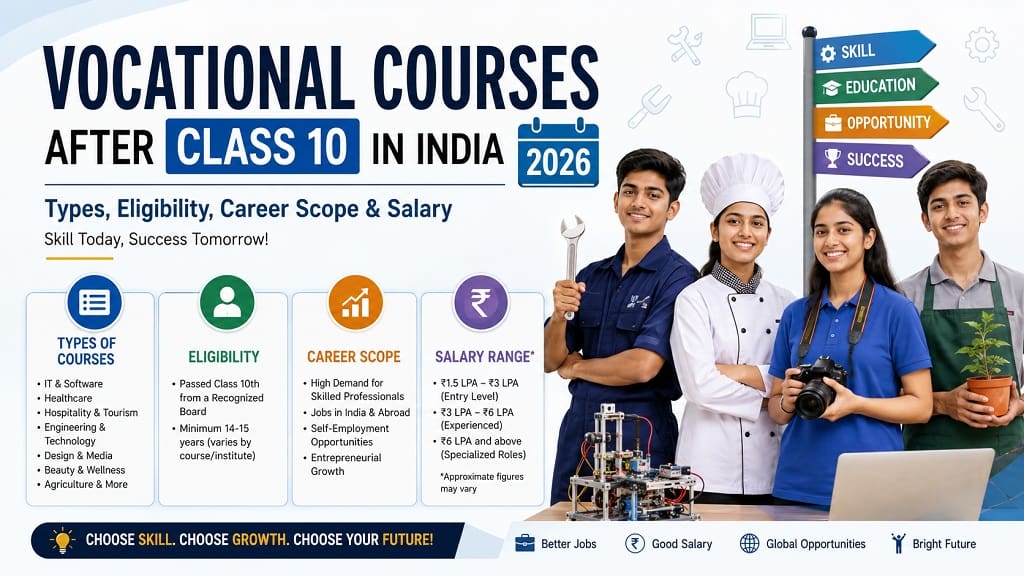
Every year, millions of Class 10 students in India face the same question: what next? Most assume the only path is to pick Science, Commerce, or Arts and continue to Class 11. But here is what fewer people talk about — vocational courses after Class 10 in India are opening up real, well-paying careers faster than traditional academic routes, and in 2026, the opportunities have never been wider.
India currently needs over 400 million skilled workers by 2030, according to the Skill India Mission. Yet a massive gap exists between what schools produce and what industries need. That gap is exactly where vocational education steps in — and where smart students are finding their advantage.
Whether you are a student figuring out your options, a parent trying to help your child make the right call, or a career counsellor looking for an updated guide, this article covers everything you need to know: the types of vocational courses, who can apply, what each course leads to, and how much you can realistically expect to earn.
What Are Vocational Courses?
A vocational course is a training programme that teaches you a specific skill or trade — directly, practically, and with a clear job in mind. Think of it this way: if a traditional degree is like reading a recipe book from cover to cover, a vocational course is like jumping straight into the kitchen and cooking.
Instead of spending years studying theory, you learn exactly what an employer needs — whether that is wiring an electrical panel, coding a website, assisting in a hospital lab, or managing a hotel front desk. Most vocational programmes after Class 10 in India run from 6 months to 3 years, cost significantly less than a degree, and get you job-ready fast.
Purpose of doing a vocational course
The core purpose is simple: earn sooner, spend less, and build a career on practical skills. But beyond that, vocational training also serves students who may not want to sit through two more years of board exams before they can move forward. In 2026, with India’s economy adding jobs heavily in manufacturing, healthcare, technology, and hospitality, a certified vocational graduate is genuinely in demand.
Vocational vs academic stream — a quick comparison
| Feature | Vocational course | Academic stream (11th–12th) |
| Duration | 6 months – 3 years | 2 years minimum |
| Cost | Low (₹500 – ₹1.5L/year) | Moderate to high |
| Time to first job | 6 months – 2 years | 2–4+ years (after degree) |
| Theory vs practical | 80% practical | 70% theory |
| Further study possible? | Yes – lateral entry to B.Tech, B.Voc | Yes – regular college path |
| Government job eligible? | Yes (ITI/NCVT for Railways, Army etc.) | Yes |
Types of Vocational Courses After Class 10 in India 2026
Not all vocational paths are the same. In India, there are five main types of vocational training available after Class 10, each with a different structure, duration, and end goal. Understanding these upfront saves a lot of confusion later.
1. ITI — Industrial Training Institute courses
ITI courses are the most well-known vocational path in India. Run by the Ministry of Skill Development and Entrepreneurship, ITIs offer trade-based training in over 130 trades — from Electrician to Computer Operator and Programming Assistant (COPA) to Welder.
- Duration: 6 months to 2 years
- Certificate: National Trade Certificate (NTC) issued by NCVT
- Key advantage: NCVT certificates are valid across India and recognised in Gulf countries and Europe for skilled worker visa categories
2. Polytechnic / diploma courses
A polytechnic diploma is a step above ITI in terms of academic level. These 3-year programmes are offered by government and private polytechnic colleges and cover engineering branches like Mechanical, Civil, Computer Science, and Electrical.
- Best for: Students who want a supervisor-level role rather than a technician role
- Big benefit: After completing a diploma, you can enter the second year of a B.Tech programme directly through lateral entry exams like JEECUP or AP POLYCET — saving one full year
3. NSDC / PMKVY short-term Skill India courses
Under the Pradhan Mantri Kaushal Vikas Yojana (PMKVY 4.0), the government offers free or subsidised short-term skill training in over 40 sectors. These are NSQF-certified (National Skills Qualification Framework), which means employers across India recognise the certificate.
- Duration: 3 to 6 months
- Cost: Free for eligible candidates
- Sectors covered: Retail, beauty, logistics, IT, healthcare, construction, and more
4. CBSE vocational stream (Class 11–12)
Not every student wants to leave school after Class 10. CBSE offers a vocational subject alongside regular Class 11 and 12 board subjects. This means you can appear for board exams and earn an NSQF-aligned skill certification at the same time — a smart dual-track option.
5. NIOS vocational courses
The National Institute of Open Schooling (NIOS) offers flexible vocational programmes for students who want to study at their own pace or alongside a part-time job. These are ideal for students from rural areas, students who could not continue regular school, or those who want to work and study simultaneously.
Quick pick guide: Choose ITI if you want a job within 1–2 years. Choose polytechnic if you want supervisor-level roles and the B.Tech option later. Choose PMKVY if you want a free, short certification. Choose CBSE vocational if you want a skill alongside your board exams.
Popular Vocational Courses After Class 10 — Subject-wise List with Salary
Below is a subject-wise breakdown of the most sought-after vocational courses after Class 10 in India in 2026, along with realistic salary expectations for fresh graduates.
Engineering & technology
- Electrician (ITI): 1–2 years | Starting salary ₹12,000–₹22,000/month | High demand in manufacturing and construction
- Fitter (ITI): 2 years | ₹12,000–₹20,000/month | Core to automobile and heavy machinery industries
- Welder (ITI): 1 year | ₹10,000–₹18,000/month | In demand for Gulf country jobs
- Electronics Mechanic (ITI): 2 years | ₹12,000–₹20,000/month | Repair and maintenance of consumer electronics
- 3D Printing Technician (NSQF Level 4): 6 months–1 year | ₹15,000–₹25,000/month | Growing demand in design and manufacturing
Computer science & IT
- COPA — Computer Operator & Programming Assistant (ITI): 1 year | ₹10,000–₹18,000/month | Entry-level IT and data entry roles
- Web Design & Development: 6 months–1 year | ₹12,000–₹30,000/month | Freelance and agency work available immediately
- Digital Marketing (PMKVY / online): 3–6 months | ₹15,000–₹35,000/month | One of the fastest-growing career tracks in India
- Cybersecurity Basics (NSDC-certified): 6 months | ₹18,000–₹40,000/month | Entry-level roles in IT security teams
Healthcare & paramedical
- Medical Lab Technician: 1–2 years | ₹12,000–₹22,000/month | High demand post-COVID in labs and clinics
- Radiology Technician: 2 years | ₹14,000–₹24,000/month | Hospitals and diagnostic centres
- General Nursing Aide: 6 months–1 year | ₹10,000–₹18,000/month | Government and private hospitals
- Pharm (Diploma in Pharmacy): 2 years | ₹15,000–₹28,000/month | Pharmacy shops and hospital dispensaries
Hospitality & tourism
- Hotel Management Diploma: 1–3 years | ₹12,000–₹30,000/month | Hotels, resorts, airlines, cruise ships
- Bakery & Confectionery (ITI): 1 year | ₹10,000–₹20,000/month | Bakeries, hotels, self-employment
Art, design & media
- Fashion Design (NIFT entry-level / short course): 6 months–2 years | ₹12,000–₹35,000/month | Fashion houses, export units, boutiques
- Graphic Design & Digital Design: 6 months–1 year | ₹12,000–₹30,000/month | Agencies, freelance, e-commerce brands
- Photography: 6 months | ₹10,000–₹40,000/month | Events, media, commercial photography
Commerce & accounts
- Tally with GST (short course): 3–6 months | ₹10,000–₹18,000/month | Small and medium businesses, accounting firms
- Accounting & Taxation Certificate: 6 months | ₹10,000–₹20,000/month | Entry-level accounts roles
Emerging 2026 trades to watch
These are the high-growth trades where early movers have a clear salary advantage:
- Solar Panel Installation Technician: NSQF Level 4 | ₹14,000–₹24,000/month | Solar energy sector boom in India
- EV (Electric Vehicle) Mechanic: ITI / PMKVY | ₹15,000–₹28,000/month | Automotive industry transition to EVs
- Drone Operator & Technician: DGCA-approved short course | ₹18,000–₹35,000/month | Agriculture, surveillance, delivery sectors
- AI Data Annotator: Online certification | ₹12,000–₹25,000/month | AI and machine learning companies
Eligibility Criteria for Vocational Courses After Class 10
Basic eligibility
The good news is that the entry bar for most vocational courses after Class 10 is straightforward. Here is what you generally need:
- Education: Class 10 pass certificate from any recognised board (CBSE, ICSE, or any State Board)
- Marks: Minimum 35–40% in aggregate (some courses and institutes may ask for more in specific subjects like Maths or Science)
- Age: 14 to 40 years for ITI courses; most other courses have no strict upper age limit
Admission process — step by step
- Fill the application form: Either online through the official NCVT MIS portal (nimi.nic.in) for ITI courses or through the institute’s website
- Entrance test (if applicable): Some institutes hold aptitude tests; many admit students on a merit basis using Class 10 marks
- Merit list: Check the institute’s website for the announced merit list and your seat allocation
- Document verification: Carry your Class 10 marksheet, school transfer certificate, Aadhaar card, and passport-size photographs
- Fee payment & enrollment: Pay the admission fee (government ITIs charge as low as ₹1,000–2,500 per year) and confirm your seat.
Government Schemes & Free Vocational Training in India 2026
One of the biggest advantages of pursuing vocational education in India is the number of government schemes that either subsidise or fully fund your training. Here are the key ones every student should know:
- PMKVY 4.0 (Pradhan Mantri Kaushal Vikas Yojana): The flagship free skilling scheme run by NSDC. Covers 40+ sectors, provides NSQF-certified training, and even offers a stipend during training in some programmes. Apply at skillindiadigital.gov.in.
- Skill India Mission: An umbrella initiative covering Jan Shikshan Sansthan (for rural and semi-urban students), NSDC centres, and sector skill councils. Over 30 million students have been trained since its launch.
- NAPS — National Apprenticeship Promotion Scheme: This is a hidden gem. Under NAPS, you get placed with a real employer for 1 year, earn a monthly stipend while you work, and receive a government-recognised apprenticeship certificate. Ideal for ITI graduates who want real industry experience before a full-time job.
NCVT vs SCVT — which certificate is better?
This question comes up constantly, so let’s settle it clearly:
| Feature | NCVT | SCVT |
| Full form | National Council for Vocational Training | State Council for Vocational Training |
| Validity | Pan-India + internationally recognised | Only within that state |
| Government jobs | Preferred by Railways, Defence, PSUs | Limited recognition |
| Abroad jobs | Accepted in Gulf, Europe | Not accepted |
| Recommendation | Always choose NCVT if available | Only if NCVT is unavailable |
Career Scope & Salary After Vocational Courses in India
Let’s address the most important question directly: can you build a good career through a vocational course after Class 10? The answer in 2026 is a clear yes — and in several fields, the salary trajectory is competitive with conventional degree holders.
Private sector jobs
- ITI graduates (Electrician, Fitter, COPA): ₹12,000–₹25,000/month to start. Top ITI-certified electricians in Maharashtra and Gujarat are earning ₹35,000+ after 3–5 years.
- Polytechnic diploma holders: ₹2.5–5 LPA in first job. Computer Science and Electronics diploma holders often command ₹3–5 LPA at private tech companies.
- IT and digital vocational certs: Digital marketing and web development certificate holders frequently earn ₹15,000–30,000/month within 6 months of completing training.
Government job options
Several central government recruitment exams specifically accept ITI and vocational qualifications:
- Indian Railways (RRB Group D, ALP): One of the largest recruiters of ITI-certified candidates. Starting pay ₹18,000–22,000/month plus HRA and allowances.
- Indian Army Tradesman: ITI-certified candidates are eligible for Soldier Technical and Tradesman categories.
- SSC MTS and State Police Constable: Open to 10th-pass candidates; vocational certification adds a competitive edge.
Jobs abroad
This is where ITI certification has a truly global edge. Saudi Arabia, UAE, Qatar, Germany, and Japan have active demand for Indian-certified technicians. An ITI-certified Electrician or Welder with an NCVT certificate can earn 3–4 times their Indian salary in Gulf countries through programmes like the Pravasi Kaushal Vikas Yojana.
Self-employment
Do not overlook this path. Many ITI graduates in Tier 2 and Tier 3 cities have set up their own electrical repair shops, AC servicing businesses, beauty salons, and bakeries within 2–3 years of completing their course. The investment needed is low, the skill is in demand locally, and the earning potential long-term often exceeds that of a salaried job.
Top Institutes for Vocational Courses After Class 10 in India
When choosing an institute, always verify NCVT affiliation before taking admission. Below are some of the most respected categories of institutes across India:
- Government ITIs (NCVT-affiliated): The most trusted option for trade-based courses. Every state has government ITIs; fees are minimal (₹1,000–2,500/year) and the National Trade Certificate carries strong credibility.
- State Polytechnic Colleges: Government-run polytechnics offer engineering diplomas at low cost with strong industry connections for campus placements.
- Specialised vocational institutes: College of Vocational Studies (CVS, Delhi) for media and commerce; State Institutes of Hotel Management (SIHMs) for hospitality; Bhartiya Skill Development University (BSDU, Jaipur) for NSQF-level skill programmes; Vishwakarma Skill University (Haryana); and TISS School of Skill Education (Mumbai) for community-focused vocational programmes.
- Online platforms for digital vocational courses: The Skill India Digital portal (skillindiadigital.gov.in), iGOT Karmayogi, and NSDC’s eLearning platform offer government-certified online courses you can complete from home.
How to Choose the Right Vocational Course After Class 10
This is the question most students get wrong — not because they are not smart, but because they choose based on what their friends are doing or what sounds impressive. Here is a better way to think about it.
Use the 3-filter decision framework
- How soon do you want to earn? If you need income within 1–2 years, ITI or PMKVY short-term courses are your best bet. If you can wait 3 years and want higher roles, polytechnic is the better investment.
- How comfortable are you with Maths and Science? Trades like Electrician and Fitter need basic Physics and Maths. If you are stronger in commerce or arts, consider Fashion Design, Digital Marketing, Tally, or Hotel Management instead.
- Government job or private/self-employment? If a government job is the goal, NCVT-affiliated ITI courses (Electrician, Fitter, COPA, Draughtsman) give you the strongest eligibility for Railways, Army, and PSU recruitments.
Interest-based quick mapping
- Like machines and tools? → ITI Electrician, Fitter, Diesel Mechanic, or EV Mechanic
- Like computers and coding? → COPA, Web Development, Cybersecurity, or Digital Marketing
- Like caring for people? → Medical Lab Tech, Nursing Aide, or General Duty Assistant
- Like cooking and hospitality? → Hotel Management, Bakery & Confectionery
- Like drawing, design, or photography? → Fashion Design, Graphic Design, Photography
How career counselling helps
A 30-minute session with a trained career counsellor can save you 2 years of going in the wrong direction. Career counsellors use psychometric tests to map your personality and aptitude to vocational options that genuinely suit you, rather than simply listing courses. If your school or district has a career guidance centre, use it.
Common Mistakes to Avoid When Choosing Vocational Courses
Before you finalise anything, check yourself against these five mistakes that students repeatedly make:
- Choosing based on friends, not interest: A course that is perfect for your friend may be a dead end for you. Career fit matters more than what is popular.
- Not checking NCVT affiliation: An ITI certificate from a non-NCVT-affiliated institute has limited value for government jobs and almost no value for jobs abroad. Always verify at the NCVT MIS portal before applying.
- Ignoring the NCVT vs SCVT distinction: SCVT certificates are state-limited. If you have any plans to work outside your home state or abroad, NCVT is non-negotiable.
- Chasing course names over job demand: A course that sounds impressive but has low industry demand will leave you struggling. Always check actual job postings on Naukri and Indeed before committing.
- Delaying the decision and missing admission cycles: Most ITI and polytechnic admissions happen between June and August. Waiting too long means losing a full year.
Frequently Asked Questions (FAQs)
What is the difference between ITI and polytechnic after 10th?
ITI courses focus on hands-on trade skills and take 1–2 years. They lead directly to technician-level jobs. Polytechnic diplomas take 3 years, cover more academic content, and lead to supervisor-level roles. Polytechnic diploma holders can also use lateral entry to join the second year of a B.Tech programme, which ITI graduates can also do after completing a polytechnic diploma.
Are vocational courses valid for government jobs?
Yes. NCVT-certified ITI graduates are eligible for Indian Railways (RRB Group D, ALP), Indian Army Tradesman, and various state government vacancies. Always ensure your ITI is NCVT-affiliated, as SCVT certificates have limited government job recognition.
Can I do a degree after a vocational course?
Absolutely. After completing an ITI course, you can pursue a polytechnic diploma via lateral entry. After a polytechnic diploma, you can use lateral entry to join the second year of a B.Tech at government engineering colleges through state-level exams. This step-by-step path allows you to build a degree while gaining industry experience along the way.
Are there free vocational courses from the government in 2026?
Yes. PMKVY 4.0 offers free short-term vocational training across 40+ sectors for eligible candidates. The Skill India Digital portal (skillindiadigital.gov.in) also lists free online courses. Many government ITIs charge minimal fees of ₹1,000–2,500 per year, making them extremely affordable.
Is NCVT or SCVT better for ITI?
NCVT is almost always the better choice. NCVT certificates are valid pan-India and internationally recognised in Gulf countries and Europe. SCVT certificates are valid only within the issuing state. If you want government job eligibility, jobs abroad, or the flexibility to work in any state, choose an NCVT-affiliated ITI.
What vocational courses can I do online after 10th?
Several government-approved vocational courses are available online in 2026. Digital Marketing, Web Development, Graphic Design, Tally with GST, Cybersecurity Basics, and AI Data Annotation can all be done online through NSDC-approved platforms, private institutes, or international platforms like Coursera and Google Career Certificates. These are ideal for students in areas where physical institutes are limited.
Conclusion
Vocational courses after Class 10 in India are no longer a backup plan — they are a strategic first move for millions of students who want to build real careers faster and smarter. In 2026, with the Skill India push, growing industry demand for certified technicians, and the digital economy creating entirely new job categories, a well-chosen vocational course can put you ahead of someone who spent the same two years in a generic Class 11–12 cycle.
The key is to choose based on interest, verify NCVT affiliation for trade courses, and look at actual job demand in your target industry before committing. Use the government’s free training schemes wherever possible, and remember that the path does not end at your first certificate — every vocational qualification can be a stepping stone to a diploma, a degree, or even your own business.
If you found this guide helpful, explore our related articles on the best stream after 10th for AI jobs in India and the full ITI vs polytechnic comparison to make the most informed decision for your future.








1 comment