How to Study NCERT Effectively Without Rote Learning
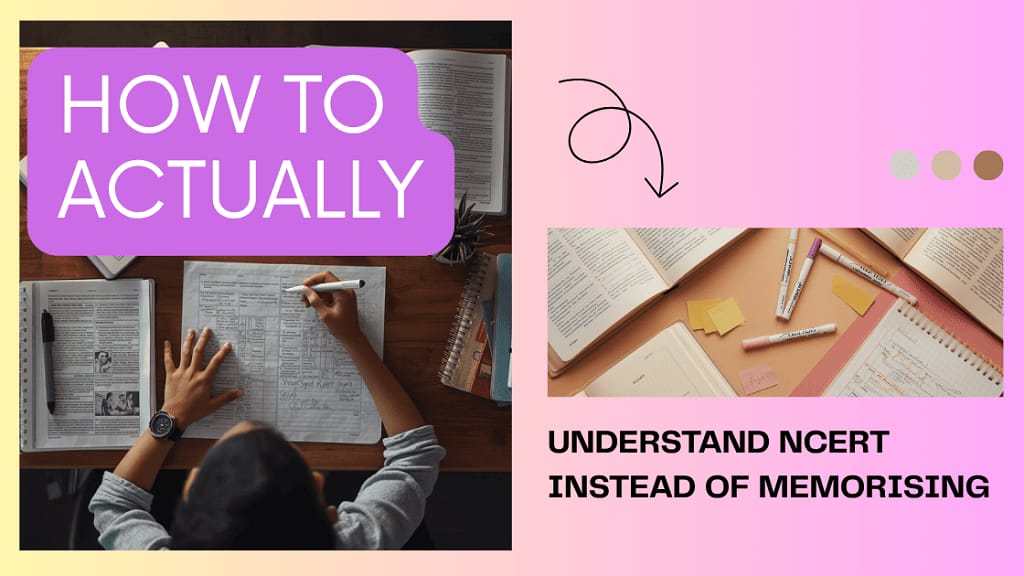
Many students struggle to study NCERT effectively because they rely on memorisation instead of understanding. A simple shift in how you study NCERT can turn it from something you mug up into something you truly understand.
If you ask most CBSE students how they study NCERT, the answer is usually the same. They read it again and again, try to remember lines, and underline important points. It feels like effort is being put in, and in many cases, it is. But when exams arrive, that effort does not always translate into clarity.
The problem here is not a lack of discipline or consistency. Students are spending time with the material. The real issue is the approach being used. NCERT is not meant to be memorised word for word, even though it may feel that way. It is meant to be understood at a deeper level.
Learning becomes difficult when we confuse repetition with understanding. Reading something multiple times can create a sense of familiarity, but familiarity is not the same as clarity. This is why many students feel confident while studying but uncertain during exams.
For official curriculum guidelines and academic updates, students can refer to the NCERT.
📚 Why Memorising Feels Safe (But Isn’t Enough)
There is a reason memorising feels like the safer option. Exams reward correct answers, and remembering exact phrasing can feel like a shortcut. Teachers and coaching systems sometimes reinforce this by focusing on “important questions” and expected answers.
Over time, students begin to believe that success depends on how much they can store in memory. This belief is hard to break because it has worked to some extent in the past. But it starts to fail when questions become slightly different or require application.
Memorised knowledge is fragile. It works only when the question looks familiar. The moment the format changes, that memory becomes difficult to access.
🧠 Understanding vs Memorising
Understanding, on the other hand, is flexible. It allows you to approach new problems with confidence. When you study NCERT with the goal of understanding, you will notice that it is not just a collection of facts.
Each chapter follows a structured flow where concepts build on one another. Explanations are followed by examples, and examples are followed by exercises.
This structure is not accidental. It is designed to guide your thinking step by step. The book is trying to teach you how to approach a concept, not just what to write in an answer.
🔍 How NCERT is Designed to Help You Learn
When you rush through this flow, you miss the real value. Treating NCERT as something to understand rather than memorise changes how you interact with it.
You start noticing connections, patterns, and logic that were not obvious before. That is where real learning begins.
📖 Study Technique 1: Explain in Your Own Words
One simple but powerful shift is to read with the intention of explaining.
After going through a paragraph, pause for a moment and try to put it into your own words. If you cannot do that, it means you have not fully understood it yet.
This might feel slow at first, especially if you are used to reading quickly. But slowing down forces your brain to engage with the content. It moves you from passive reading to active thinking.
❓ Study Technique 2: Ask Questions While Studying
Explaining in your own words is one of the clearest signs of understanding. But it works even better when combined with questioning.
Most students wait until they are completely stuck before they question something. Instead, questioning should happen continuously.
Ask yourself:
- Why does this concept work this way?
- What happens if a condition changes?
- Where is this used in real life?
Even if you do not get all the answers immediately, the process itself deepens your understanding.
📊 Study Technique 3: Learn Through Examples
Examples in NCERT are often more valuable than they appear.
Many students skip through them quickly, focusing only on definitions or highlighted points. But examples are where concepts come to life.
When you work through an example carefully, you see how a concept is applied step by step. This helps bridge the gap between theory and practice.
🧪 Study Technique 4: Practice Without Support
Practice is another area where students often fall into ineffective habits.
Solving questions while constantly referring to the textbook can create a false sense of confidence. It feels like you know the answer, but you are still relying on support.
True understanding shows when you try to solve questions without looking.
🔄 Study Technique 5: Active Revision
Revision is often misunderstood as rereading.
Students go through the same chapters multiple times, hoping the content will stay in their memory. While this may help slightly, it is not the most effective method.
A better approach is active recall:
- Close the book
- Try to remember key ideas
- Write or explain them
This strengthens memory much more effectively.
⚠️ Dealing with Confusion
There will always be moments when a concept does not make sense.
This is where many students feel frustrated and return to memorising as a backup strategy. But staying with that confusion, even for a little longer, can lead to deeper understanding.
When you work through a difficult idea step by step, it becomes clearer and more meaningful.
🌐 Getting Help the Smart Way
Interactive support can make a big difference. Instead of staying stuck, learners should try to resolve doubts through discussion, guidance, or structured help.
You can also explore more study resources and notes on Insight Study Hub to strengthen your preparation.
🎯 Why Understanding Helps in Exams
From an exam perspective, when you study NCERT with proper understanding, it becomes a much smarter strategy than memorisation.
Questions today are often designed to test application rather than direct recall. They may combine multiple concepts or present problems in new formats.
When you understand the underlying ideas, you can handle these variations more easily.
🚀 Start Small, But Start Right
You do not need to change everything at once.
Pick one chapter and try a different approach:
- Read slowly
- Explain in your own words
- Focus on examples
- Practice independently
At first, it may feel slower. But over time, concepts will stick naturally and require fewer revisions.
📌 Conclusion
Understanding takes a little more effort upfront, but it saves a lot of effort later.
It builds confidence that goes beyond exams. In the end, NCERT is not something to rush through or fear. It is a well-designed resource that can help you build strong foundations if used properly.
Memorising may give short-term results, but understanding creates long-term clarity.
For more study guides, notes, and exam resources, visit Insight Study Hub.
Author Bio
 |
Gaurav Parashar is the founder of Edzy, an AI-powered personal tutor built for CBSE students. An alumnus of IIT Bombay and IIM Bangalore, he was a CBSE Ajmer Zone topper and has spent years working closely with students to understand how they learn. His work focuses on building tools that help learners move from memorizing content to truly understanding concepts through guided, interactive learning. |










1 comment