Class 10 Science Chapter 1 Notes PDF Download (Chemical Reactions and Equations 2026)
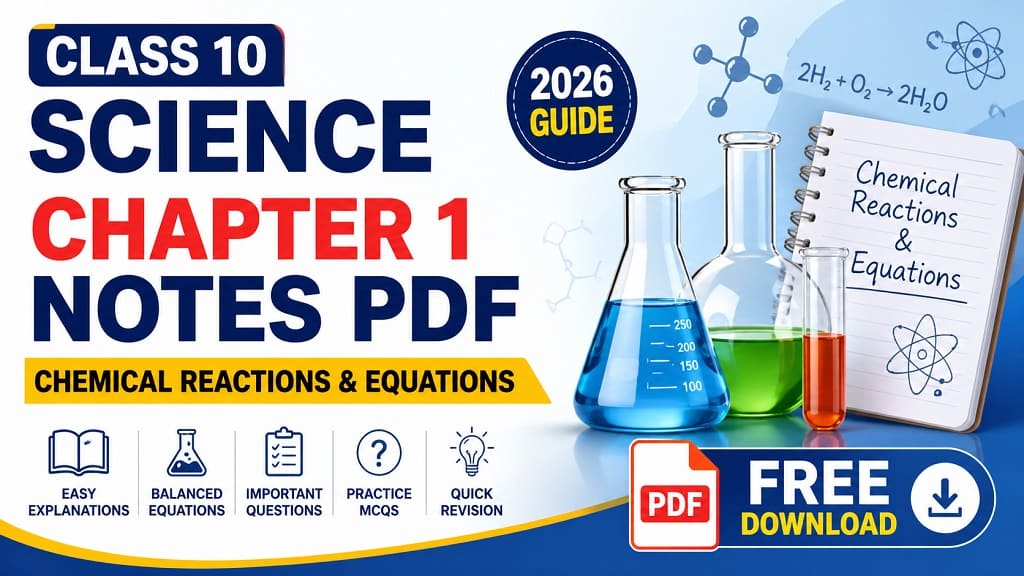
Class 10 Science Chapter 1 “Chemical Reactions and Equations” is one of the most important chapters for CBSE board exams. It helps students understand how substances react and form new products in everyday life.
From rusting of iron to cooking food, chemical reactions are all around us. This chapter builds a strong foundation for higher-level chemistry concepts and is frequently asked in exams.
For official syllabus updates and exam guidelines, students can refer to the Central Board of Secondary Education.
In this article, you will get easy notes, important questions, and a free PDF download to help you revise quickly and score better in exams.
📄 Download Class 10 Science Chapter 1 Notes PDF (Free)
If you are preparing for your board exams and need quick revision material, these Class 10 Science Chapter 1 Notes PDF will help you study efficiently and save time. You can also refer to additional learning resources on DIKSHA for better understanding.
👉 Download Class 10 Science Chapter 1 Notes PDF (Free)
(Add your Google Drive or file link here)
📌 What the PDF Includes
- Easy-to-understand explanations of all concepts
- Balanced chemical equations
- Important questions and answers
- Quick revision points
- Practice MCQs
📌 How to Use Notes for Revision
- Revise daily for 20–30 minutes
- Focus on important reactions and definitions
- Practice questions regularly
- Use the PDF for last-minute revision
🔍 Overview of Chemical Reactions and Equations (Class 10)
📖 Definition of Chemical Reaction
A chemical reaction is a process in which one or more substances (reactants) are converted into new substances (products) with different properties.
🌍 Real-Life Examples
- Rusting of iron
- Cooking food
- Digestion process
🎯 Importance in Exams
- Frequently asked in board exams
- Includes definitions, equations, and reasoning questions
- High scoring chapter if concepts are clear
🔄 Physical and Chemical Changes
⚪ Physical Changes
A physical change only affects the form or state of a substance without forming a new substance.
Example: Ice melting into water
🔴 Chemical Changes
A chemical change results in the formation of a new substance with different properties.
Example: Burning of paper
⚖️ Difference Between Physical and Chemical Changes
| Feature | Physical Change | Chemical Change |
|---|---|---|
| New substance formed | No | Yes |
| Reversibility | Usually reversible | Irreversible |
| Example | Melting ice | Rusting iron |
⚗️ What is a Chemical Reaction?
📘 Definition and Explanation
A chemical reaction is a transformation where reactants change into products through chemical processes. According to Encyclopaedia Britannica, a chemical reaction involves the rearrangement of atoms to form new substances with different properties.
🔍 Characteristics of Chemical Reactions
✔ Change in Color
Example: Copper turns green when exposed to air
✔ Evolution of Gas
Example: Reaction between acid and metal produces gas
✔ Temperature Change
Heat may be released or absorbed
✔ Formation of Precipitate
A solid substance forms in a solution
🧾 Writing Chemical Equations
📝 Word Equation
Magnesium + Oxygen → Magnesium Oxide
🧪 Skeletal Chemical Equation
Mg + O₂ → MgO
📌 Steps to Write Chemical Equations
- Identify reactants and products
- Write correct chemical formulas
- Form the equation
⚛️ Symbols and Valencies of Elements
- Hydrogen (H) → 1
- Oxygen (O) → 2
- Sodium (Na) → 1
- Calcium (Ca) → 2
⚖️ Balancing Chemical Equations
📘 Balanced Chemical Equation
A balanced equation has an equal number of atoms on both sides.
📜 Law of Conservation of Mass
Mass is neither created nor destroyed during a chemical reaction.
🧠 Step-by-Step Balancing Method
- Write the unbalanced equation
- Count atoms on both sides
- Adjust coefficients to balance
⚡ Shortcut Techniques for Balancing
- Balance metals first
- Then non-metals
- Balance hydrogen and oxygen last
🔥 Types of Chemical Reactions
➕ Combination Reaction
Two or more substances combine to form one product
➗ Decomposition Reaction
One compound breaks into simpler substances
🔄 Displacement Reaction
A more reactive element replaces a less reactive one
🔁 Double Displacement Reaction
Exchange of ions between compounds
🔥 Redox Reaction
Oxidation and reduction occur together
🌡️ Exothermic and Endothermic Reactions
- Exothermic → heat is released
- Endothermic → heat is absorbed
👀 Observations of Chemical Reactions
- Gas formation
- Color change
- Formation of precipitate
- Energy change
🌍 Effects of Chemical Reactions in Everyday Life
🧱 Corrosion
Corrosion is the gradual destruction of metals due to moisture and air.
Example: Rusting of iron
🍟 Rancidity
Rancidity is the spoilage of food due to oxidation.
🛡️ Prevention of Rancidity
- Use airtight containers
- Refrigeration
- Adding antioxidants
⚙️ Activity Series of Metals
🔢 Reactivity Order
Metals are arranged from most reactive to least reactive.
🔧 Application in Displacement Reactions
More reactive metals displace less reactive metals from compounds.
📝 Important Questions and Solved Examples
📌 Conceptual Question
Q. What is oxidation?
👉 Addition of oxygen or removal of hydrogen
📌 Numerical-Based Practice
Balance the equation:
H₂ + O₂ → H₂O
👉 Answer: 2H₂ + O₂ → 2H₂O
📌 Previous Year Question
Q. Define chemical reaction with example
📚 NCERT Solutions for Class 10 Science Chapter 1
- All exercise questions covered
- Step-by-step solutions
- Exam-oriented answers
🎯 Benefits of Class 10 Science Chapter 1 Notes PDF
- Quick revision
- Saves time
- Easy to understand
- Helpful for exams
❓ Frequently Asked Questions (FAQs)
What is a balanced chemical equation?
Equal number of atoms on both sides
Why is balancing important?
To follow the law of conservation of mass
What is oxidation and reduction?
Gain and loss of oxygen respectively
What is a decomposition reaction?
Breaking down of a compound
How to identify a chemical reaction?
By observing color change, gas formation, or temperature change
What are types of chemical reactions?
Combination, decomposition, displacement, and more
📌 Conclusion
Chemical Reactions and Equations is a fundamental chapter in Class 10 Science. By understanding the concepts, practicing equations, and revising regularly, students can score high marks in exams. Use the notes PDF and important questions to strengthen your preparation.
For more study resources, notes, and exam updates, visit our Insight Study Hub.







2 comments