CSAB 2026 Counselling — Special Rounds, Registration, Dates & Complete Guide After JoSAA
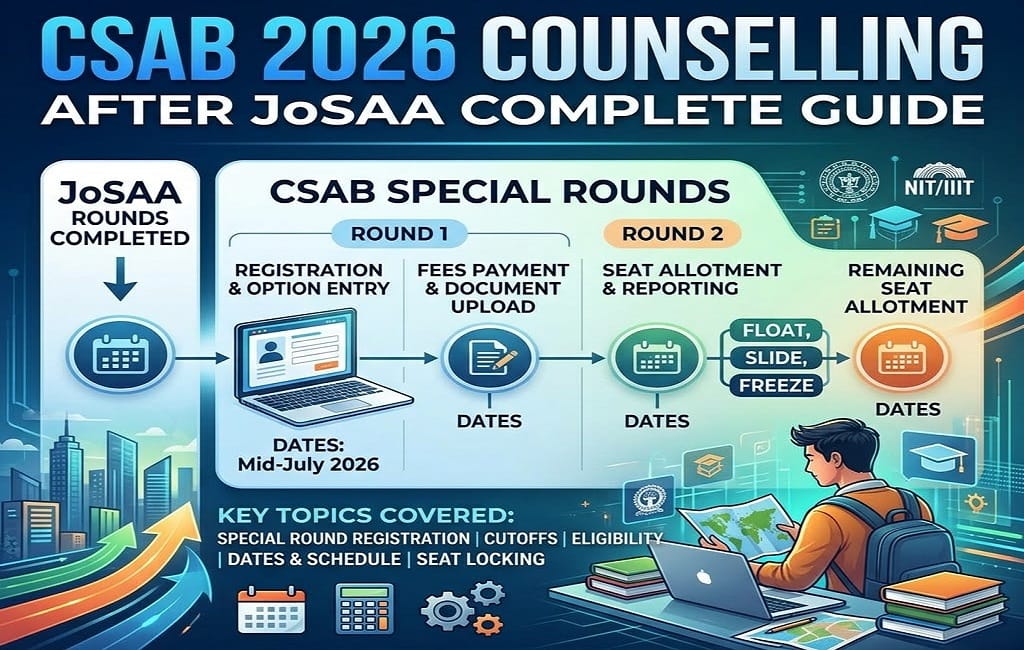
If you did not get a seat through JoSAA 2026 — or if you got one but are still hoping for something better — CSAB 2026 counselling is your next real opportunity. The Central Seat Allocation Board runs special rounds every year to fill seats that remain vacant in NITs, IIITs, and GFTIs after JoSAA closes. This year, CSAB 2026 special round registration opens on July 28, 2026 at csab.nic.in.
Think of CSAB as JoSAA’s follow-up act — it steps in after JoSAA’s curtain falls and offers one more chance at the same premier engineering colleges through leftover seats. Moreover, you do not even need to have participated in JoSAA to apply for CSAB — all you need is a valid JEE Main 2026 rank.
This complete guide covers the CSAB 2026 counselling schedule, eligibility, registration process, choice filling strategy, and everything else you need to make the most of this opportunity.
Also read: JoSAA 2026 Counselling — Registration, Choice Filling & Complete Guide
CSAB 2026 Counselling — Key Dates at a Glance
Before diving into the details, bookmark these confirmed and expected dates so you do not miss any deadline.
| Event | Date |
|---|---|
| JoSAA Final Round (Round 5) | July 16–17, 2026 |
| CSAB Special Registration Opens | July 28, 2026 |
| Choice Filling Deadline | August 5, 2026 |
| Special Round 1 Seat Allotment | August 6, 2026 |
| Special Round 2 Seat Allotment | Mid August 2026 |
| Physical Reporting at Institute | August 2026 |
| Official Portal | csab.nic.in |
Important: CSAB 2026 special rounds begin only after JoSAA completes all its rounds. Therefore, the dates above are subject to change based on JoSAA’s final schedule. Keep checking csab.nic.in for official announcements.
What is CSAB 2026 Counselling?
Every year, after JoSAA runs five rounds of joint counselling for IITs, NITs, IIITs, and GFTIs, a significant number of seats remain empty. Candidates withdraw, do not report, or upgrade to other institutes — and those vacancies need to be filled. That is exactly where CSAB steps in.
The Central Seat Allocation Board conducts special rounds to fill these leftover seats in the NIT+ system using JEE Main ranks. In other words, CSAB gives JEE Main qualified candidates one final, structured opportunity to secure admission in a government-funded engineering college.
CSAB vs JoSAA — Key Difference
Many students confuse CSAB with JoSAA. However, they are two distinct processes with important differences:
| Factor | JoSAA 2026 | CSAB 2026 |
|---|---|---|
| Institutes covered | IITs + NITs + IIITs + GFTIs | NIT+ system only |
| Rank basis | JEE Advanced (IITs) + JEE Main | JEE Main 2026 only |
| When does it happen? | June–July 2026 | After JoSAA ends — July/August |
| Seats available | All seats | Vacant seats only |
| JoSAA participation required? | Yes | No — directly eligible |
In short — JoSAA is the main event, and CSAB is the second chance. Furthermore, the key advantage of CSAB is that even candidates who never participated in JoSAA can register directly.
Institutes Covered Under CSAB 2026
CSAB 2026 covers a wide network of premier technical institutes under the NIT+ system:
- 31 NITs (National Institutes of Technology) across India
- IIEST Shibpur — Indian Institute of Engineering Science and Technology
- 25 IIITs — including government-funded and PPP model institutions
- Schools of Planning and Architecture (SPAs) — SPA Delhi and SPA Bhopal
- Other GFTIs — Government Funded Technical Institutes including SLIET Longowal and others
CSAB 2026 Eligibility Criteria
Special Round Eligibility
To participate in CSAB 2026 special rounds, you must meet the following criteria:
- Valid JEE Main 2026 rank — mandatory for all candidates
- JoSAA 2026 participation is not required — you can apply directly
- Studied Physics and Mathematics as compulsory subjects in Class 12
- One of Chemistry / Biology / Biotechnology / Technical Vocational as the third subject in Class 12
- Minimum 75% aggregate marks in Class 12 (65% for SC/ST/PwD candidates)
- Age criteria as per JEE Main 2026 norms
NEUT Round Eligibility
The NEUT round is a special provision for a specific group of candidates:
- Only candidates with domicile from North-Eastern states (Assam, Meghalaya, Manipur, Mizoram, Nagaland, Arunachal Pradesh, Tripura, Sikkim) and Union Territories are eligible
- Valid JEE Main 2026 rank required
- Domicile or bonafide certificate from the home state or UT is mandatory for verification
Supernumerary Round Eligibility
The Supernumerary Round creates additional seats specifically for candidates from remote island territories:
- Eligible candidates must be domiciled in Andaman & Nicobar Islands, Lakshadweep, or Dadra & Nagar Haveli
- Participating institutes include NIT Calicut, NIT Durgapur, and SVNIT Surat
- These seats are over and above the standard seat matrix — consequently, they do not affect seats available to other candidates
CSAB 2026 Rounds — 3 Types Explained
Special Round 1 and Round 2
These are the main CSAB rounds that most JEE Main candidates participate in.
After JoSAA publishes its final vacant seat list, CSAB runs two back-to-back special rounds. In both rounds, the process follows the same structure:
- CSAB displays the list of vacant seats before registration opens
- Candidates register, pay the fee, and fill choices in order of preference
- Seat allotment result is announced
- Candidates accept, withdraw, or upgrade their seat
- Online reporting and document verification follow
- Physical reporting at the allotted institute completes the process
Pro Tip: Before filling choices, study the vacant seat list carefully. CSAB cutoffs are generally more relaxed than JoSAA cutoffs — because these are seats that went unfilled even in JoSAA’s final rounds. Therefore, you may find seats in institutes that were previously out of reach.
NEUT Round
The NEUT (North East + Union Territory) round is a separate, parallel process with its own seat pool. In fact, many candidates from eligible states miss this round simply because they are unaware of it.
- NEUT seats are reserved specifically for NE state and UT candidates
- The cutoffs are significantly more relaxed than the general Special Round
- Document verification happens before seat allotment — so upload your domicile certificate accurately at the time of registration
Supernumerary Round
The Supernumerary Round creates additional seats in select NITs for candidates from island territories. These are not leftover seats — they are specifically created to ensure representation from remote regions. Moreover, candidates from Andaman, Lakshadweep, and Dadra & Nagar Haveli should check participating institutes carefully before applying.
CSAB 2026 Registration Process
Step-by-Step at csab.nic.in
When CSAB 2026 registration opens on July 28, follow these steps:
- Open your browser and go to csab.nic.in
- Click on “New Registration 2026” — do not use your JoSAA login; fresh registration is required
- Enter your JEE Main 2026 application number and complete OTP verification
- Review and submit your personal, academic, and category details
- Pay the registration fee online via net banking, debit card, or UPI
- Proceed to the choice filling section
- Add college-branch combinations in your preferred order
- Lock your choices before August 5 — saved but unlocked choices are not submitted
- Download your locked choice PDF for your records
Registration Fees
| Category | Special Round Participation Fee |
|---|---|
| General / OBC-NCL / EWS | Rs. 1,000 |
| SC / ST / PwD | Rs. 500 |
Note: The registration fee is separate from the seat acceptance fee, which is paid only after a seat is allotted to you.
Choice Filling Strategy for CSAB 2026
Fill Choices in True Preference Order
This is the most critical step — and the one where most candidates make expensive mistakes. Your choice order must reflect your genuine preferences, not just what you think you will get.
Here is a smart, tiered approach:
- Dream choices at the top — institutes and branches you genuinely want, even if they seem slightly out of reach
- Realistic choices in the middle — options where your JEE Main rank falls within last year’s CSAB closing rank with a 10 to 15% buffer
- Safe backup choices at the bottom — GFTIs and lower-ranked NITs where admission is highly likely
Additionally, fill at least 50 choices — there is no upper limit and no penalty for adding more options.
Common Mistakes to Avoid
Many candidates lose good seats not because of their rank, but because of avoidable errors. Therefore, avoid these:
- Filling only CSE choices — Computer Science is the most competitive branch; add ECE, Mechanical, Civil, and other branches too
- Comparing JoSAA and CSAB cutoffs directly — CSAB cutoffs are typically more relaxed because seats are vacant; do not apply JoSAA closing ranks directly
- Ignoring Home State quota — for NITs, always check both Home State and Other State cutoffs separately
- Not checking the vacant seat list — always fill choices only from seats that are actually available in CSAB
- Missing the document query deadline — if CSAB flags a document issue, respond within the given window or your seat may be cancelled
CSAB 2026 Seat Allotment Process
Round 1 Allotment — What to Do
When the Round 1 result drops on August 6, you have three options:
- Accept the seat — pay the seat acceptance fee, upload documents, and report online. Physical reporting at the institute follows
- Withdraw — exit CSAB completely. Your registration fee is not refunded
- Upgrade — stay in CSAB for Round 2 while keeping your Round 1 seat secured
Important: If you choose to upgrade, your Round 1 allotted seat remains secured. CSAB will consider you for a better option in Round 2 based on your choice order — similar to the Float option in JoSAA.
Round 2 Allotment
Round 2 fills any seats that remain vacant after Round 1 decisions. Candidates who accepted a Round 1 seat but chose upgrade, as well as new candidates who did not get a seat in Round 1, participate in Round 2. After Round 2, physical reporting at the allotted institute completes your CSAB admission process.
Who Should Apply for CSAB 2026?
CSAB is relevant for a wider group of candidates than most people realise. Specifically, you should register for CSAB 2026 if:
- You did not receive a seat through JoSAA 2026 — CSAB gives you a fresh shot at NIT+ seats
- You received a JoSAA seat but want a better institute or branch — you can participate in CSAB simultaneously
- You did not participate in JoSAA at all — direct CSAB registration is available
- You are from a North-Eastern state or Union Territory — the NEUT round offers significantly more relaxed cutoffs
- Your JEE Main rank is up to approximately 3 lakh — seats are available at various institutes even at this range
Documents Required for CSAB 2026 Counselling
Keep these documents scanned and ready before July 28:
- JEE Main 2026 rank card
- Class 10 mark sheet and passing certificate
- Class 12 mark sheet and passing certificate
- Category certificate — OBC-NCL, SC, ST, or EWS (current financial year)
- PwD certificate (if applicable)
- Valid photo ID — Aadhaar card or PAN card
- Domicile certificate (mandatory for NEUT round candidates)
- 6 to 8 passport-size photographs (recent, white background)
Pro Tip: Scan all files at 200 DPI and keep each under 500 KB. Many candidates waste critical time on reporting day resizing documents — prepare everything in advance.
Frequently Asked Questions
Is fresh registration required for CSAB 2026?
Yes — fresh registration on csab.nic.in is mandatory. Your JoSAA login credentials do not carry over to CSAB. Therefore, register separately on the CSAB portal starting July 28.
Can I apply for CSAB 2026 without participating in JoSAA?
Yes — CSAB participation does not require prior JoSAA registration. All you need is a valid JEE Main 2026 rank and the Class 12 eligibility criteria. Consequently, candidates who missed JoSAA can still access NIT+ seats through CSAB.
Does CSAB offer IIT seats?
No. CSAB covers only the NIT+ system — NITs, IIITs, IIEST Shibpur, SPAs, and GFTIs. IIT seats are allocated exclusively through JoSAA based on JEE Advanced ranks. CSAB uses only JEE Main ranks.
What is the CSAB NEUT round?
NEUT stands for North East and Union Territories. This round is exclusively for candidates domiciled in the eight North-Eastern states and Union Territories. Moreover, it has a separate seat pool and typically more relaxed cutoffs than the general Special Round.
How many special rounds does CSAB 2026 conduct?
CSAB 2026 conducts two Special Rounds for general candidates, plus the NEUT and Supernumerary rounds for specific eligible groups. Round 1 allotment releases on August 6, and Round 2 follows in mid-August.
Is CSAB cutoff lower than JoSAA cutoff for the same college?
Generally yes — CSAB deals with seats that remained vacant even after JoSAA's final round. Therefore, CSAB closing ranks are typically more relaxed than JoSAA's final round closing ranks for the same institute and branch.
Can I participate in CSAB if I already have a JoSAA seat?
Yes — you can participate in CSAB even with an active JoSAA seat. However, if you accept a CSAB seat, you must withdraw from your JoSAA allotment. Plan your decision carefully based on which option is better for your goals.
Conclusion — Your CSAB 2026 Action Plan
CSAB 2026 counselling is a genuine second chance — and for thousands of students every year, it delivers seats in top NITs and IIITs that they could not secure through JoSAA. First, keep checking csab.nic.in after July 16 for the official schedule and vacant seat list. Next, register promptly on July 28 and start building your choice list using the vacant seat data and 2025 CSAB cutoff trends. Meanwhile, prepare all your documents in advance so the reporting process is smooth.
Finally, fill at least 50 choices across all branches and institutes — not just Computer Science — and lock before August 5. Moreover, if you are from a North-Eastern state or Union Territory, make sure you also register for the NEUT round for a significantly better chance.
For more education updates and exam guides, visit InsightStudyHub.com.
Also read: JoSAA 2026 Round 1 Seat Allotment Result — June 13 Guide
Also read: JoSAA 2026 Opening & Closing Ranks — IIT NIT IIIT Cutoff Guide
Official portal:
- csab.nic.in — CSAB 2026 registration, choice filling, seat allotment







1 comment