Board Exams
Exams
board exam preparation, cbse 2026 preparation, CBSE board exam 2026, cbse board exam 2026 study plan, CBSE class 10, cbse class 10 exam timetable preparation, cbse class 10 final revision tips, cbse class 10 preparation guide 2026, cbse class 10 revision, cbse class 10 subject wise revision plan, cbse exam tips, CBSE students guide, class 10 exam strategy, class 10 revision tips, class 10 study plan, how to prepare for cbse class 10 board exam 2026, last 30 days study plan
Insight Study Hub
6 Comments
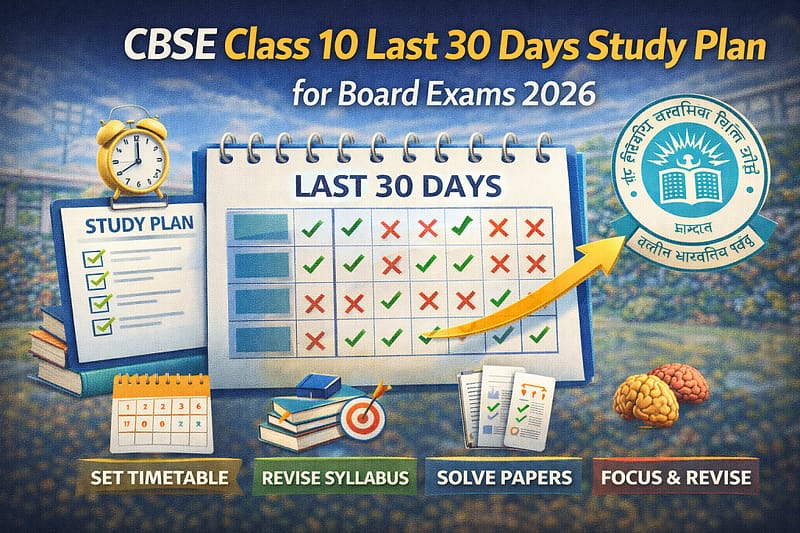
CBSE Class 10 Last 30 Days Study Plan for Board Exams 2026
The last 30 days before the CBSE Class 10 Board Exams 2026 can completely change your final result—if you use them smartly.
At this stage, your success does not depend on learning brand-new chapters. It depends on how well you revise, how confidently you solve questions, and how effectively you manage your time during the exam. In simple words, these 30 days are your polishing phase. You already have the knowledge. Now you must turn it into marks.
This guide will help you build a practical, realistic and student-friendly CBSE Class 10 last 30 days study plan that focuses on:
- structured revision
- competency-based question practice
- smart time management
- stress control before the exam
Why the Last 30 Days Are Crucial for CBSE Class 10 Board Exams 2026 Preparation
This period is the bridge between learning and performing. It’s not about starting fresh chapters you haven’t touched all year. Instead, it’s about solidifying what you already know. You need to shift gears from passive reading to active recall.
The exam pattern for 2026 places high importance on conceptual clarity, and your revision strategy needs to align with these requirements. This final stretch is where you fine-tune your time management skills and fix recurring errors. It is the difference between an average score and a topper’s mark sheet.
Effective Use of the Last 30 Days: How to Structure Your Study Plan
Random study sessions won’t cut it anymore. You need a routine that mimics the exam environment. Consistency is far more valuable than intensity right now. A consistent 6 hours is better than a sporadic 12 hours.
Set realistic daily targets. Don’t say “I will finish Science today.” Say “I will finish Electricity and Carbon Compounds today.” Use study blocks of 50 minutes with 10-minute breaks to keep your brain fresh. Prioritize your hardest subjects for the time of day when you are most alert.
Week-Wise Class 10 Board Exams Study Plan for the Last 30 Days
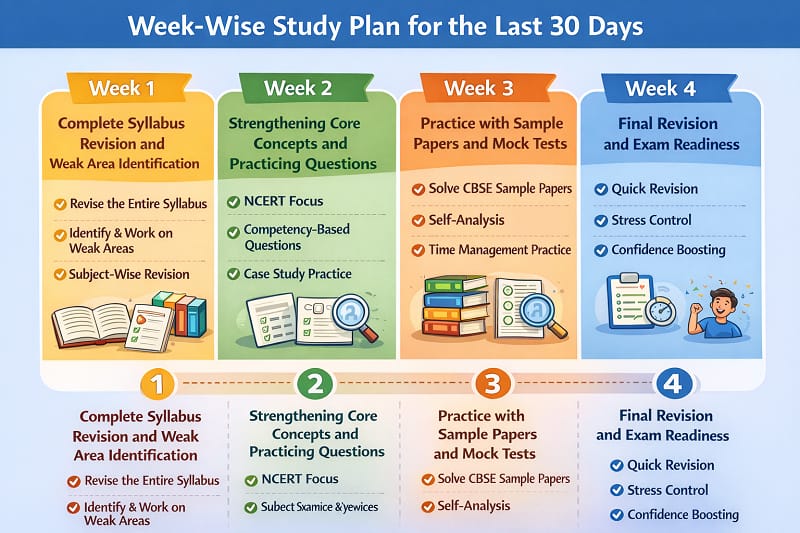
Breaking down the last 30 days into weeks allows for targeted preparation. Here’s a detailed week-wise strategy:
Week 1: Complete Syllabus Revision and Weak Area Identification
Start by revisiting the entire cbsc class syllabus. Identify the areas where you’re struggling the most and dedicate extra time to these topics. For each subject:
- English: Focus on writing skills, grammar, and literature.
- Hindi: Practice the important chapters and focus on language skills.
- Mathematics: Revise all key formulas and practice different types of problems.
- Science: Review core concepts, especially in Physics and Chemistry.
- Social Science: Revise history, geography, and economics thoroughly.
Week 2: Strengthening Core Concepts and Practicing Questions
Now that you’ve revised the syllabus, it’s time to strengthen core concepts and practice:
- NCERT Focus: Make NCERT your primary resource. Ensure that you understand every line and concept from the textbooks.
- Competency-Based Questions: With the new exam pattern focusing on application-based questions, practice solving competency-based questions to improve your problem-solving skills.
- Case Study Questions: These require critical thinking and analytical skills, so practice them regularly.
Week 3: Practice with Sample Papers and Mock Tests
Mock tests are an excellent way to simulate exam conditions. Here’s how to approach the final stages:
- CBSE Sample Papers: Solve sample papers to get familiar with the exam format. They help you understand the question types and improve time management.
- Self-Analysis: After each test, analyze your performance. Identify weak areas and allocate more study time to those subjects.
- Time Management: Practice solving questions within the time limits to ensure you complete the exam on time.
Week 4: Final Revision and Exam Readiness
In the final week, aim for light revision and exam preparation. Here’s how:
- Quick Revision: Focus on revising formulas, important diagrams, and key points from each subject.
- Stress Control: Take care of your mental health. Practice relaxation techniques such as deep breathing or meditation.
- Confidence Boosting: Trust in your preparation. Review your performance in mock tests and remind yourself of the progress you’ve made.
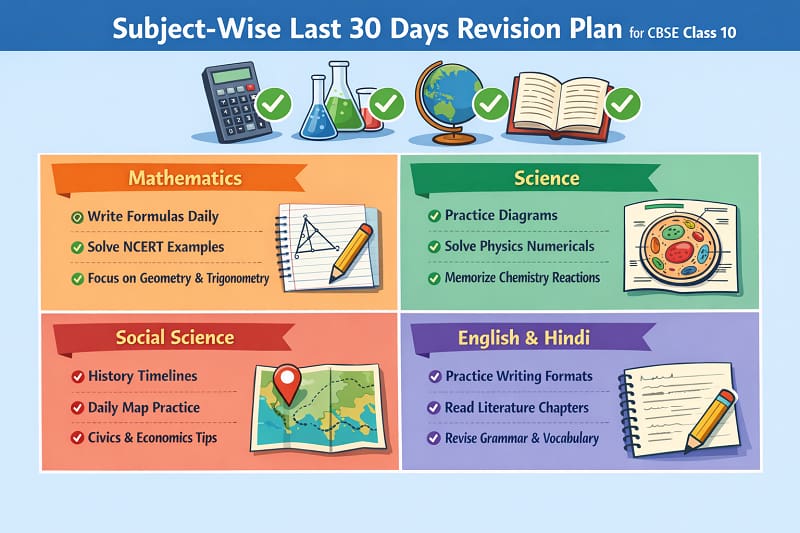
Subject-Wise Revision Plan for CBSE Class 10 Board Exams 2026
Mathematics
Practice is non-negotiable here. Reading math won’t help; you must solve it. Write down every formula daily to keep them fresh in your memory. Solve NCERT examples and miscellaneous exercises, as these are frequently asked. Focus heavily on geometry theorems and trigonometry identities.
Science
Biology diagrams need to be neat and labeled; practice drawing them from memory. For Physics, practice numericals and ensure you understand sign conventions. In Chemistry, memorize the reactions and periodic trends. Pay attention to activities in the NCERT book, as questions often stem from them.
Social Science
Create timelines for History chapters to remember the sequence of events. Practice map pointing for Geography daily—these are free marks. Use mnemonic devices to remember points for Civics and Economics answers. Structure your long answers with bullet points.
English & Hindi
Don’t neglect languages; they boost your overall percentage. Practice writing formats for letters, essays, and analytical paragraphs. Read the literature chapters to recall specific quotes and character sketches.
Daily Study Time Table
A structured day reduces decision fatigue. Here is a sample schedule for the last 30 days:
| Time | Activity | Focus |
|---|---|---|
| 5:30 AM – 7:30 AM | Heavy Subjects (Math/Physics) | Complex problem-solving, fresh mind for tough subjects |
| 10:30 AM – 1:30 PM | Sample Paper Solving | Simulate real exam conditions, practice time management |
| 3:00 PM – 5:00 PM | Social Science/Biology | Memory-based subjects, focus on retention |
| 6:30 PM – 8:00 PM | Language Subjects/Quick Revision of Notes | Revise grammar, writing skills, and notes |
| 9:00 PM – 10:00 PM | Review Errors from Morning Sample Paper | Identify mistakes and revise them |

How to Prepare Competency-Based Questions for CBSE Class 10 Board Exams 2026
The CBSE 2026 pattern emphasizes application over rote memorization. Competency-based questions test your understanding of concepts in real-life scenarios. You cannot simply memorize definitions to answer these.
Practice case-study questions found in official CBSE question banks. For assertion-reasoning questions, ensure your conceptual clarity is 100%. If you understand the ‘why’ behind a concept, you can answer these easily. Do not panic when you see a new type of question; relate it back to the core concept you learned in NCERT.
Common Mistakes to Avoid
- Ignoring NCERT: It is the bible for board exams. Do not prioritize expensive reference books over your primary textbook.
- Skipping Mocks: You need to know if you can finish the paper in 3 hours. Writing speed is just as important as knowledge.
- Social Media Distraction: A “5-minute break” often turns into an hour of scrolling. Keep the phone away during study blocks.
- Comparing Progress: Don’t ask your friends how much they have finished. Focus entirely on your own lane.
Last Minute Tips
- revise short notes daily
- avoid comparing yourself with others
- keep one light revision slot at night
- stop heavy studying one day before exam
- trust your preparation
CBSE Class 10 Board Exams 2026 – Frequently Asked Questions
How many sample papers should I solve?
Aim for at least 5-7 sample papers per subject. This gives you enough exposure to different question types and helps with time management.
Should I study late at night or early morning?
This depends on your personal biological clock. However, since the exam is in the morning, try to be active and alert during the first half of the day.
Conclusion – Smart 30-Day Strategy for CBSE Class 10 Board Exams 2026
The last 30 days are your time to perfect your knowledge, sharpen your skills, and boost your confidence. Stick to a well-structured study plan, avoid distractions, and remember to take care of your health. Best of luck for your CBSE Class 10 Board Exams in 2026!
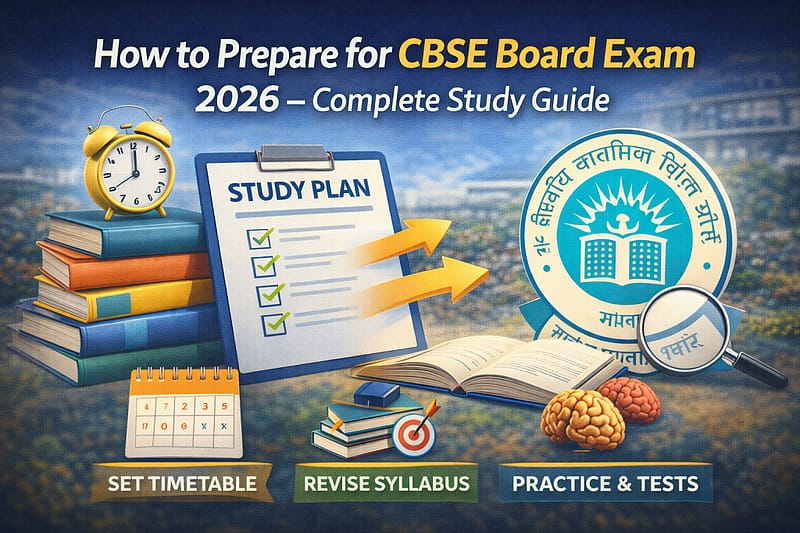
For a complete long-term strategy, you can also refer to: CBSE Board Exam 2026 Preparation Guide






6 comments