ITI Courses List After 10th 2026: Top Trades, Fees, Duration & Salary Guide

Choosing what to do after Class 10 is a decision that shapes the next several years of a student’s life. For many students in India, therefore, exploring the ITI courses list after 10th is the first step toward building practical skills and starting a rewarding career.
Moreover, with ITI Admission 2026 closing on August 8, this is the ideal time to compare available trades, course fees, eligibility, and salary expectations before making a final decision. Instead of relying only on admission brochures, this guide explains every major ITI trade in detail. In addition, it covers career opportunities, average salaries, and important factors to help you choose the course that best matches your interests and future goals.
What Is an ITI Course?
An ITI, short for Industrial Training Institute, is a government-recognised vocational training centre that teaches a specific trade through hands-on practice rather than long theory sessions. Courses are approved either by the National Council for Vocational Training (NCVT) or the State Council for Vocational Training (SCVT), and both are accepted by employers, though NCVT certificates carry recognition across the country while SCVT certificates are mainly valid within the issuing state.
Why Choose ITI Courses After 10th in 2026?
- Short duration — most trades finish in six months to two years, not four
- Low fees, especially at government institutes, compared to any degree course
- Practical, job-ready skills that employers actually test for during hiring
- Direct eligibility for several government job exams and technical apprenticeships
- A clear path to upgrade later through diploma or degree engineering via lateral entry
Eligibility Criteria for ITI Courses After 10th
Eligibility varies slightly by trade and state, but the general requirements are consistent nationwide.
| Requirement | Details |
| Minimum Qualification | Passed Class 10 (some trades also accept Class 8 pass) |
| Minimum Marks | Usually 35% to 45% aggregate, depending on the state and institute |
| Minimum Age | 14 years as of the admission cut-off date |
| Selection Process | Merit-based on Class 10 marks in most states; Bihar conducts ITICAT entrance exam |
Types of ITI Courses After 10th
Technical Trades
These focus on machinery, electrical systems, and mechanical work — Electrician, Fitter, Welder, Turner, and Mechanic trades fall here.
Non-Technical Trades
These cover service-oriented and creative skills — Dress Making, Hospital Housekeeping, Stenography, Front Office Attendant, and Hair and Skin Care are common examples.
Complete ITI Courses List After 10th (2026)
Here is a consolidated list covering the most sought-after trades across India, along with duration and eligibility.
| Trade Name | Duration | Eligibility |
| Electrician | 2 years | Class 10 pass with Science & Maths |
| Fitter | 2 years | Class 10 pass with Science & Maths |
| Welder | 1 year | Class 10 pass |
| COPA (Computer Operator) | 1 year | Class 10 pass |
| Mechanic Motor Vehicle | 1 year | Class 10 pass |
| Draughtsman Civil | 2 years | Class 10 pass with Science & Maths |
| Turner | 2 years | Class 10 pass with Science & Maths |
| Plumber | 1 year | Class 8 or 10 pass |
| Refrigeration & AC Mechanic | 1 year | Class 10 pass |
| Diesel Mechanic | 1 year | Class 10 pass |
| Instrument Mechanic | 2 years | Class 10 pass with Science & Maths |
| Dress Making | 1 year | Class 8 or 10 pass |
| Stenography (English/Hindi) | 1 year | Class 10 pass |
Top 6 ITI Courses After 10th — Detailed Breakdown
1. Electrician
This trade remains the most consistently in-demand option, since every industry — from manufacturing to real estate — needs qualified electricians for installation and maintenance work.
2. Fitter
Similarly, the Fitter trade prepares students to assemble, install, and maintain mechanical equipment. As a result, it serves as a strong entry point into manufacturing plants, production units, engineering workshops, and maintenance industries.
3. COPA (Computer Operator and Programming Assistant)
On the other hand, students who prefer desk-based work may find COPA a better fit. During the course, students learn basic programming, office software, and data entry skills. Consequently, they can pursue private-sector clerical, IT support, data entry, and administrative roles after completing the course..
4. Welder
Welding is a shorter, one-year trade with strong demand in construction and fabrication industries, and many welders eventually move into supervisory roles or start their own workshops.
5. Mechanic Motor Vehicle
Given how fast India’s vehicle ownership is growing, trained motor vehicle mechanics rarely struggle to find work, whether in authorised service centres or independent garages.
6. Draughtsman Civil
This trade suits students with an interest in construction and design, since it trains them to prepare technical drawings used by civil engineers and architects.
Best ITI Courses for Girls After 10th
While every trade is open to all genders, certain courses have traditionally seen strong participation and placement support for women, including Dress Making, Hair and Skin Care, Stenography, and Front Office Attendant. Health-focused options such as ANM Nursing, offered as a two-year female-only programme in several states, are also worth considering for students interested in the healthcare sector.
NCVT vs SCVT — Which Certificate Is Better?
| Basis | NCVT | SCVT |
| Issuing Authority | National Council for Vocational Training | State Council for Vocational Training |
| Recognition | Valid across India | Mainly valid within the issuing state |
| Government Job Value | Preferred for central government exams | Accepted for most state-level jobs |
ITI Course Fees 2026
| Institute Type | Approximate Annual Fee |
| Government ITI | Rs 1,000 to Rs 5,000 per year |
| Private ITI | Rs 15,000 to Rs 60,000 per year, depending on trade and location |
Government institutes are, therefore, significantly more affordable, though seats are limited and competition for admission is naturally higher.
ITI Trade-Wise Expected Salary After Completion
Naturally, one of the first questions students ask is what they can realistically expect to earn once the course is complete.
| Trade | Starting Salary (Monthly) | Common Sector |
| Electrician | Rs 12,000 – Rs 20,000 | Government & Private |
| Fitter | Rs 12,000 – Rs 18,000 | Manufacturing & PSU |
| COPA | Rs 10,000 – Rs 16,000 | Private (IT/Office Support) |
| Welder | Rs 13,000 – Rs 22,000 | Construction & Fabrication |
| Mechanic Motor Vehicle | Rs 10,000 – Rs 18,000 | Private & Self-Employed |
These figures are entry-level estimates and can vary based on location, employer, and whether the candidate works in the government or private sector. Skilled workers with a few years of experience often earn considerably more, particularly if they add certifications or move into supervisory roles.
Top Government Job Opportunities After ITI
- Indian Railways — Technician and Group C posts
- Indian Army, Navy, and Air Force — Technical trades entry
- PSU apprenticeships — BHEL, ONGC, NTPC, and similar organisations
- State Electricity Boards — Lineman and technician roles
ITI vs Diploma (Polytechnic) — Which Is Better After 10th?
| Basis | ITI | Polytechnic Diploma |
| Duration | 6 months to 2 years | 3 years |
| Focus | Single trade, hands-on skill | Broader engineering theory + practice |
| Cost | Lower, especially government institutes | Moderate to high |
| Best For | Quick entry into skilled jobs | Students aiming for lateral entry into engineering degrees |
In short, ITI works best for students who want to start earning quickly, while a diploma suits those who are willing to invest an extra year for broader career flexibility, including the option to join a degree engineering programme later through lateral entry.
How to Apply for ITI Admission 2026 — Step-by-Step
- Visit your state’s official ITI admission portal
- Register using an active mobile number and email address
- Fill in personal, academic, and trade preference details
- Upload scanned documents — Class 10 marksheet, photo, and signature
- Pay the registration fee and download the confirmation page
- Check the merit list once released and complete document verification at the allotted institute
Common Mistakes Students Make While Choosing an ITI Trade
- Picking a trade because a friend joined it, rather than checking personal interest or aptitude
- Ignoring the placement record and industry tie-ups of the specific institute
- Overlooking government ITIs in favour of private ones without comparing fees first
- Not checking whether the trade is NCVT or SCVT affiliated before applying
What After ITI? Career Growth Options
Completing an ITI course is rarely the end of your career journey. In fact, many students choose to join a one-year apprenticeship under the Apprentices Act after finishing their training. This hands-on experience allows them to apply their skills in real workplaces, gain valuable industry exposure, and improve their employability.
As a result, many apprentices receive permanent job offers from the companies where they complete their training, making apprenticeships an excellent stepping stone to long-term career success. Others use their ITI certificate for lateral entry into the second year of a diploma or degree engineering programme, effectively skipping a year compared to students entering after Class 12.
Additionally, Skill India certifications and short-term upskilling courses can help ITI graduates move into supervisory or specialised technical roles over time.
Frequently Asked Questions
Which ITI trade has the highest salary?
Welding and Electrician trades tend to offer higher starting salaries compared to most other one and two-year trades, especially in construction and industrial sectors.
What is the ITI admission last date for 2026?
The last date for ITI admission 2026 is August 8, though individual states may set earlier deadlines, so checking the relevant state portal is important.
Can I do a diploma or degree after completing ITI?
Yes. ITI graduates are eligible for lateral entry into the second year of a diploma or, in some states, directly into degree engineering programmes.
What is the difference between NCVT and SCVT certificates?
NCVT certificates are recognised nationwide, while SCVT certificates are primarily valid within the issuing state, which matters most for central government job applications.
Is there a government job guarantee after ITI?
No course guarantees a government job, but ITI certification does make candidates eligible for several technical posts in Railways, Defence, and PSUs, provided they clear the respective entrance exams.
Conclusion
To sum up, the ITI courses list after 10th offers a genuinely practical, affordable, and fast route into skilled employment, whether the goal is a government job, a private-sector role, or eventual entry into an engineering diploma. With ITI Admission 2026 closing on August 8, students who are still deciding should compare trades based on personal interest, local industry demand, and the institute’s placement record rather than following the crowd.
For students still weighing their options, our detailed guide on choosing the best stream after 10th covers Science, Commerce, and Arts alongside vocational paths like ITI.
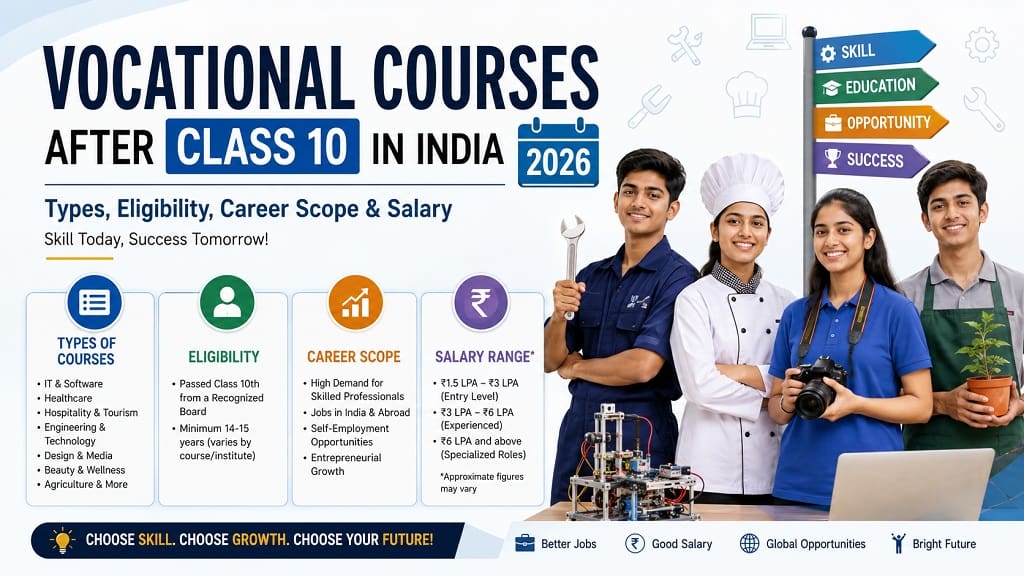
Those exploring broader skill-based alternatives can also read our guide to vocational courses after 10th for a wider comparison beyond ITI trades.
For more career guidance, admission updates, and educational resources, visit Insight Study Hub to explore detailed guides and expert articles for students.
Additionally, for the latest ITI admission schedule, eligibility criteria, counselling updates, and state-wise application portals, always verify the information on the official Directorate General of Training (DGT) website. Since admission dates, counselling rounds, and application procedures may vary by state, checking the official portal before applying ensures you have the most accurate and up-to-date information.
Since admission dates and procedures may vary from one state to another, checking the official portal before applying helps ensure you have the most accurate and up-to-date information.









3 comments