Syllabus
CBSE 10th syllabus 2026-27, CBSE 10th syllabus PDF 2026-27, CBSE academic update, CBSE board class 10 syllabus, CBSE board exam 2026, CBSE class 10, CBSE class 10 assessment pattern 2026, CBSE class 10 curriculum 2026, CBSE class 10 exam pattern 2026-27, CBSE class 10 subjects syllabus, CBSE curriculum, CBSE exam pattern, CBSE students guide, CBSE syllabus for class 10 2026, class 10 preparation, class 10 syllabus, latest CBSE class 10 syllabus, syllabus download
Insight Study Hub
4 Comments
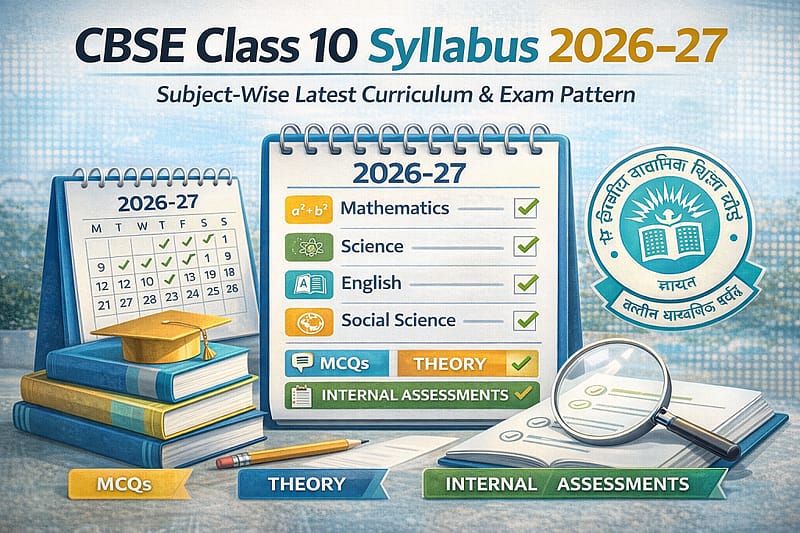
CBSE Class 10 Syllabus 2026–27: Subject-Wise Latest Curriculum & Exam Pattern
The CBSE Class 10 Syllabus 2026–27 is a crucial part of your academic journey, setting the stage for success. Therefore, understanding this syllabus early on is the first step toward preparing for the board exams and acquiring essential skills for the future. The Class 10 syllabus for 2026–27, designed by the Central Board of Secondary Education (CBSE), not only helps you prepare for exams but also equips you with skills needed beyond school. Moreover, this guide provides a detailed breakdown of the latest CBSE Class 10 syllabus, exam patterns, and key changes, ensuring you have all the necessary information to plan your studies effectively. In addition, think of the syllabus as your roadmap—knowing the terrain well will make your journey smoother and more successful.
What’s New in CBSE Class 10 Syllabus 2026–27?
The 2026–27 session introduces several updates aligned with the National Education Policy (NEP). As a result, these changes aim to make learning more holistic, flexible, and competency-focused, moving away from rote memorization. Moreover, the emphasis on practical skills and critical thinking ensures that students are better prepared for real-world challenges.

Changes in curriculum structure
The curriculum has been refined to promote a deeper understanding of concepts. In addition, some topics have been rationalized to reduce the content load, allowing students to engage more thoroughly with the material. Moreover, the focus is now on interdisciplinary learning, helping students connect ideas across different subjects.
Skill-based and competency-based learning focus
A major shift is the increased emphasis on competency-based questions. As a result, these questions require you to apply your knowledge to solve real-world problems. For example, you can expect more case studies, source-based analysis, and critical-thinking questions in your exams. Moreover, this approach helps develop practical skills that are valuable beyond the classroom.
Internal assessment updates
Internal assessments will carry significant weight and are designed to evaluate your skills throughout the year. This includes periodic tests, project work, portfolio submissions, and practical exams. The goal is to ensure continuous evaluation rather than a single, high-stakes final exam.
CBSE to conduct two board exams from 2026
Starting with the 2025-26 session, as per the New Curriculum Framework, CBSE will offer students the opportunity to appear for board exams twice a year. This allows students a chance to improve their scores. Students can choose to appear for one or both exams, and the best of the two scores will be considered for the final result. This flexibility aims to reduce the immense stress associated with a single board examination.
Two exams for Class 10 Science & Social Science (if applicable)
While the two-exam format is a broader policy, its specific implementation for subjects like Science and Social Science will be detailed by the board. The structure might involve different sets of papers or a choice-based system. Students should await official circulars from CBSE for precise guidelines on this matter.
Key Highlights of CBSE Class 10 Syllabus 2026–27
Understanding the core components of the syllabus and grading system is essential for effective preparation. Here are the key highlights you should know.
CBSE Class 10 grading system & exam structure
The grading system in CBSE Class 10 uses a 9-point scale, from A1 (highest) to E (needs improvement). The final result is a combination of marks from the board examination (theory) and internal assessments.
- Board Examination: 80 marks for most major subjects.
- Internal Assessment: 20 marks, broken down into periodic tests, portfolio, subject enrichment activities, and practical work.
Key features of CBSE Class 10 syllabus 2026–27
- Competency-Focused: At least 50% of questions will be competency-based (MCQs, case-based, source-based integrated questions).
- Reduced Rote Learning: The syllabus is designed to discourage memorization and promote critical thinking.
- Skill Development: Emphasis on 21st-century skills like creativity, communication, and problem-solving.
- Flexibility: The introduction of two board exams provides students with more opportunities to perform their best.
CBSE Class 10 Syllabus 2026–27 – Subject-Wise Overview
Here’s a look at the curriculum for the main subjects. However, it’s crucial to refer to the detailed syllabus for each subject for specific topics and weightage. In addition, this overview will help you understand the structure and importance of each subject, providing a foundation for more targeted preparation.
CBSE Class 10 English Language & Literature Syllabus 2026–27
The English syllabus is divided into three sections: Reading Comprehension, Writing Skills with Grammar, and Literature. Overall, the focus is on developing strong communication and analytical skills. In addition, students will study both prose and poetry from the prescribed textbooks, First Flight and Footprints Without Feet, which help build interpretation and language usage skills.
CBSE Class 10 Hindi Syllabus 2026–27
For Hindi (Course A or Course B), the syllabus covers reading, writing, grammar, and literature from the prescribed textbooks. Specifically, Course A includes Kshitij and Kritika, while Course B includes Sparsh and Sanchayan. Moreover, the syllabus aims to enhance overall language proficiency and promote a deeper appreciation of Hindi literature.
CBSE Class 10 Mathematics Syllabus 2026–27
The Mathematics syllabus is available in two levels: Mathematics Standard and Mathematics Basic. Standard is for students who wish to pursue Math in higher classes, while Basic is for those who do not. Key units include Number Systems, Algebra, Coordinate Geometry, Geometry, Trigonometry, Mensuration, and Statistics & Probability.
CBSE Class 10 Science Syllabus 2026–27
The Science syllabus combines Physics, Chemistry, and Biology. It is designed to foster a scientific temper and understanding of natural phenomena. Major themes include Chemical Substances, World of Living, Natural Phenomena (light and electricity), and Natural Resources.
CBSE Class 10 Social Science Syllabus 2026–27
Social Science covers four disciplines: History (India and the Contemporary World – II), Geography (Contemporary India – II), Political Science (Democratic Politics – II), and Economics (Understanding Economic Development). The curriculum aims to provide a comprehensive understanding of India’s past, its geography, political systems, and economy.
CBSE Class 10 Information Technology / Skill Subjects Syllabus 2026–27
Besides the core subjects, CBSE offers a range of skill subjects like Information Technology (Code 402), Artificial Intelligence, and more. These subjects are designed to provide vocational skills and practical knowledge, preparing students for specific career paths.
CBSE Class 10 Syllabus 2026–27 – Group-Wise Overview
The subjects in Class 10 are organized into different groups to provide a structured yet flexible academic framework.
Main Subjects (Group A1)
These are the compulsory scholastic subjects that form the core of the Class 10 curriculum.
- Mathematics
- Science
- Social Science
Languages (Group L)
Students must choose two languages.
- Language 1: English or Hindi.
- Language 2: Any language from the prescribed list, which includes regional and foreign languages.
Other Subjects and Electives (Group A2 & Others)
Students can opt for a skill subject as an additional elective. These subjects focus on vocational training and practical skills. Examples include Information Technology, Artificial Intelligence, Marketing & Sales, and more.
CBSE Class 10 Syllabus 2026–27 for Core Subjects
Let’s dive deeper into the core subjects to understand the chapter-wise distribution and key areas of focus.
Mathematics Syllabus 2026–27
The syllabus aims to build a strong foundation in mathematical concepts.
|
Unit Name |
Key Topics |
|---|---|
|
Number Systems |
Real Numbers, Euclid’s division lemma |
|
Algebra |
Polynomials, Linear Equations, Quadratic Equations |
|
Coordinate Geometry |
Lines (In two-dimensions) |
|
Geometry |
Triangles, Circles, Constructions |
|
Trigonometry |
Introduction to Trigonometry, Identities, Heights |
|
Mensuration |
Areas related to Circles, Surface Areas & Volumes |
|
Statistics & Probability |
Mean, Median, Mode, Probability |
Science Syllabus 2026–27
The integrated science curriculum emphasizes practical application and understanding.
|
Unit Name |
Key Topics |
|---|---|
|
Chemical Substances |
Chemical Reactions, Acids, Bases, Metals, Carbon Compounds |
|
World of Living |
Life Processes, Control and Coordination, Reproduction, Heredity |
|
Natural Phenomena |
Reflection & Refraction of Light, The Human Eye |
|
Effects of Current |
Electricity, Magnetic Effects of Electric Current |
|
Natural Resources |
Our Environment, Management of Natural Resources |
Social Science Syllabus 2026–27
This subject provides a multidisciplinary perspective on society and the world.
|
Subject |
Key Topics |
|---|---|
|
History |
Nationalism in Europe & India, The Making of a Global World |
|
Geography |
Resources, Agriculture, Minerals, Manufacturing Industries |
|
Political Science |
Power Sharing, Federalism, Political Parties, Outcomes of Democracy |
|
Economics |
Development, Sectors of the Indian Economy, Money and Credit |
English Syllabus 2026–27
The focus is on comprehension, expression, and literary analysis.
|
Section |
Key Areas |
|---|---|
|
Reading Skills |
Discursive and Case-based factual passages |
|
Writing Skills & Grammar |
Formal Letter writing, Analytical Paragraph, Tenses, Modals, etc. |
|
Literature |
Questions based on extracts from prose and poetry |
CBSE Class 10 Syllabus 2026–27 for Other Subjects
Beyond the core subjects, students have a wide array of languages and skill-based electives to choose from.
Other Language Subjects
CBSE offers a diverse list of languages as a second or third language option. For example, this includes Sanskrit, French, German, Spanish, and several Indian regional languages. In addition, the syllabus for each language focuses on developing reading, writing, and conversational skills.
Other academic and skill-based electives
These subjects are designed to nurture specific talents and provide vocational training.
- Painting: Develops artistic skills and an appreciation for art.
- Home Science: Covers topics like nutrition, resource management, and human development.
- Computer Applications/IT: Focuses on digital literacy, web applications, and basic programming.
- Artificial Intelligence: Introduces students to the fundamentals of AI and its applications.
Also read: CBSE Admit Card 2026 Released
CBSE Class 10 Exam Pattern 2026–27
Understanding the exam pattern is just as important as knowing the syllabus. It tells you how you will be evaluated.
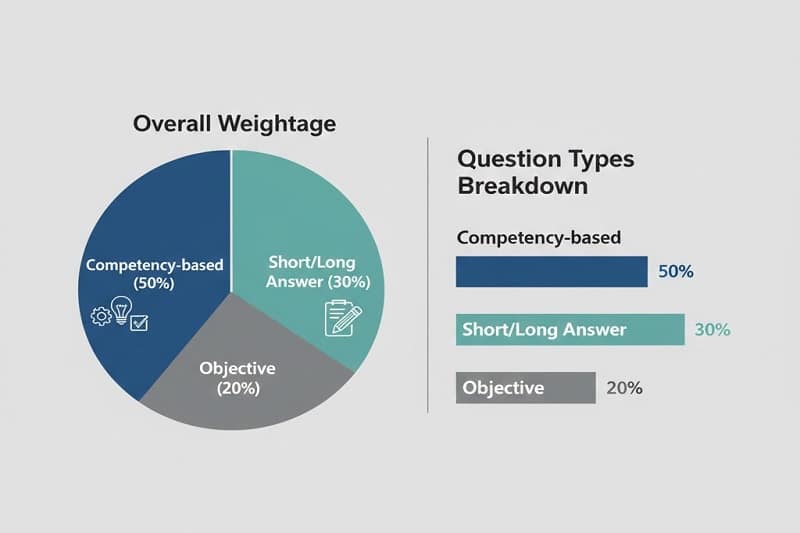
CBSE Class 10 scheme of studies
The scheme includes five compulsory subjects: two languages, Mathematics, Science, and Social Science. In addition, there is an optional sixth skill subject that students can choose based on their interests. Furthermore, performance in the best five subjects is considered for the final percentage calculation, ensuring that students can focus on their strengths.
Internal assessment structure
The 20 marks for internal assessment are generally distributed as follows:
- Periodic Tests (5 marks): Best two out of three tests conducted during the year.
- Multiple Assessments (5 marks): Quizzes, oral tests, concept maps, exit cards, etc.
- Portfolio (5 marks): A collection of the student’s work over the year, showing growth.
- Subject Enrichment Activities (5 marks): Practical lab work, projects, listening and speaking skills.
Board examination format
The theory paper for most subjects is for 80 marks with a duration of 3 hours. The question paper will have a mix of:
- Objective Type Questions: Multiple Choice Questions (MCQs).
- Competency-Based Questions: Case studies, source-based questions.
- Short & Long Answer Questions: Requiring descriptive answers.
Competency-based questions focus
With at least 50% of the paper dedicated to competency-based questions, you must focus on understanding and applying concepts. Simply memorizing facts will not be enough. Practice solving sample papers and questions that require analysis and interpretation.
Why Is CBSE Class 10 Syllabus 2026–27 Important for Students?
The syllabus is your primary guide for the academic year. Its importance cannot be overstated.
- Provides Clarity: It gives a clear outline of what you need to study, including topics and sub-topics.
- Helps in Planning: Knowing the syllabus helps you create a realistic study schedule and allocate time for each subject.
- Sets Expectations: It informs you about the learning objectives and the skills you are expected to develop.
- Reduces Anxiety: A well-understood syllabus eliminates surprises and reduces exam-related stress.
CBSE Class 10 Syllabus 2026–27 PDF Download (Official Source)
Always rely on official sources for the syllabus to ensure you have the most accurate and updated information.
Where to check the official CBSE syllabus
The official and most reliable place to find the syllabus is the CBSE Academic website: cbseacademic.nic.in. Navigate to the “Curriculum” section and select the curriculum for the session 2026–27.
How to use the syllabus for planning studies
Once you download the syllabus PDF, print it out. Go through each subject, marking the weightage of different units. Use this information to prioritize topics and create a balanced study plan that covers the entire curriculum well before the exams.
How to Use CBSE Class 10 Syllabus 2026–27 for Smart Preparation
A syllabus is a tool. Here’s how to use it smartly.
Study planning tips
- Break It Down: Divide the syllabus into smaller, manageable parts.
- Prioritize: Focus on high-weightage units first, but don’t neglect the others.
- Set Deadlines: Assign deadlines for completing each topic to stay on track.
Weekly schedule method
Create a weekly timetable that allocates specific hours for each subject. Include time for revision, practice, and breaks. For example, dedicate 2 hours to Math on Monday, 2 to Science on Tuesday, and so on. Consistency is key.
Linking syllabus with sample papers
After completing a chapter, solve questions related to it from CBSE sample papers and previous years’ question papers. This helps you understand the types of questions asked and improves your time management and problem-solving skills.
Important Tips for Students and Parents
Success in Class 10 is a team effort. Here are some tips for both students and parents.
Common mistakes while following the syllabus
- Ignoring the detailed curriculum: Only looking at chapter names is not enough. Read the topics within each chapter.
- Selective studying: Skipping chapters you find difficult is a risky strategy.
- Neglecting internal assessments: The 20 internal marks are crucial and can significantly boost your overall percentage.
- Last-minute preparation: The new pattern requires consistent effort throughout the year.
How parents can support Class 10 students
- Create a positive study environment: Ensure a quiet, organized space for your child to study.
- Monitor progress without pressure: Stay informed about their studies but avoid creating undue stress.
- Encourage breaks and hobbies: A balanced routine with time for relaxation is essential for mental well-being.
- Communicate with teachers: Regularly interact with teachers to understand your child’s performance and areas for improvement.
Frequently Asked Questions on CBSE Class 10 Syllabus 2026–27
Has CBSE reduced any chapters for 2026–27?
CBSE often rationalizes the syllabus to reduce content load. Any deletions or modifications for the 2026–27 session will be clearly mentioned in the official curriculum document released by the board.
Is the syllabus same for all CBSE schools?
Yes, the core curriculum and syllabus provided by the Central Board of Secondary Education are mandatory for all affiliated schools in India and abroad.
Where can I download the official CBSE Class 10 syllabus PDF?
You can download the official syllabus directly from the CBSE Academic website (cbseacademic.nic.in) under the 'Curriculum' tab. Avoid relying on unverified third-party websites.
Conclusion
The CBSE Class 10 syllabus for 2026–27 is a modern, student-centric framework designed to foster deep understanding and practical skills. By doing so, familiarizing yourself with the curriculum, exam pattern, and the new emphasis on competency-based learning will help you navigate this important year with confidence and a clear strategy. Additionally, remember to use the syllabus as a roadmap, plan your studies consistently, and focus on applying what you learn.
Moreover, for more detailed study plans, chapter-wise notes, and expert guidance to help you excel, be sure to explore the resources available at InsightStudyHub.com. In conclusion, here’s to a successful and enriching academic year.






4 comments