Board Exams
Exams
cbse board exam qr code, cbse class 12 maths exam, cbse class 12 maths paper, cbse digital exam system, cbse exam paper security, cbse exam technology, cbse maths qr code, cbse question paper qr code, how to scan qr code on cbse paper, qr code in board exams
Insight Study Hub
0 Comments
How to Scan CBSE Class 12 Maths Paper QR Code – Complete Guide 2026
The CBSE Class 12 board exams are among the most important academic milestones for students in India. Every year, millions of students appear for these exams to secure admission into colleges and universities.
Among all subjects, Mathematics is often considered one of the most challenging. Students prepare for months to perform well in the exam.
In recent years, a new element has appeared on many exam papers — the CBSE Class 12 Maths paper QR code. Many students noticed this small square code printed on the question paper and wondered what it does.
The use of QR codes in exams is part of a broader effort to improve security, transparency, and digital verification in the examination process.
Students often search online for answers to questions such as:
-
What does the QR code on the maths paper do?
-
Can it reveal answers?
-
How do you scan it?
-
Is it safe to use?
In this guide, we will explain everything you need to know about the CBSE Class 12 Maths paper QR code, including how to scan it, what information it contains, and why the board introduced this technology.
What is the CBSE Class 12 Maths Paper QR Code?
A QR code (Quick Response code) is a two-dimensional barcode that stores information digitally. It can be scanned using a smartphone camera or a QR scanning app.
On the CBSE Class 12 Maths question paper, this code is printed in a corner or header area of the paper.
Purpose of the QR Code
The main goal of the QR code is verification and security.
It helps the board confirm that:
-
The question paper is authentic
-
The paper belongs to the correct exam
-
The exam set matches the official record
How QR Codes Help the Exam System
QR codes are now widely used in many systems, including payments, tickets, and product authentication.
Similarly, in board exams they help:
-
Digitally track exam papers
-
Verify authenticity quickly
-
Prevent fake or leaked papers
Information Stored in the QR Code
The CBSE Class 12 Maths paper QR code may contain several types of exam data.
| Information Type | Description |
|---|---|
| Question Paper Code | Unique ID assigned to the exam paper |
| Subject Information | Confirms the paper belongs to Mathematics |
| Paper Set Number | Identifies different question paper versions |
| Exam Date & Session | Links to specific exam schedules |
| Internal CBSE Tracking | Used by authorities for verification |
This information helps ensure that every question paper can be tracked and verified quickly.
Why CBSE Added QR Codes to Class 12 Maths Papers
The introduction of QR codes in exam papers did not happen randomly. It was implemented to address several challenges faced by examination boards.
1. Preventing Question Paper Leaks
Paper leaks are one of the biggest concerns in large examinations.
QR codes help reduce this risk by allowing quick verification of each paper’s authenticity.
If a paper leaks online, authorities can trace it using the encoded information.
2. Verification of Authenticity
Students and invigilators can confirm that the question paper is genuine.
This ensures that the paper:
-
Has not been tampered with
-
Matches official CBSE records
-
Belongs to the correct exam set
3. Real-Time Traceability
Every exam paper can be linked to its origin.
This helps authorities track:
-
Which printing batch produced the paper
-
Which exam center received it
-
Whether the correct paper was distributed
4. Improving Exam Transparency
Modern exams require high levels of trust and transparency.
QR codes provide a digital verification layer that helps ensure fairness.
5. Digital Modernization
Education systems around the world are moving toward digital tools.
QR codes are part of CBSE’s effort to:
-
Modernize exam management
-
Improve efficiency
-
Adopt secure technologies
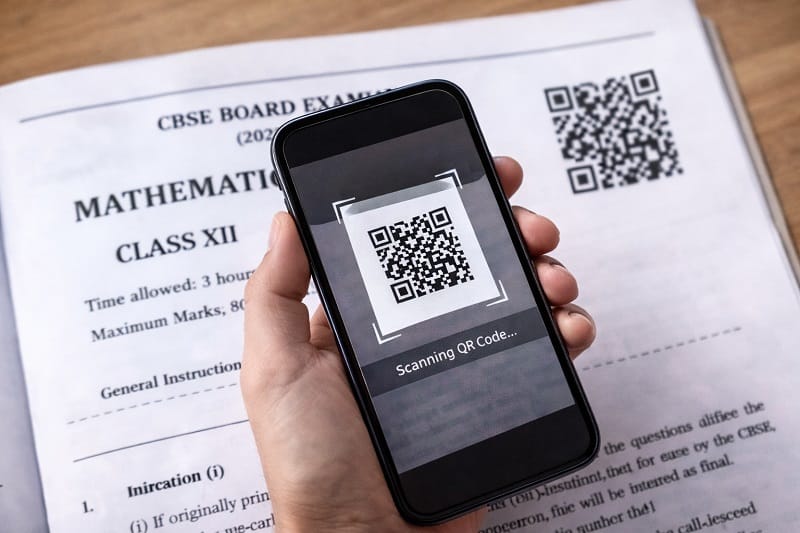
How to Scan CBSE Class 12 Maths Paper QR Code on Mobile (Step-by-Step)
Scanning a QR code is very simple. Most modern smartphones already have the feature built into the camera.
Follow these steps.
Step 1: Prepare Your Smartphone
Before scanning, make sure:
-
Your phone camera is clean
-
The phone has internet access
-
The camera is functioning properly
If your camera is older, you may need a QR scanner app.
Step 2: Use the Built-in Camera or QR Scanner App
Most phones can scan QR codes directly.
For Android:
-
Open the camera app
-
Point it toward the QR code
-
Wait for the link notification
For iPhone:
-
Open your IPhone Camera
-
Focus on the QR code
-
Tap the link that appears
Step 3: Align the QR Code Properly
Hold the phone steady.
Tips for better scanning:
-
Keep the code within the camera frame
-
Ensure good lighting
-
Avoid shadows covering the code
Step 4: Tap the Link and Verify the Source
After scanning, a link may appear.
Before opening it, check:
-
The website domain
-
Whether it belongs to an official source
This prevents phishing or fake pages.
Step 5: Access or Download the Related Content
If the link is legitimate, you may see:
-
Exam paper details
-
Authentication confirmation
-
Official exam resources
You may also be able to download a PDF or view exam information.
Tips for Safe Scanning
Keep these safety tips in mind:
-
Only scan QR codes from trusted sources
-
Avoid unknown links
-
Never enter personal data on suspicious sites
Tips for Students When Scanning CBSE QR Codes
Many students are new to QR scanning. These tips can make the process easier.
Best QR Scanner Apps
If your phone camera cannot scan codes, try these apps:
-
Google Lens
-
QR Code Reader
-
Kaspersky QR Scanner
These apps are reliable and easy to use.
Check Authenticity
Always verify the website before opening it.
Signs of official pages include:
-
Government domain (.gov.in)
-
Recognized educational platforms
-
Secure HTTPS connection
Organize Downloaded Papers
When downloading study materials:
-
Save them in subject folders
-
Rename files clearly
-
Keep backups in cloud storage
Example:
This helps during revision.
Avoid Fake QR Codes
Sometimes unofficial sources create fake QR codes.
Avoid scanning codes from:
-
Random social media posts
-
Unknown websites
-
Suspicious messaging links
Common Issues While Scanning QR Codes and Solutions
Students may face some scanning problems. Most are easy to fix.
| Problem | Possible Cause | Solution |
|---|---|---|
| QR code not detected | Poor lighting | Move to brighter area |
| Blurry image | Camera not focused | Tap screen to focus |
| Damaged QR code | Printing issue | Try scanning from another angle |
| Link not opening | No internet | Connect to Wi-Fi or data |
In most cases, improving lighting and camera focus solves the issue.
Can Students Get Answers from the CBSE Maths Paper QR Code?
This is one of the most common misconceptions.
Some students believe scanning the CBSE Class 12 Maths paper QR code will reveal answers.
However, this is not true.
QR Codes Do NOT Show Answers
The QR code does not contain:
-
Answer keys
-
Solutions
-
Marking schemes
It only contains verification data related to the exam paper.
Why This Myth Exists
Students sometimes encounter viral posts claiming QR codes reveal answers.
In reality, these claims are misleading.
The board designs these codes only for security and verification.
Official Guidelines
Students should remember:
-
QR codes are not meant to help solve the exam
-
Scanning during the exam is generally not allowed
-
The code is mainly for administrative purposes
Always follow exam rules and invigilator instructions.
Benefits of QR Codes in CBSE Board Exams
QR codes provide several advantages for the education system.
Increased Exam Security
Digital verification makes it harder to distribute fake papers.
Faster Verification
Authorities can quickly confirm:
-
Paper authenticity
-
Correct exam set
Reduced Risk of Paper Leaks
Tracking information makes it easier to detect unauthorized distribution.
Eco-Friendly and Efficient
QR codes help reduce dependence on printed verification documents.
This contributes to more efficient exam management.
Frequently Asked Questions (FAQs)
Does the CBSE Class 12 Maths paper QR code show answers?
No. The QR code only contains authentication information about the exam paper.
Is scanning the QR code allowed during the exam?
Generally, students are not allowed to use phones during exams. Scanning usually happens after the exam or by officials.
What happens if the QR code is damaged?
If the code is damaged, it does not affect your exam. Invigilators and authorities have other verification methods.
Why does a QR code sometimes open a video?
Sometimes a code may link to external resources. However, official exam codes usually connect to verification systems.
Do all CBSE question papers contain QR codes?
Many recent CBSE papers include QR codes, but this may vary depending on exam year and subject.
Conclusion
The CBSE Class 12 Maths paper QR code is an important step toward modernizing board examinations. It helps improve exam security, prevent paper leaks, and ensure the authenticity of question papers.
Although students often wonder whether the code provides answers or extra information, its real purpose is verification and tracking.
Understanding how these QR codes work helps students avoid confusion and misinformation.
As technology continues to evolve, tools like QR codes will play a bigger role in making exams safer, more transparent, and more efficient.
For students preparing for board exams, the best approach is simple:
Focus on preparation, use official study materials, and treat the CBSE Class 12 Maths paper QR code as a security feature rather than a shortcut.
With the right preparation and mindset, success in the exam will follow naturally.










Post Comment