No Ball Rules in Cricket: Complete Guide to Every No-Ball Type
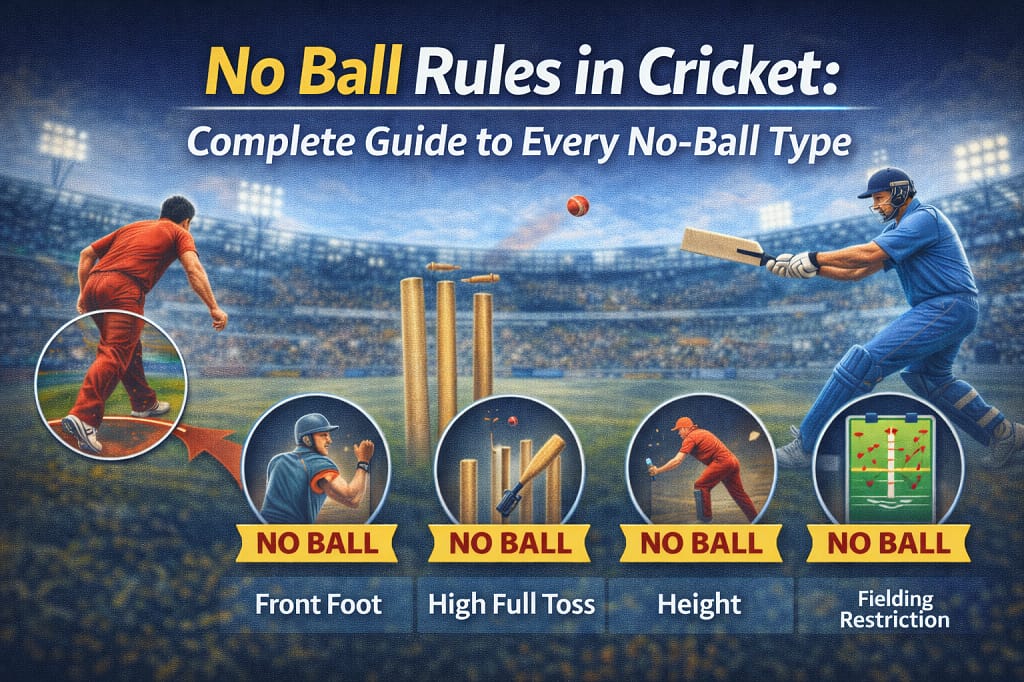
There is nothing more heartbreaking for a bowler than seeing the stumps fly out of the ground, starting a celebration — and then noticing the umpire’s arm stretched out horizontally. A no-ball can instantly turn a perfect delivery into a costly mistake.Understanding the no ball rules in Cricket is important not only for players, but also for parents, young learners and fans who want to truly understand what is happening on the field.
A no ball is one of the most penalising errors a fielding team can make. It gives the batting side an extra run, an extra delivery, and in limited-overs formats, a free hit — which allows the batter to attack without the risk of most dismissals.
In this article, we break down all types of no balls — from the common front-foot fault to lesser-known fielding and positioning violations — using simple language, real match examples and clear explanations based on ICC and MCC laws.
What Is a No Ball Rules in Cricket?
Simply put, a no ball is an illegal delivery. It is a ball that the bowler has not bowled according to the laws of the game.
When a no ball is bowled, the delivery does not count towards the six balls in the over. The batting team is awarded one penalty run (plus any runs scored off the bat), and the bowler must bowl the ball again.
Think of it as a “do-over” for the batter, but with a penalty attached for the bowler. It is the umpire’s way of saying, “That delivery was unfair or dangerous; do it again properly.”
The Basic Law of No Ball Rules (ICC / MCC Laws Explained Simply)
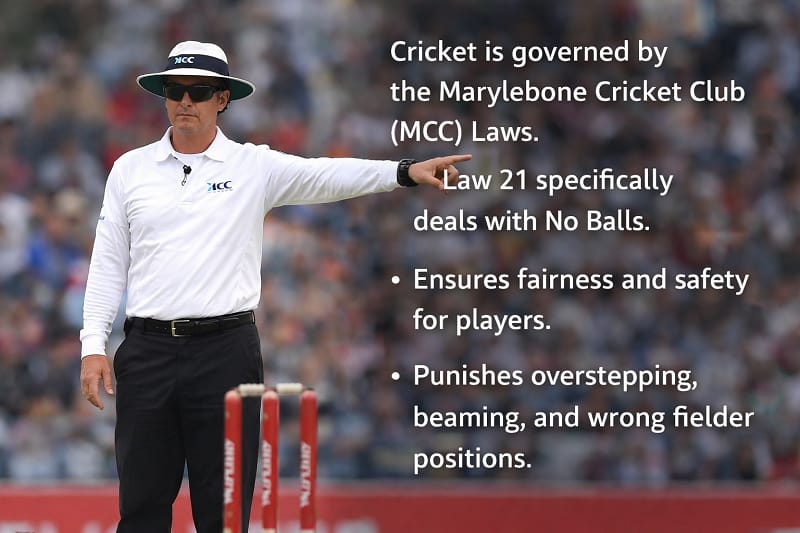
Cricket is governed by the Marylebone Cricket Club (MCC) Laws. Law 21 specifically deals with No Balls.
The core principle is fairness and safety. The laws ensure that bowlers don’t gain an unfair advantage by shortening the pitch (stepping over the line) or bowling dangerously (beaming the batter).
While the front-foot rule is the most famous, the laws cover everything from where the wicketkeeper stands to how many fielders are behind square leg. If the fielding team violates these positioning or delivery rules, the umpire calls a no ball.
All Types of No Ball Rules in Cricket
Most fans know about overstepping, but did you know there are over 20 different ways to concede a no ball? Let’s break them down.
Front Foot No Ball
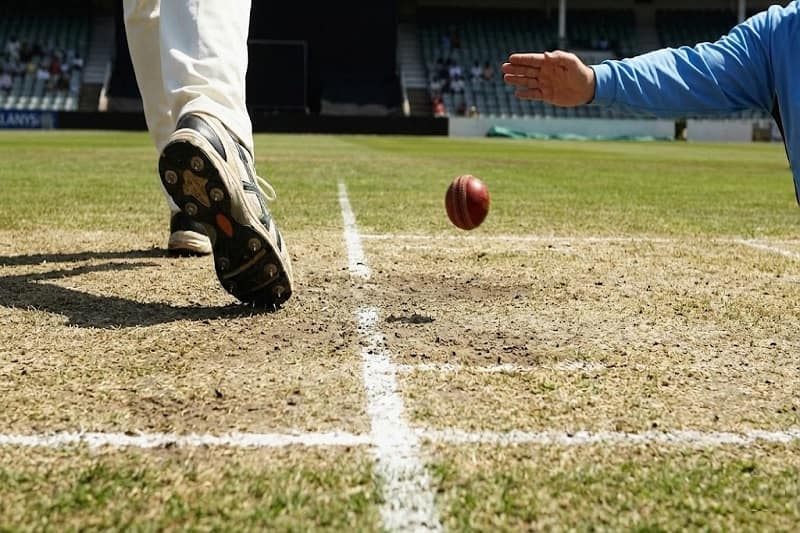
This is the most common violation. It happens when the bowler’s front foot lands and some part of it is not behind the popping crease (the front line). Even if the heel is on the line, if no part of the foot is grounded behind it, it’s a no ball.
Check out our guide on bowling techniques to fix your run-up.
Back Foot No Ball
This is rare. For a legal delivery, the bowler’s back foot must land within the return crease (the side lines of the pitch). If the back foot touches or crosses the return crease, it is a no ball.
High Full Toss (Beamer) No Ball
Safety is key here. Any ball that reaches the batter above waist height without bouncing is a no ball. This is often called a “beamer.” It is dangerous, and if a bowler bowls two of these in an innings, they can be removed from the attack.
Head-High Bouncer No Ball
A bowler can bowl short balls (bouncers), but they cannot fly over the batter’s head freely. If a bouncer passes over the batter’s head height, the umpire calls a wide. However, if it is aimed dangerously or repeats too often, it can be called a no ball in certain playing conditions.
Illegal Bowling Action (Throwing / Chucking)
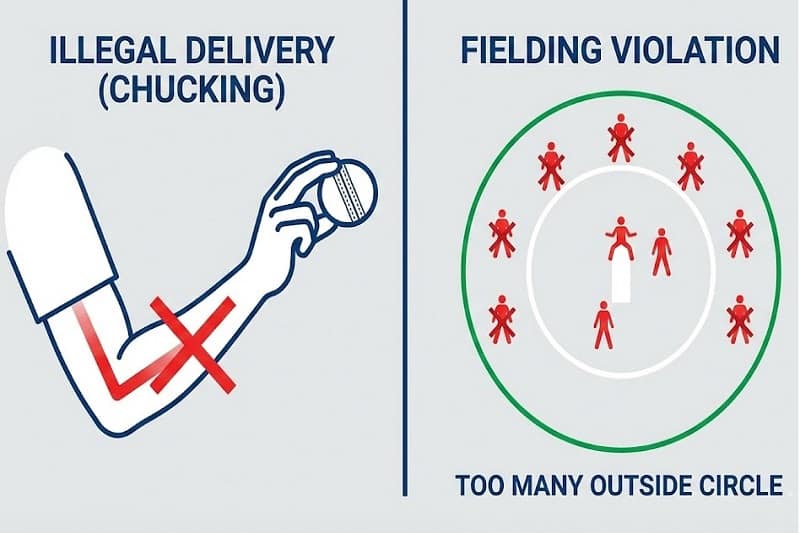
The bowler’s arm must remain straight during the delivery swing. If the elbow bends more than 15 degrees, it is considered “throwing” or “chucking.” This is a technical no ball usually called by match referees after review, rather than on-field umpires.
Change of Bowling Arm or Side Without Informing Umpire
A bowler must tell the umpire if they are switching from “over the wicket” to “round the wicket,” or from right-arm to left-arm. If they switch without notifying the umpire (and the batter), the delivery is a no ball.
Underarm Bowling No Ball
Underarm bowling was banned after the infamous 1981 incident between Australia and New Zealand. Today, if a bowler rolls the ball along the ground or bowls underarm, it is an instant no ball.
Ball Bouncing More Than Once
The ball is allowed to bounce once before reaching the popping crease. If it bounces twice or more before reaching the batter, it is a no ball.
Ball Rolling on the Ground
Similarly, the ball cannot roll along the turf. It must fly through the air and pitch. A rolling ball is a no ball.
Ball Pitching Outside the Pitch
The ball must land on the designated pitch strip. If the ball slips out of the bowler’s hand and lands on the grass completely off the pitch, it is a no ball.
Ball Coming to Rest in Front of the Batter
If a delivery is so slow or poor that it stops completely before reaching the batter, the umpire calls a no ball.
Bowler Breaking the Wicket During Delivery
Sometimes, a bowler gets too close to the stumps during their delivery stride and knocks the bails off with their arm or clothes. This counts as a no ball.
Dangerous and Unfair Bowling
Umpires have discretion. If they feel a bowler is intentionally bowling at the batter’s body in a dangerous way, or running onto the danger area of the pitch consistently after warnings, they can call a no ball.
More Than Allowed Bouncers in an Over
In T20s and ODIs, a bowler is usually allowed one bouncer (above shoulder height) per over. In Tests, it is usually two. If they bowl another one in the same over, the umpire calls a no ball.
Wicketkeeper Position No Ball
The wicketkeeper must remain completely behind the stumps until the ball passes the wicket or touches the bat/body of the striker. If they take the ball in front of the stumps, it is a no ball.
Fielder Encroaching on the Pitch
Fielders cannot stand on or extend their bodies over the pitch strip itself while the ball is being played.
Illegal Fielding / Fielding Interference
A fielder cannot distract the batter with significant movement or noise as the bowler runs in. If they do, the umpire can penalize the team with a no ball.
More Than Two Fielders Behind Square on the Leg Side
This is a safety rule to prevent the “Bodyline” tactic. At the instant of delivery, the fielding team can have no more than two fielders positioned behind the popping crease on the leg side (behind the batter’s back).
On-side / Fielding Restriction Violations
In limited-overs cricket, you must have a minimum number of fielders inside the 30-yard circle (usually 4 or 5 depending on the over). If you have too many fielders on the boundary, it is a no ball.
Powerplay Field Restriction No Ball
During the “Powerplay” (the first few overs of a T20 or ODI), only two fielders are allowed outside the 30-yard circle. If a captain forgets and leaves a third person deep, the umpire signals a no ball.
T20 Specific Fielding Restriction No Ball
Recently, a penalty was introduced in T20s for slow over-rates. If a team is bowling too slowly, they are forced to bring an extra fielder inside the circle for the final overs. Violating this setup results in a no ball.
Causes of No Balls in Cricket
We can group these errors into two main categories: the bowler’s fault and the fielder’s fault.
Illegal Action by the Bowler
This includes physical errors like overstepping, bowling beamers, chucking, or breaking the wicket. These are usually due to a lack of rhythm, fatigue, or slipping on the crease.
Illegal Action by a Fielder
These are strategic errors. It includes having too many fielders outside the circle or placing three men behind square on the leg side. These are mental errors by the captain or the fielders themselves.
What Happens When a No Ball Is Called?
The consequences of a no ball are severe, especially in close matches.
Runs on a No Ball
The batting team is immediately awarded 1 run. This is recorded as an “Extra.” This run is given regardless of whether the batter hits the ball or not.
Free Hit Rule
In ODIs and T20s, a no ball is followed by a “Free Hit.” The bowler must bowl the next ball, but the batter cannot be dismissed by bowling, catch, leg before wicket (LBW), or stumping. They can only be run out. This gives the batter a massive advantage to swing hard.
| Situation | What Happens |
|---|---|
| No ball is delivered | 1 extra run added automatically |
| Delivery is illegal | Ball does NOT count in the over |
| Limited-overs match | Next ball becomes a free hit |
| Batter hits boundary | Boundary runs + no-ball run |
| Both wide & no ball occur | No ball takes priority |
| Ball still in play | Batters can run normally |
| Dismissal on no ball | Only run out / obstructing allowed |
Additional Delivery
The ball does not count toward the over. The bowler must bowl an extra ball to replace the bad one. A 6-ball over becomes a 7-ball over.
How Runs Are Scored on a No Ball
If the batter hits the no ball for 4, the team gets 1 run for the no ball plus 4 runs for the shot (Total: 5 runs). If they run a single, they get 1 (no ball) + 1 (run) = 2 runs.
Ball Remains in Play
Unlike a “Dead Ball,” the ball is still live on a no ball. The batters can run byes or leg byes even if they don’t hit it.
No Ball Takes Priority Over Wide
If a ball is both a wide (too far from the batter) and a no ball (overstepping), the umpire calls it a No Ball.
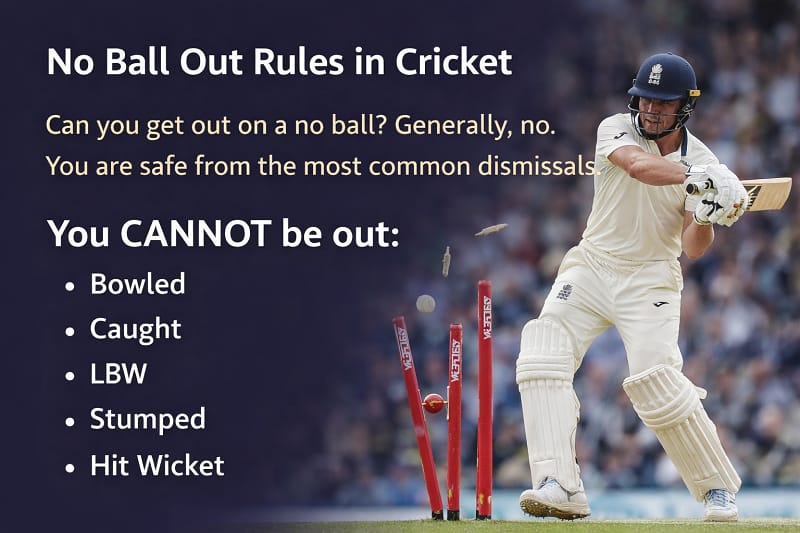
No Ball Out Rules in Cricket
Can you get out on a no ball? Generally, no. You are safe from the most common dismissals.
You CANNOT be out:
- Bowled
- Caught
- LBW
- Stumped
- Hit Wicket
You CAN be out:
- Run Out: If you attempt a run and fall short.
- Handled the Ball: Intentionally touching the ball with your hand (rare).
- Obstructing the Field: Willfully blocking a fielder.
- Hit the Ball Twice: Hitting the ball a second time to prevent it hitting stumps (rare).
Variations in No Ball Rules Across Formats
The rules tweak slightly depending on whether you are watching a fast-paced T20 or a traditional Test match.
| Rule / Feature | T20 Cricket | ODI Cricket | Test Cricket |
|---|---|---|---|
| Free Hit for No Ball | Yes – free hit is awarded for all types of no balls | Yes – free hit is awarded for all types of no balls | ❌ No free hit in Test cricket |
| Maximum Bouncers per Over | 1 bouncer allowed per over | 2 bouncers allowed per over (as per modern playing conditions) | 2 bouncers allowed per over |
| Over-rate / Timing Penalty Impact | Yes – slow over-rate penalties can restrict fielding positions | Yes – slow over-rate penalties can restrict fielding positions | No fielding restriction linked to over-rate during play |
| Main Penalty for a No Ball | 1 run + extra delivery + free hit | 1 run + extra delivery + free hit | 1 run + extra delivery only |
| Overall Nature of No-Ball Rules | Stricter and designed for fast-paced matches | Balanced for limited-overs format | Traditional rules with minimum penalties |
Who Can Call a No Ball?
- The Bowler’s End Umpire: Calls front foot no balls (though now often checked by technology), back foot no balls, and wicket-breaking.
- The Square Leg Umpire: Judges height (beamers and bouncers) and looks for stumpings.
- The TV Umpire (Third Umpire): In professional matches, technology automatically monitors the front line. If the bowler oversteps, the TV umpire buzzes the on-field umpire to signal the no ball.
Recent Changes in No Ball Rules
The biggest change in recent years is the automation of the front foot no ball. Previously, the on-field umpire had to watch the line and the batter simultaneously. This led to many missed calls.
Now, in major tournaments, a dedicated camera monitors the line. The TV umpire watches every single delivery. If the foot crosses the line, they alert the on-field umpire via a buzzer or earpiece immediately. This has made the game much fairer.
Why Are No Ball Rules Important?
Without these rules, the game would be chaotic and dangerous.
- Safety: Prevents bowlers from aiming at heads or bowling from too close.
- Fairness: Ensures the pitch remains a standard 22 yards.
- Balance: Prevents fielding captains from setting impossible defensive fields (like the Bodyline era).
How Parents Can Help Kids Understand No Ball Rules
If you are teaching a young cricketer, keep it simple:
- The “Line is Lava” Game: Tell them their shoe cannot touch the “lava” (the popping crease) when they bowl.
- Safety First: Explain why we don’t bowl full tosses at people’s heads.
- Positivity: If they bowl a no ball, remind them it’s okay! Even the best pros do it. Just step back a few inches next time.
Looking for gear for your child? Read our guide on junior cricket equipment.
Conclusion: Why No Ball Rules Matter in Cricket
No ball rules in cricket might seem complicated with all the different variations, but they exist to keep the contest between bat and ball fair. For a bowler, discipline behind the line is a critical skill. For a batter, recognizing a no ball is a chance to score big.
The next time you hear the siren or see the umpire’s arm stretched out, you’ll know exactly what went wrong and what exciting moment is about to follow. For more such simple, in-depth explanations of cricket rules, sports updates, and educational guides, keep exploring Insight Study Hub at 👉 https://insightstudyhub.com.






Post Comment