Skills
best skills for students in India, career skills for freshers, digital skills for students, digital skills for students 2026, education and skills India, future career skills 2026, future careers India, future skills 2026, future skills for students in 2026, future skills in India 2026, high demand skills in India 2026, in demand skills India, in-demand skills for students 2026, skills for jobs 2026, skills for jobs in 2026 India, skills students should learn in 2026, student career guide India, student skill roadmap, top future skills for students
Insight Study Hub
0 Comments
Future Skills for Students in 2026: India Guide (Top In-Demand Skills & Roadmap)

Education in India is no longer only about collecting degrees and moving on. In 2026, learning is becoming a direct pathway to employment, entrepreneurship, and continuous growth. That’s why future skills for students in 2026 isn’t just an inspiring phrase—it’s a practical checklist for staying relevant in a fast-changing job market.
This guide breaks down what’s changing, what skills students should learn in 2026, and how to build them with a clear 30-day and 90-day roadmap. The goal is simple: help you become confident, job-ready and future-proof—without feeling overwhelmed.
Why Future Skills for Students Are Changing Education in India in 2026
The changing purpose of education (jobs + outcomes)
Think of education like a driving license. Earlier, just having the license was enough. Now the road is crowded, vehicles are smarter, and rules keep updating—so you need real driving skills, not just the certificate. In 2026, education is shifting from “finish syllabus” to “prove you can do the work.”
What’s changing:
- Employers want job-ready proof: projects, communication skills, and basic tech comfort.
- Students want clarity: “Which skills will actually help me get opportunities?”
- Careers are becoming flexible: one degree can lead to multiple roles, and upskilling is normal.
Online & hybrid degrees: from alternative to mainstream
Online and hybrid learning isn’t a “second option” anymore. It’s becoming the normal way students learn—especially for skills like data, marketing, design, cloud, and communication.
Hybrid models solve a real problem: you can learn from strong mentors regardless of your city, while still getting campus exposure and peer learning. Even if you’re in a full-time program, your skill-building will likely be a mix of campus + online.
EdTech platforms as core learning infrastructure
EdTech has moved from “extra coaching” to “core learning support.” Students use platforms for:
- Concept clarity (micro-lessons)
- Skill tracks (job-focused learning paths)
- Practice (quizzes, labs, mock interviews)
- Portfolio building (projects + feedback)
Smart students treat EdTech like a gym membership: consistency builds strength.
Gamification + engagement-driven learning
Modern learning is becoming more game-like:
- Levels = skill milestones
- Quests = projects
- XP = consistent practice hours
- Leaderboards = peer motivation
Gamification works because it makes learning feel achievable. Instead of “learn AI,” you do “finish 5 mini tasks and build 1 mini project.”
Vocational & skill-based education takes center stage
Vocational education is gaining respect because it improves employability. Skill-based learning is no longer “only for non-academic students.” Even engineering and commerce students need practical skills—tools, teamwork, communication, and industry exposure.
Role of policy & the new education framework (NEP, skilling push)
Policy direction is encouraging:
- Multidisciplinary learning (mix tech + business + humanities)
- Skill credits / internships / practical exposure
- Stronger links between education and employability
For students, the message is simple: learning is becoming more flexible, and skills matter as much as marks.
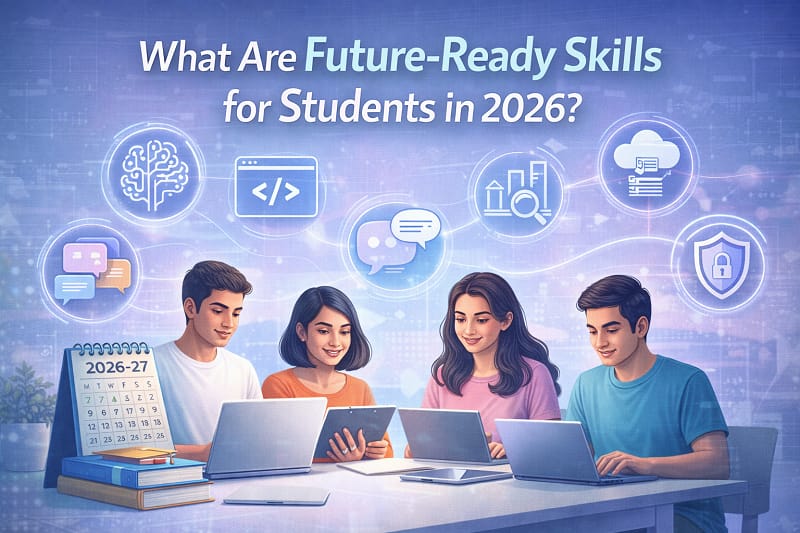
What Are Future-Ready Skills for Students in 2026?
Simple definition (skills that stay valuable as tech + jobs change)
Future-ready skills are abilities that help you stay useful even when tools, job roles, and industries evolve. They include:
- Tech skills (what you can do with tools)
- Human skills (how you think and work with people)
- Career skills (how you present and prove your value)
Analogy: If your career is a smartphone, future-ready skills are the OS updates that keep it running smoothly.
Future-ready skills in business (how companies use them)
Companies use future-ready skills to:
- Automate repetitive work (so humans focus on better decisions)
- Improve speed and accuracy (data-driven thinking)
- Protect systems (cybersecurity hygiene)
- Run operations efficiently (cloud + DevOps basics)
- Grow revenue (digital marketing, eCommerce)
- Build strong teams (communication + collaboration)
That’s why these are in-demand skills for students 2026, not just “good to have.”
The Current Skill Landscape for Students in India (2026)
Employability gap: what students know vs what jobs demand
Many students graduate with degrees but lack job-ready proof. The gap often looks like this:
| What many students have | What employers also want |
|---|---|
| Theory knowledge | Practical application |
| Certificates | Projects + portfolio |
| Marks | Communication + teamwork |
| One-time learning | Continuous learning habit |
What recruiters look for in freshers (skills + proof)
Recruiters typically scan for:
- Basic digital confidence (tools, emails, docs, spreadsheets)
- Clear communication (speaking + writing)
- Evidence of learning (projects, internships, freelancing, competitions)
- Problem-solving attitude (how you approach tasks)
- Professional online presence (especially LinkedIn)
If you have skills but can’t show proof, it’s like having a great product with no packaging—people won’t trust it.
Also read: Top Courses After 12th
Must-Have Future Skills for Students in 2026 (India)
Below are the top future skills for students that matter across streams. You don’t need to master everything. You need the right combination: a foundation, one strong skill track, and proof.

A) Digital & Tech Foundation (Non-Negotiable)
Digital & tech literacy (tools, internet, productivity, basic coding)
This is the baseline. Without it, everything feels harder: assignments, internships, interviews, even basic office work.
What it includes:
- Google Workspace / Microsoft Office basics (Docs/Sheets/Slides)
- Internet research skills (finding reliable info fast)
- File management (folders, naming, sharing, PDFs)
- Basic logic/coding understanding (even if you’re non-tech)
Beginner-friendly habit: create a structured folder system and practice 20 minutes of spreadsheet work daily. This alone improves your confidence massively.
Communication & collaboration (docs, email, meetings, remote work)
Communication is a “money skill.” Students who can explain clearly get better internships and faster growth.
Must-have abilities:
- Writing professional emails
- Summarizing work in simple language
- Presenting ideas confidently
- Working in teams using online tools
Quick practice: after learning any topic, explain it in 60 seconds like you’re teaching a junior.
B) High-Demand Tech Skills (Career Boosters)
Data analysis & quantitative skills (Excel/Sheets, SQL, dashboards)
Data is one of the biggest high demand skills in India 2026 because every function uses it—marketing, HR, finance, operations, product.
Learn:
- Spreadsheets (pivot tables, charts, lookups)
- Basic SQL (select, filter, group by)
- Dashboards (simple KPIs)
Real-world example: build a dashboard tracking your monthly study hours, mock test scores, and weak topics. That’s real analysis, not theory.
AI & machine learning awareness (how AI works + where it’s used)
You don’t need to become an AI engineer to benefit. But you must understand:
- What AI does well (summaries, drafts, pattern recognition)
- What AI can’t do safely (blind trust, sensitive decisions)
- How AI fits into your field (marketing, coding, design, finance)
Think of AI like a super-fast intern: helpful, but you must check the work.
Prompt engineering (using AI tools effectively + safely)
Prompting is basically “asking better questions.” Students who learn this save time and produce higher-quality work.
Good prompting includes:
- Clear role (“Act as a placement mentor…”)
- Clear output format (“Give a table + checklist…”)
- Constraints (“In simple English, no jargon…”)
- Examples (show what “good” looks like)
Practical task: Use AI to create a study plan, then refine it with your real constraints (college hours, weak subjects, deadlines).
Cybersecurity basics & data protection (safe habits + fundamentals)
Cybersecurity is not only for IT teams. Basic cyber hygiene is essential for every student:
- Spot phishing messages
- Use password managers
- Enable 2-factor authentication
- Understand privacy risks
Real-world example: Internship applications often involve documents and personal info. Cyber basics protect your identity and career.
Cloud computing & DevOps basics (cloud concepts, deployment, CI/CD)
Cloud is how modern apps and businesses run. Even if you’re not a developer, cloud basics make you smarter in tech conversations.
Learn:
- What cloud services are (storage, servers, databases)
- Basics of deployment
- DevOps concepts: version control, CI/CD, monitoring
Beginner mindset: don’t memorize terms—understand the “why.” Cloud helps teams build, deploy, and scale faster.
Web development (front-end basics, APIs, projects)
Web development remains a powerful skill for skills for jobs in 2026 India:
- For tech students: strong foundations
- For non-tech students: real projects + freelancing options
Start small:
- One landing page
- One form + database concept
- One API integration
Project idea: a portfolio website + an “internship tracker” web app.
UI/UX design (user research, wireframes, usability, portfolios)
UI/UX keeps growing because products compete on experience. UI is how it looks; UX is how it feels and works.
Build:
- Wireframes
- A redesign case study (fix a confusing app screen)
- A portfolio of 2–3 case studies
C) Business, Growth & Internet Skills (Money Skills)
Digital marketing & SEO
If you can help a business get attention and customers, you become valuable quickly. Digital marketing is one of the most practical future career skills 2026 because startups and SMEs always need growth.
Core areas:
- SEO basics (search intent, content, on-page SEO)
- Social media content systems
- Ads fundamentals (targeting, creatives)
- Analytics (what worked, what didn’t)
Mini project: pick a local business and create a 1-page SEO plan + 10 content ideas + a simple keyword list.
eCommerce & online business basics (marketplaces, D2C, funnels)
eCommerce is not only “selling online.” It includes operations, customer experience, pricing, logistics, and content.
Learn:
- Product listing and copywriting
- Customer journey (click → trust → purchase)
- Funnel basics (awareness → consideration → conversion)
D) Human Skills That AI Can’t Replace (Differentiators)
Critical thinking & problem solving
Recruiters love this because it’s rare. Show it by:
- Asking better questions
- Breaking big problems into steps
- Explaining your logic clearly
Creativity & innovation
Creativity is not only art. It’s improving how things work—like turning boring notes into a visual cheat-sheet or building a simple tracker to manage tasks.
Adaptability & continuous learning mindset
Tools will change. Your degree won’t update every semester. Your mindset must.
Simple rule: don’t chase “courses.” Chase “outcomes.” Learn → build → show.
Emotional intelligence (EQ) & teamwork
Teams hire people who are:
- Easy to work with
- Good listeners
- Calm under pressure
- Respectful in disagreements
EQ is a career multiplier.
E) Career Skills (Getting Hired Faster)
Career planning & self-awareness (strengths, role-fit)
Many students feel stuck because they choose careers based on trends, not fit. Career planning means:
- Knowing what you enjoy
- Understanding your strengths
- Testing roles through mini projects
Personal branding (LinkedIn & online presence)
In 2026, your online presence is your first impression.
Branding basics:
- Clear headline (what you’re learning + what you can do)
- 2–3 projects with links
- A short “About” section in simple English
- Consistent activity (1 helpful post/week)
Financial literacy (salary, taxes, savings, basics)
Financial literacy helps you avoid mistakes early:
- Budgeting
- Understanding salary structure
- Basics of taxes
- Saving and investing fundamentals
Practical experience & skill proof (internships, freelancing, projects)
Proof beats potential. Aim for:
- One internship, OR
- One freelance project, OR
- 2–3 solid personal projects
For tech portfolios, GitHub is a great proof platform. For design portfolios, Behance works well.
What Problems Do Future Skills for Students Solve in 2026?
Automation & AI disruption
Automation reduces repetitive tasks. Future-ready students move toward higher-value work: analysis, creativity, decisions, and communication.
Skill mismatch + low interview conversion
Many students fail interviews not because they’re weak, but because they can’t show:
- What they can do
- How they think
- What they built
Remote/hybrid work readiness
Remote work needs self-management, clear communication, and online collaboration.
Faster career switches + multiple income options
Future skills create flexibility: freelancing, internships across domains, side projects, and switching roles without restarting from zero.
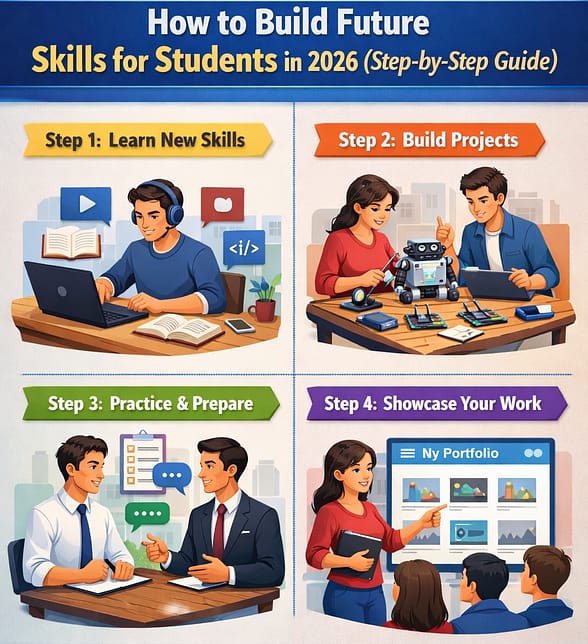
How to Build Future Skills for Students in 2026 (Step-by-Step Guide)
1) Educational reforms (curriculum + outcome-based learning)
If your college curriculum updates slowly, don’t wait. Do outcome-based learning yourself:
- Pick a skill
- Build a project
- Get feedback
- Improve it
2) Government-led initiatives (skills programs + certifications)
Firstly, use free or low-cost learning programs strategically. However, remember that certificates help only when they are paired with practical projects.
3) Technical training programs (bootcamps, short courses, labs)
Bootcamps work best when you:
- Choose one outcome (job role)
- Build 2–3 portfolio projects
- Practice interviews weekly
4) Corporate reskilling programs (job-ready tracks)
Similarly, corporate training programs and skill challenges are highly useful. More importantly, they closely reflect real industry expectations and workplace standards.
5) Industry–academia partnerships (internships + live projects)
Ideally, if your college offers industry-linked projects, you should take them seriously. Otherwise, create your own opportunities by collaborating with startups, local businesses, or freelance clients.
- Help a local shop with social media + a business profile
- Build a simple website for a family business
- Create a dashboard for a student club
Student Roadmap (30-Day + 90-Day Plan)
30-Day Plan (Foundation + One Mini Project)
Goal: become confident with basics and ship one mini project.
| Week | Focus | What you do (simple tasks) | Output by end of week |
|---|---|---|---|
| Week 1 | Digital tools + communication basics | Organize files/folders, learn Docs/Sheets/Slides basics, write 3 professional emails, practice 1 short presentation (60–90 sec) | Clean folder system + sample email set + short intro script |
| Week 2 | Choose one skill track | Pick ONE track (data/web/marketing/design), learn daily (45–60 min), take notes, do practice tasks | Track selected + notes + practice outputs |
| Week 3 | Build a mini project | Create a small project end-to-end, keep it simple, capture screenshots | Mini project v1 + screenshots |
| Week 4 | Improve + case study + post | Clean it up, fix errors, write a 1-page case study, publish online | Final mini project + case study + shareable link |
Mini Project Examples (Choose One)
| Track | Mini project idea | What it includes | Tool examples |
|---|---|---|---|
| Data | Expense tracker dashboard | Categories, charts, monthly summary KPIs | Sheets/Excel |
| Marketing | SEO audit + content plan | Audit checklist, keywords, 10 blog topics | Search + free SEO tools |
| Web | Portfolio landing page | One-page responsive site with projects + contact | HTML/CSS (+ basic JS) |
| UI/UX | Redesign case study | Wireframe + final UI + explanation of improvements | Figma |
90-Day Plan (Portfolio + Internship/Freelance Proof)
Goal: become interview-ready.
| Timeline | Main goal | What you must build | Deliverables by end |
|---|---|---|---|
| Day 1–30 | Strong foundation | 1 mini project + core basics | 1 published mini project + case study |
| Day 31–60 | Skill depth | Project #1 (bigger, polished) | 1 strong project with clear outcomes |
| Day 61–90 | Interview readiness | Project #2 + applications + practice | 2 strong projects + internship pack + mocks + clean profile |
Portfolio Checklist (Job-Ready Look)
| Category | Must-have | Notes / standard |
|---|---|---|
| Projects | 2–3 projects | Link + short explanation (problem → solution → result) |
| Resume | 1 page | Add measurable outcomes where possible |
| Niche direction | 1 clear direction | Example: “Data for marketing” vs “I do everything” |
| Online profile | Updated + projects featured | Make it easy to verify your work |
| Proof platform | GitHub (tech) / Behance (design) | Clean structure, pinned best projects |
| Skills + tools | Short and honest list | Only what you can actually use |
| References | 2 (if possible) | Mentor/teacher/client (with permission) |
Challenges in Future Skills for Students Development in India

Access, affordability, language barriers
Not everyone has equal access to devices, internet, or English-first courses. What helps:
- Low-data learning formats (notes + offline videos)
- Learn in your preferred language first, then write short English summaries
- Focus on “skills that pay back quickly” (spreadsheets, communication, digital marketing)
Quality issues (fake certificates, outdated courses)
Avoid traps:
- If a course has no projects, be careful.
- If it promises “job guaranteed” without effort, avoid.
- Always check: “What will I build by the end?”
Time management + exam pressure
A simple, realistic system:
- 45 minutes daily skill practice
- 2 hours weekend project work
- 15 minutes daily communication practice
Digital divide + device/internet constraints
If you only have a phone, start with:
-
Marketing, communication, basic data tracking, prompt skills
Build proof using simple tools (Sheets, basic design apps, notes + case studies). Upgrade later.
The Road Ahead: Education Beyond 2026
What will grow next (AI-first workflows, creator economy, micro-credentials)
What’s likely to grow:
- AI-assisted workflows in every field
- Short, job-focused credentials
- Learning from practitioners (creator-led learning)
- Portfolios becoming more important than grades in many roles
How students can stay future-proof (learn–build–show loop)
If you remember only one strategy, remember this:
Learn → Build → Show → Repeat
- Learn a concept
- Build a small output
- Show it publicly (portfolio, post, case study)
- Improve based on feedback
This loop turns “learning” into employability.
FAQs on Future Skills for Students in 2026
What are the best skills for students in India in 2026?
Digital literacy, data skills, communication, AI awareness and problem-solving.
Which skill gets a job fastest for freshers?
Data tools, digital marketing and web development usually offer quicker entry roles.
How do I build a portfolio without experience?
Create self-projects, contribute to open platforms, volunteer or work on internship assignments.
What is better: degree, certifications or projects?
A strong combination of all three works best.
How much time daily is enough to learn a new skill?
Even 60 to 90 minutes daily can produce meaningful progress within three months.
Conclusion: Building a Future-Ready Career Starts Today
Future skills for students in 2026 are no longer optional. Instead, they have become the foundation of sustainable careers in India. In fact, when you combine digital confidence, one strong in-demand skill, relevant human skills, and real proof through projects and a portfolio, you become employable even as industries continue to evolve.
To begin with, start small. Then, build consistently over time and, at the same time, showcase your learning clearly. Most importantly, if you keep following the Learn → Build → Show loop, you will gradually move from “confused” to “confident.” As a result, you will be surprised by how quickly your career direction becomes clear.
To explore more student-friendly career guidance, exam updates, and skill roadmaps, visit Insightstudyhub.com






Post Comment