Cricket Explained
average run rate, cricket, cricket basics, cricket match interruption, cricket methods, cricket rules, cricket scoring, cricket scoring system, cricket strategy, cricket target calculation, dls explained, dls in ipl, dls method, duckworth-lewis method, rain affected matches, rain delay in cricket, revised target in cricket, sports education
Insight Study Hub
0 Comments
Duckworth-Lewis Method Explained – DLS Method in Cricket
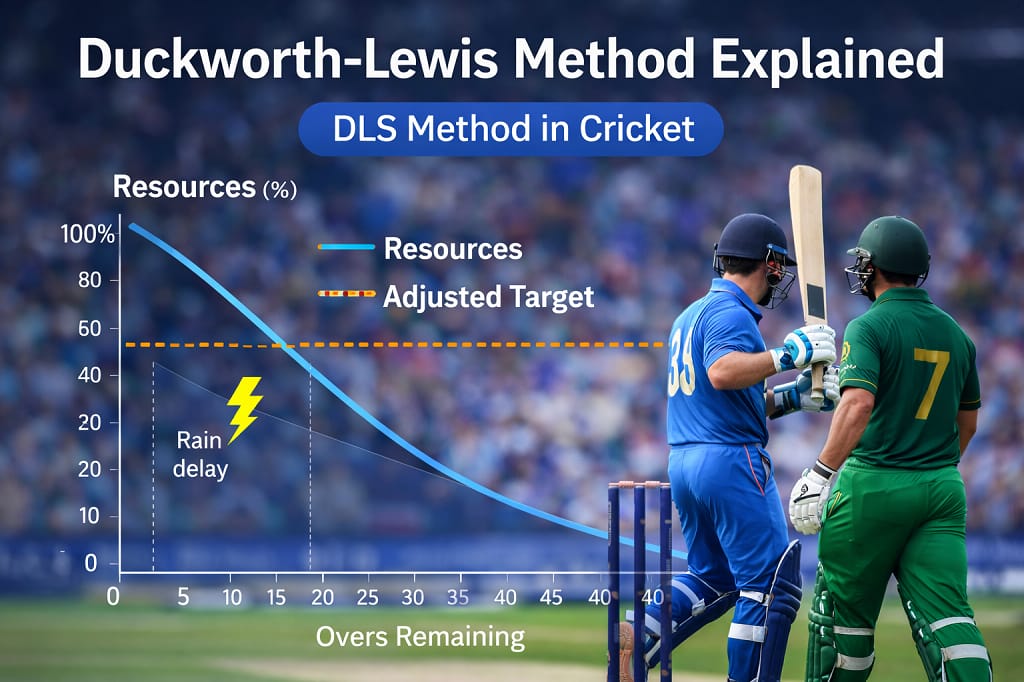
If you’ve ever watched a rain-affected cricket match and wondered why the target suddenly changes, you’re not alone. The Duckworth-Lewis Method, also known as the DLS method in cricket, explains exactly why that happens.
In simple terms, the Duckworth-Lewis Method offers a fair way to set revised targets when rain or other interruptions cause teams to lose overs. Rather than relying on guesses or basic averages, it uses a data-driven system that considers how many overs and wickets a team still has.
This guide breaks down the DLS method step-by-step, using real-world logic, easy examples, and clear tables—so even beginners can grasp it with confidence.
What is the Duckworth-Lewis Method?
The Duckworth-Lewis Method, now known as the Duckworth-Lewis-Stern (DLS) Method, is a mathematical system used in limited-overs cricket to fairly adjust targets when a match is interrupted, usually by rain.
In simple words:
DLS tries to answer one question:
“What should the chasing team realistically need to score, given fewer overs and possibly fewer wickets remaining?”
It is mainly used in:
-
One Day Internationals (ODIs)
-
T20 matches
-
Major leagues such as the Indian Premier League
The Origin and Need for the DLS Method
Before the DLS method, cricket used rough methods to revise targets, which often led to unfair results.
Two statisticians initially developed the method, and Steven Stern later improved it. This is why it now carries the official name, the Duckworth-Lewis-Stern method.
Today, the International Cricket Council, the sport’s global governing body, maintains and endorses the system.
How the Duckworth-Lewis Method Works
The DLS method works by calculating the resources a team has at any point in the match. This resource is based on two factors:
-
Overs remaining: How many overs are left in the innings after the rain interruption.
-
Wickets in hand: The number of batsmen still available to face the remaining overs.
The more overs remaining or the more wickets a team has, the greater their resources. The DLS method uses tables to determine the percentage of remaining resources based on these two factors. The final target for the second team adjusts according to this percentage, ensuring the chase remains fair.
Why is the Duckworth-Lewis Method Needed?
The Rain-Interrupted Dilemma in Cricket
Cricket is often played under clear skies, but the weather can sometimes disrupt the game. Whether it’s a sudden downpour or an unexpected delay, these interruptions leave players, officials, and fans in a state of uncertainty. In such cases, the DLS method becomes essential in determining a new, fair target score.
Why Older Methods Were Discarded
Before the DLS method, two common methods were used to calculate revised targets:
-
The Average Run Rate (ARR) Method: This method calculated the average run rate per over in the first innings and applied it to the number of overs in the second innings. It didn’t account for wickets lost, which could lead to unfair results if one team lost several wickets early on.
-
The Most Productive Overs (MPO) Method: This method aimed to adjust the target based on the most productive overs, but it was still inaccurate in many cases and led to disputes.
The DLS method was introduced because it considers both the number of overs and wickets, providing a more accurate and fair way to calculate revised targets.
How the DLS Method Works (Step-by-Step)
The DLS method is based on a simple principle: the fewer overs a team has, and the more wickets they lose, the fewer resources they have to chase down a target. Here’s how the DLS method works in simple steps:
Par Score vs. Target Score
There are two important numbers in a DLS-affected match:
| Term | Meaning |
|---|---|
| Par Score | The score the chasing team should have at a specific moment to be exactly level |
| Revised Target | The final number the chasing team must reach to win |
Think of it like this:
-
Par score = “Where should we be right now?”
-
Target score = “What do we need to win?”
How Team Resources Are Calculated
DLS uses pre-calculated resource tables.
Resources depend on:
-
overs remaining
-
wickets remaining
A simplified idea:
| Overs left | Wickets in hand | Resource value (example) |
|---|---|---|
| 30 | 10 | High |
| 30 | 4 | Medium |
| 10 | 10 | Medium |
| 10 | 2 | Very low |
The more overs and wickets you have, the more scoring potential you still possess.
Real-World Examples: Calculating Team Resources
Let’s use a realistic scenario.
-
Team A scores: 250 in 50 overs
-
Team B starts chasing
-
After 25 overs: Team B is 130/2
-
Rain reduces the match to 35 overs
Now Team B loses:
-
15 overs
But they still have:
-
8 wickets remaining
DLS compares:
-
the full resources Team A had
-
the reduced resources Team B now has
Based on this ratio, the system calculates a fair revised target.
You don’t manually calculate this in real matches—the official scorer uses DLS software—but understanding the logic helps you follow the game.
Common Misunderstandings About the DLS Method
Wickets Lost After an Interruption
One of the most common misconceptions is that the wickets lost after the interruption don’t matter. In reality, the DLS method adjusts the target based on the number of wickets lost. If a team loses wickets early in the second innings, the DLS method recalculates the target accordingly.
Why Targets Change After the Interruption
Another common confusion is that targets sometimes reduce, even if both teams have the same number of overs left. This happens because the resources available to the chasing team can vary based on the number of wickets in hand.
DLS in Action: Examples and Applications
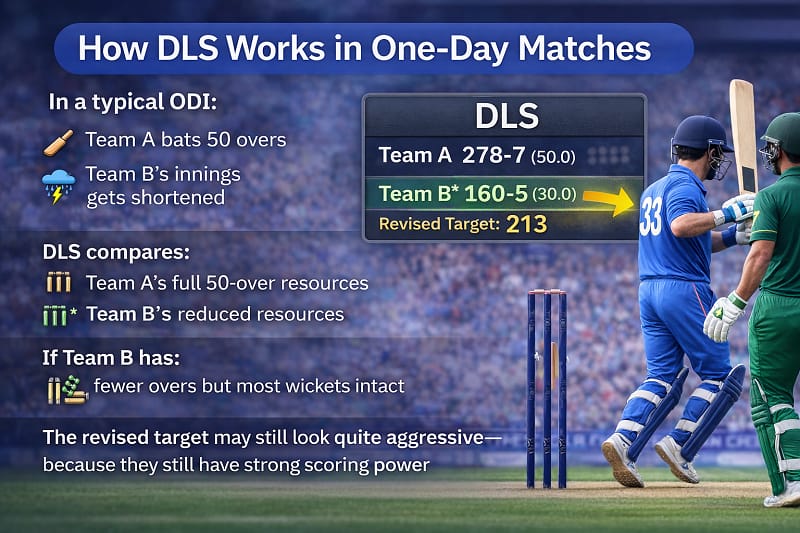
How DLS Works in One-Day Matches
In a typical ODI:
-
Team A bats 50 overs
-
Team B’s innings gets shortened
DLS compares:
-
Team A’s full 50-over resources
-
Team B’s reduced resources
If Team B has:
-
fewer overs but most wickets intact
The revised target may still look quite aggressive—because they still have strong scoring power.
DLS in the IPL
The DLS method is frequently used in the Indian Premier League.
In T20 cricket, things become even more sensitive because:
-
every over carries much higher scoring value
-
losing just 2 or 3 overs can drastically change match dynamics
That’s why you often see dramatic target revisions and par scores displayed ball-by-ball during rain-affected IPL matches.
FAQs on the Duckworth-Lewis Method
What is the full form of DLS?
DLS stands for Duckworth-Lewis-Stern, named after its creators, Frank Duckworth, Tony Lewis, and Steven Stern.
What is the Difference Between Par Score and Revised Target?
| Par Score | Revised Target |
|---|---|
| Used during live play | Used to decide the match result |
| Shows whether a team is ahead or behind | Shows how many runs are needed to win |
| Changes ball-by-ball | Fixed once play resumes |
When is the DLS Method Used in Cricket?
The DLS method is used when:
-
an interruption causes overs to be reduced
-
both teams do not get the same playing conditions
It is mainly applied in:
-
ODIs
-
T20 internationals
-
domestic leagues and tournaments governed by the International Cricket Council
Conclusion
The Duckworth-Lewis Method is not a random adjustment or a mysterious formula designed to confuse fans.
At its heart, the DLS Method in cricket is built on one fair principle:
How much real scoring power does each team actually have?
By considering both:
-
overs remaining
-
wickets remaining
DLS creates a more balanced and realistic outcome than any older system ever managed.
The next time rain interrupts a match and the revised target flashes on your screen, you’ll know exactly what’s happening behind the scenes—and why that number makes sense.






Post Comment