Cricket Formats
ODI Cricket
T20 Cricket
Test Cricket
2026 cricket guide, beginners guide, cricket comparison, cricket fans, cricket format rules, cricket formats, cricket formats explained, cricket rules, cricket rules test odi t20, cricket strategy, difference between odi t20 and test cricket, how many overs in odi, how many overs in t20, ODI cricket, odi match duration, odi vs t20 difference, T20 cricket, t20 cricket vs odi, t20 match duration, test cricket, test cricket vs odi, test match duration, test odi t20 comparison, test vs odi vs t20, what is odi cricket, what is t20 cricket, what is test cricket, which cricket format is best
Insight Study Hub
1 Comments
Difference Between ODI T20 and Test Cricket (2026 Guide)
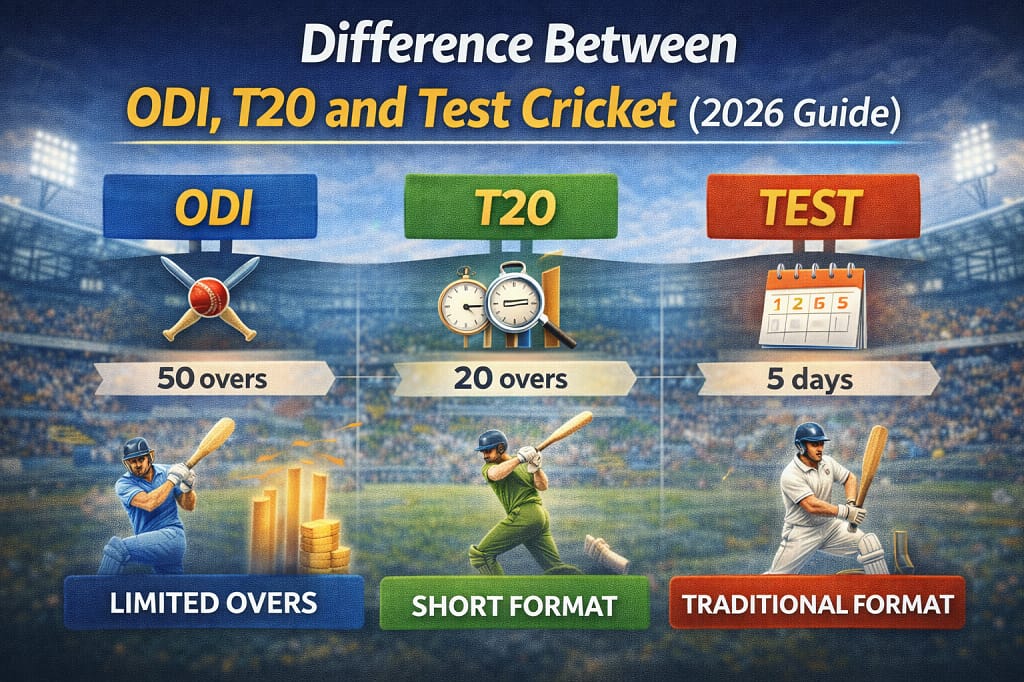
Cricket isn’t just one game—it’s three major games living under the same ruleset, each demanding a different mindset. If you’ve ever wondered about the difference between ODI T20 and Test cricket, think of it like driving the same car on three tracks: a long endurance highway (Tests), a balanced race route (ODIs), and a short, high-speed sprint circuit. The basics stay familiar, but the way you play, plan, and perform changes completely.
Understanding the difference between ODI T20 and Test cricket helps explain why strategies, player roles, and match intensity vary so much across formats. Below is a clear, expert breakdown of how each format works, what rules matter most, and why the approaches feel so different—whether you’re a beginner trying to understand cricket or a fan looking for sharper match insight.
Introduction: Key Differences Between ODI T20 and Test Cricket
This guide explains the key differences between ODI T20 and Test Cricket for beginners and fans.
Cricket is played internationally in three main formats:
- Test cricket (up to 5 days): the traditional format, built on patience, technique, and long-term strategy.
- ODI cricket (50 overs per side): a balanced format that rewards both planning and controlled aggression.
- T20 cricket (20 overs per side): cricket’s shortest mainstream format, built for pace, entertainment, and fast decisions.
All three formats share the same core goal—score more runs than the opponent—but the time limit reshapes everything: shot selection, bowling plans, field settings, fitness, and even how captains think.
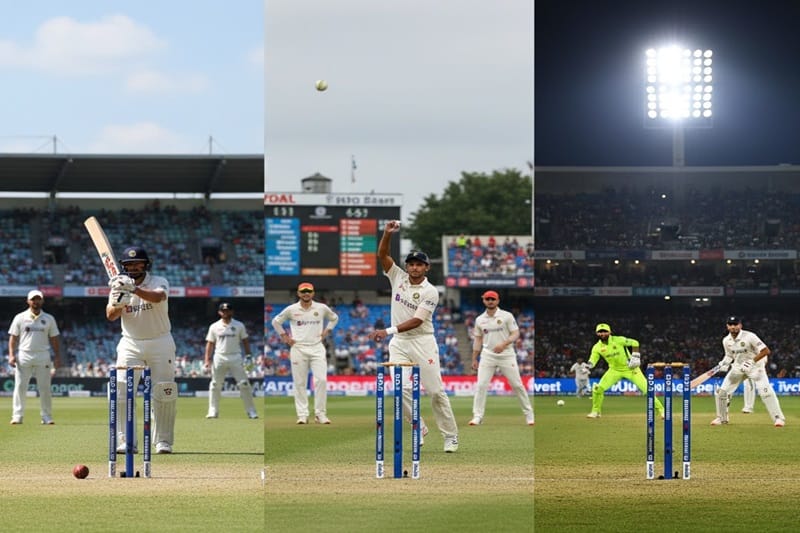
What Is Test Cricket?
Test cricket is the original and most demanding format. It’s where cricket feels like chess—except every “move” is happening at 130–150 km/h with swing, seam, and pressure.
Match Duration & Structure (innings, sessions, overs)
- Played over up to 5 days
- Each team can bat twice (two innings), depending on match flow
- A day is usually split into three sessions with breaks
- There’s no fixed overs limit—time is the limit
A key twist: a Test match can end in a win, loss, draw, or tie (ties are extremely rare). A draw happens when time runs out before a result—this is why time management and declarations matter.
Key Features of Test Cricket
- Red ball, usually white clothing
- Greater impact of pitch wear (cracks, rough patches, variable bounce)
- Bowlers can set up batters over long spells—outswing for 30 balls, then the inswinger
- Batters can play long innings and grind down attacks
Strategy & Skills Needed (patience, technique, endurance)
In Tests, survival is skill. A good Test batter knows when to leave the ball as much as when to hit it. Bowlers win by building pressure, not just taking wickets quickly.
Practical example:
In T20, a batter might attack a good-length ball to keep the run rate high. In Tests, that same shot could be a mistake—because there’s no run-rate panic, and the bowler is trying to tempt you into error across hours, not minutes.

What Is ODI Cricket?
ODI cricket (One Day Internationals) was designed to deliver a full match in one day—long enough for a story, short enough for a clear result.
Match Duration & Structure (50 overs, innings, powerplays)
- 50 overs per side
- Each team bats once
- Typically lasts 7–8 hours including breaks
- Uses a white ball and colored clothing
- Features powerplays (field restrictions that influence scoring and tactics)
ODIs are often described as the “best balance” format—because you need both the discipline of Tests and the acceleration of T20.
Key Features of ODI Cricket
-
Innings has phases:
-
Start (powerplay): field in, chance for boundaries
-
Middle overs: rotation + selective risk
-
Death overs: all-out acceleration
-
Bowlers must manage limited overs per bowler
Captains plan for matchups and contain runs, especially in the middle overs
Strategy & Skills Needed (balance of attack + control)
ODIs reward teams that can shift gears smoothly. You’ll see batters who can anchor at 80–100 strike rate early, then finish at 130–160 later.
Practical tip for beginners watching ODIs:
Don’t judge an innings only by boundaries. In ODIs, strike rotation (singles and twos) is often what keeps a chase on track while saving big shots for the end.
What Is T20 Cricket?
T20 is cricket’s fastest mainstream format and the most explosive. It’s less like chess and more like speed chess—same rules, much less time to think.
Match Duration & Structure (20 overs, powerplays)
- 20 overs per side
- One innings per team
- Usually 3 hours total
- White ball, colored kits, often played at night under lights
- Powerplays exist and are critical early on
Every over matters. One bad over can swing the match dramatically.
Key Features of T20 Cricket
- High scoring rates and aggressive intent
- Specialized roles: powerplay hitters, middle-overs anchors, finishers, death bowlers
- Heavy use of data and matchups in modern teams
- Fielding athleticism becomes a major advantage because saving 10 runs is like scoring 10
Strategy & Skills Needed (explosive intent, adaptability)
T20 success comes from smart aggression. The best batters aren’t just strong—they pick the right bowler, boundary size, and field position.
Simple analogy:
In Tests, you’re building a house brick-by-brick.
In ODIs, you’re building a house with a deadline.
In T20, you’re building a house in a storm—fast, messy, and you adapt every minute.
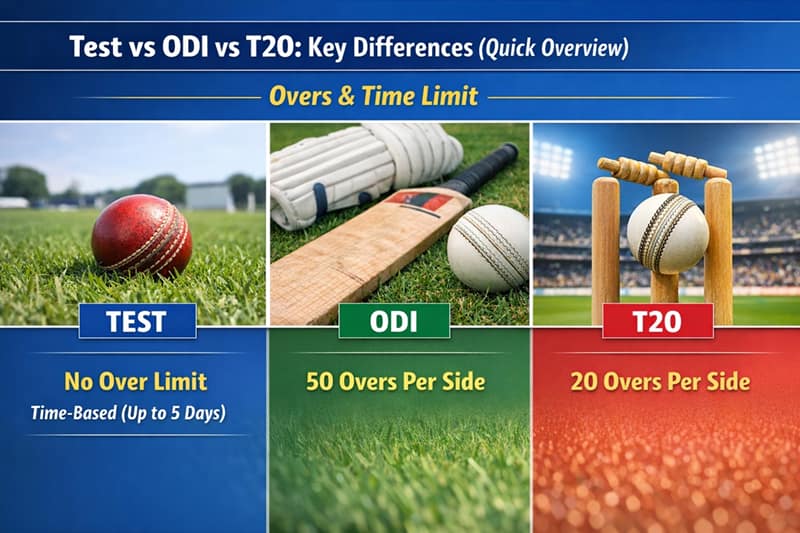
ODI T20 and Test Cricket – Quick Overview
Overs & Time Limit
- Test: no over limit; time-based (up to 5 days)
- ODI: 50 overs per side
- T20: 20 overs per side
Time limit changes risk. Shorter formats force more aggression; longer formats reward patience and planning.
Playing Approach (pace, risk, scoring patterns)
- Test: low risk early, pressure-building, long partnerships
- ODI: controlled risk, phase-based acceleration
- T20: higher risk, constant scoring pressure, boundary-heavy
Pitch/Conditions Impact
- Test: pitch deterioration matters massively; day 4–5 is a different game
- ODI: pitch matters, but the match is too short for major deterioration
- T20: pitch matters, but teams often focus more on matchups and execution
Player Roles & Team Balance
- Test: specialist batters, specialist bowlers, endurance-based roles
- ODI: all-rounders become extra valuable; balance is key
- T20: specialists for specific phases (death overs, powerplay hitting) can win tournaments
Comparison Table: Difference Between ODI T20 and Test Cricket
| Feature | Test Cricket | ODI Cricket | T20 Cricket |
|---|---|---|---|
| Match Length | Up to 5 days | ~7–8 hours | ~3 hours |
| Overs per Side | Unlimited (time-limited) | 50 | 20 |
| Innings per Team | Up to 2 | 1 | 1 |
| Ball / Clothing | Red ball / Whites | White ball / Colors | White ball / Colors |
| Result Types | Win/Loss/Draw/Tie | Win/Loss/Tie/No Result | Win/Loss/Tie/No Result |
| Scoring Rate | Lowest | Medium | Highest |
| Key Skill Focus | Technique + endurance | Balance + pacing | Power + adaptability |
| Bowling Focus | Pressure + setups | Control + phases | Variations + execution |
| Captaincy | Long-term strategy | Phase management | Rapid decisions + matchups |

Rules Explained for ODI T20 and Test Cricket (Format-wise Highlights)
Cricket’s core rules stay the same, but each format has rules that change tactics and outcomes.
Test Cricket Rules (follow-on, draws, declarations, new ball)
- Draws are possible: time can run out before a result.
- Declarations: a captain can end their team’s innings early to give more time to bowl out the opponent.
- Follow-on: if Team B trails by a large margin after the first innings, Team A can ask them to bat again (rule thresholds vary by playing conditions).
- New ball: teams get access to a new ball after a set number of overs, affecting swing and pace.
Why it matters:
In Tests, captains manage time like a resource. Declaring at the right moment is like choosing when to stop “building runs” and start “buying wickets.”
ODI Rules (powerplays, DLS, field restrictions)
- Powerplays/field restrictions: limit how many fielders can be outside the circle at different stages.
- DLS method: used to revise targets in rain-affected matches.
- Over limits per bowler: bowlers can only bowl a fixed number of overs, shaping resource management.
Why it matters:
ODIs are about building an innings with structure—start, stabilize, launch.
T20 Rules (timeouts if applicable, impact sub leagues, over-rate pressure)
- Powerplay is short and intense—often the most decisive phase.
- Some leagues include specific rules (like strategic timeouts or impact substitutions), but international T20s follow standard playing conditions.
- Over-rate penalties and strict time management can affect strategy.
Why it matters:
In T20, you don’t have time to “wait for a bad ball.” You often attack good balls safely—using ramps, scoops, sweeps, and boundary targeting.
Strategic Differences Across Formats
Batting Techniques (building vs pacing vs hitting)
- Test: leave well, defend solidly, punish loose balls, build innings
- ODI: rotate strike, keep wickets, accelerate by phases
- T20: boundary options, intent from ball one, smart risk
Practical tip:
If you’re learning batting, start with Test-style basics (balance, defense, shot selection). Those fundamentals make ODI and T20 hitting far more consistent.
Bowling Tactics (spell management, variations, death overs)
- Test: lengths, patience, swing/seam plans, setting traps
- ODI: middle-over control, cutters, hard lengths, wicket-taking without leaking runs
- T20: variations (slower balls, yorkers), tight matchups, execution under pressure
A simple way to see the difference:
Test bowling is a story (setup).
ODI bowling is a plan (phases).
T20 bowling is a moment (execution).
Fielding & Captaincy (aggression, placements, matchups)
- Test: slip cordon, close catchers, long-term fields to build pressure
- ODI: balanced rings, saving singles, setting boundary riders at the end
- T20: hyper-aggressive matchups, boundary protection, constant adjustments
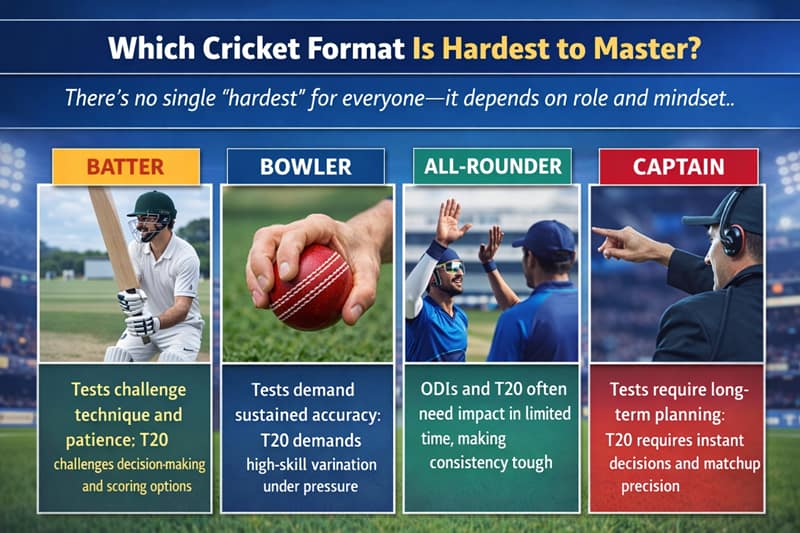
Which Cricket Format Is Hardest to Master?
There’s no single “hardest” for everyone—it depends on role and mindset.
Skill Difficulty by Role (batter, bowler, all-rounder, captain)
| Role | Test Cricket | ODI Cricket | T20 Cricket |
|---|---|---|---|
| Batters | Demands the highest level of technique, patience, and concentration over long periods | Requires balance between stability and controlled aggression | Tests quick decision-making, innovation, and a wide range of scoring options |
| Bowlers | Requires sustained accuracy, discipline, and strong mental endurance | Focuses on consistency, variations, and game awareness | Demands high-skill variations, precise execution, and calmness under extreme pressure |
| All-rounders | Must contribute over long spells with both bat and ball, testing endurance | Expected to deliver consistent impact within a limited number of overs | Requires instant impact in short windows, making consistency very challenging |
| Captains | Involves long-term planning, rotating bowlers, setting fields, and timing declarations | Balancing attack and defense while managing resources across 50 overs | Requires instant decision-making, matchup precision, and rapid tactical adjustments |
Mental & Physical Demands Compared
- Test: mental endurance + physical stamina over days
- ODI: concentration over a full day, pacing energy
- T20: high adrenaline, rapid pressure, small mistakes punished instantly
If you ask many pros, they’ll tell you:
Tests are the toughest for technique and endurance, while T20 is toughest for pressure and precision.
Which Format Is Best for Fans?
This depends on what you enjoy most.
Best for Purists (Test)
If you like strategy, momentum shifts, and battles within battles (bowler vs batter over spells), Test cricket is unmatched.
Best for Balanced Drama (ODI)
ODIs offer a complete arc in one day: early momentum, middle-overs chess, and a thrilling finish.
Best for Entertainment (T20)
T20 is perfect if you want fast results, big hits, athletic fielding, and constant action—especially for newer fans.
Frequently Asked Questions (FAQs)
Are all cricket formats equally challenging?
Yes—but in different ways. Tests test technique and patience, ODIs test balance and pacing, and T20 tests execution and nerve.
Why does cricket have multiple formats?
Because audiences, time availability, and entertainment needs differ. Multiple formats also allow different skills and styles to shine.
Which format is most popular today?
Globally, T20 often draws the biggest crowds and league attention, while Tests remain the prestige format in many countries.
Can a player be great in all three formats?
Absolutely—many players adapt successfully. But it requires adjusting technique, mindset, fitness, and risk choices.
What are the biggest rule differences between ODI and T20?
The main difference is overs (50 vs 20), which changes pacing, risk, and how teams use powerplays and bowlers.
Conclusion
The difference between ODI T20 and Test cricket ensures that the game remains dynamic and continues to attract a wide range of fans across generations. Test cricket presents a rich, strategic narrative that rewards patience and skill, making it the ultimate format for purists. ODI cricket strikes a perfect balance, offering a full day of competitive drama and tactical depth. Meanwhile, T20 cricket delivers fast-paced, high-energy entertainment that keeps audiences on the edge of their seats.
Each format challenges different aspects of a player’s ability—technique, temperament, adaptability, and power. Understanding these nuances helps fans truly appreciate the complete beauty of the game. No single format is better than the others; instead, ODI T20 and Test cricket are unique expressions of the same beloved sport. For more easy-to-understand cricket guides, sports explainers, and educational content, visit Insight Study Hub at https://insightstudyhub.com.








1 comment