Education
budget 2026 education highlights, budget 2026 for students, budget 2026 jobs for youth, budget 2026 scholarships, budget 2026 skill development, career after graduation, education news india, education reforms 2026, education to employment budget 2026, government education policy, skill development india, student schemes, student schemes budget 2026, union budget 2026 education reforms, youth employment
Insight Study Hub
0 Comments
Budget 2026 Highlights: Education, Jobs & Student Announcements in India
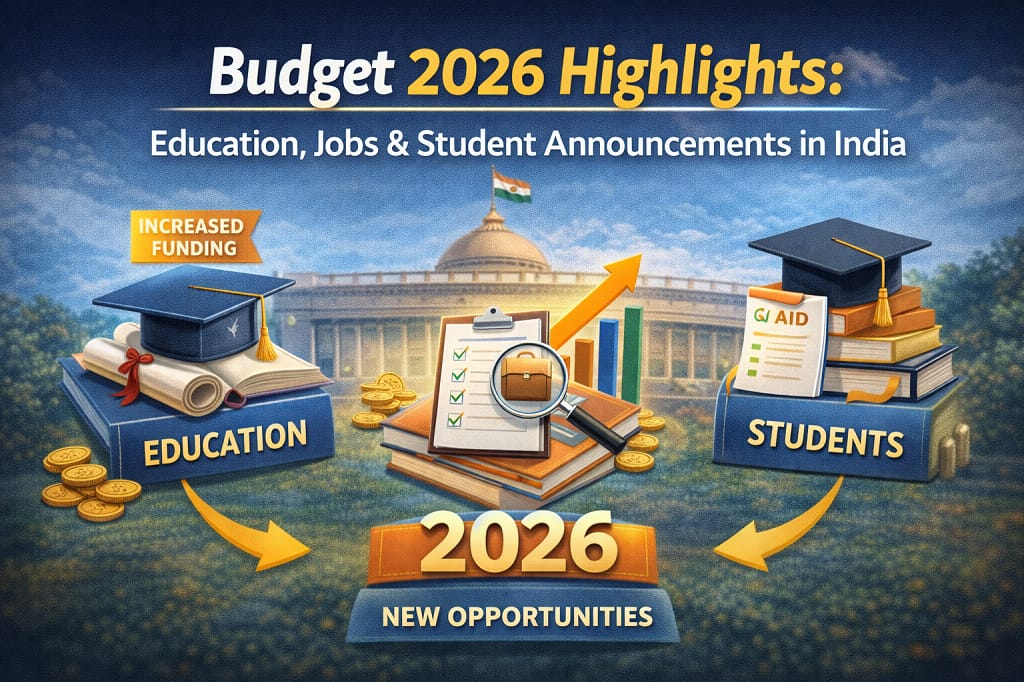
The Union Budget 2026 sets the stage for India’s future by strongly focusing on youth empowerment, education-to-employment pathways, and long-term economic growth. At the same time, it presents a forward-looking vision that aims to transform the education system into a practical bridge between academic learning and real industry needs.
For students, educators and institutions alike, Budget 2026 is not only about funding—but also about creating opportunities and improving access to future-ready skills. Moreover, it focuses on preparing young people for emerging careers in technology, innovation, and the creative economy. As a result, the overall education and workforce ecosystem is expected to become more inclusive, adaptable, and industry-aligned.
Union Budget 2026 Overview
The Union Budget sets the stage for India’s future by emphasizing youth empowerment, education-to-employment pathways, and long-term economic growth. At the same time, it presents a forward-looking plan aimed at transforming the education system into a practical bridge between academic learning and real industry needs. As a result, the gap between education and employment is expected to narrow significantly.
Why Budget 2026 Matters for Students, Teachers, and Institutions
For students, this budget not only unlocks opportunities to access quality education, scholarships, and employable skills, but also strengthens career readiness for the future. Meanwhile, teachers stand to gain through upskilling initiatives and reduced administrative burdens. In addition, institutions are supported with new infrastructure and funding for research. As a result, the overall education ecosystem becomes more inclusive, innovative, and sustainable.
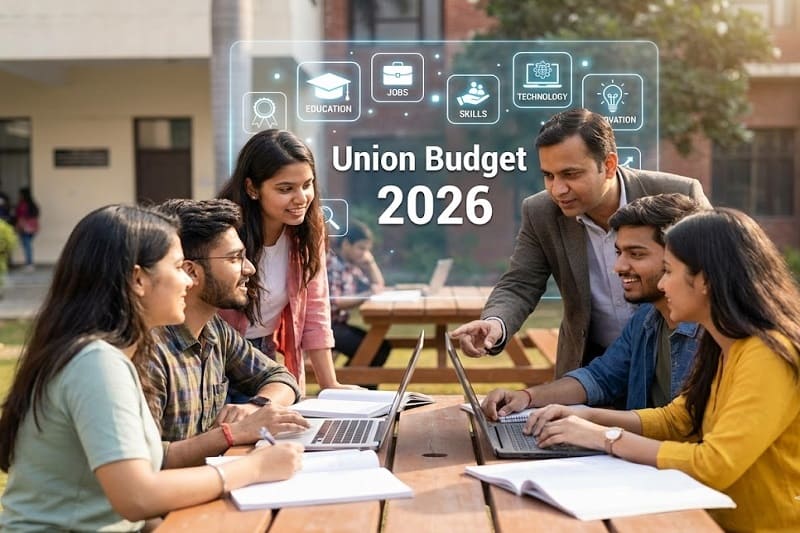
Budget 2026 Highlights for Education
In addition, the Union Budget 2026 places strong emphasis on strengthening the education ecosystem across schools, colleges and universities.
Overall education budget priorities
Budget 2026 strengthens three strategic pillars:
- quality and relevance of learning
- infrastructure and digital expansion
- job-linked education planning
Instead of increasing spending only on traditional classrooms, more resources are being aligned toward:
- applied learning
- research facilities
- specialised institutes
- industry collaboration
Linking education with industry and enterprise
One of the most important shifts in Budget 2026 is the formal connection between:
universities → skill providers → enterprises → employment hubs
This reduces the long-standing gap where students graduate but struggle to match industry expectations.
Regional and inclusive education expansion
Budget 2026 also highlights:
- balanced regional development
- inclusion of underserved districts
- access to specialised education beyond metro cities
This is especially important for students from Tier-2 and Tier-3 regions.
Major Education Reforms in Budget 2026 for Students & Institutions
More importantly, several structural reforms have been introduced to directly improve learning quality and career readiness for students. In addition, these reforms aim to strengthen industry collaboration and modernise curriculum frameworks. As a result, both students and institutions are better positioned to adapt to evolving skill demands. At the same time, the focus on digital infrastructure and faculty development further supports long-term educational excellence.
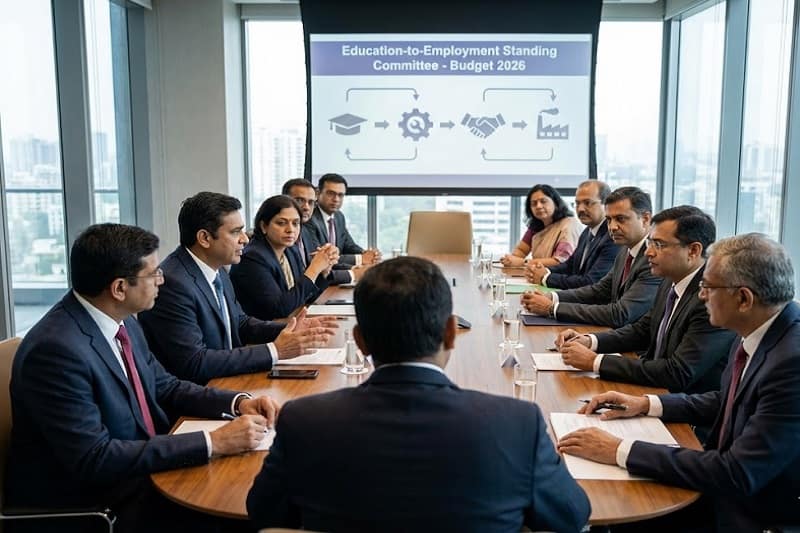
Education-to-Employment Committee in Budget 2026 for Students
A dedicated standing committee has been proposed to coordinate:
- academic institutions
- skilling bodies
- employers and industry groups
Its objective:
To continuously align curriculum, skills and job requirements.
Think of it as a permanent bridge between classrooms and workplaces.
New Institutions & University Infrastructure
Several major institutional developments are planned:
| Initiative | Purpose |
|---|---|
| New National Institute of Design (Eastern India) | Strengthen design, creative economy and industry collaboration |
| Five university townships near industrial corridors | Direct access to industry, internships and applied research |
| Regional medical education hubs | Improve availability of medical education and healthcare workforce |
These clusters are designed to function as education + employment ecosystems, not isolated campuses.
Student Infrastructure Development
To support learning and participation, Budget 2026 proposes:
- girls’ hostels in every district for STEM students
- improved campus facilities
- upgraded research infrastructure
The focus is not only enrollment, but retention and success, especially for women in technical fields.
Scholarships and Student Schemes in Budget 2026
At the same time, financial support and scholarship programmes remain a key priority for making education more accessible.
Affordability remains a major challenge for many families. Budget 2026 expands support through:
- enhanced scholarship coverage
- targeted fee incentives for priority disciplines
- broader access to education funding mechanisms
Lower TCS for education abroad
Students pursuing international education benefit from:
- reduced Tax Collection at Source (TCS) on overseas education expenses
- smoother financial planning for families
Student loan updates and affordability
The budget also improves access to:
- education-linked credit
- simplified loan procedures
- better alignment of loan repayment with employability
In practical terms, this helps students avoid the common problem of heavy debt before stable employment.
Skill Development Initiatives in Budget 2026 for Students
Similarly, the government has focused on future-ready skills to prepare students for emerging industries and digital careers.
Budget 2026 gives strong attention to future-oriented domains.
Alro read: Career skills to learn in 2026
AVGC, creative economy and digital skills
Training initiatives are expanded in:
- Animation, Visual Effects, Gaming and Comics (AVGC)
- digital media
- content technology
- creative entrepreneurship
These sectors are fast growing and increasingly global.
AI, tech and future-ready education
Institutions are encouraged to integrate:
- artificial intelligence
- data science
- automation
- emerging technologies
The idea is simple:
students should graduate with industry-relevant tools, not outdated syllabi.
National Institute of Hospitality & Tourism skilling
A dedicated national skilling institute is proposed to support:
- hospitality services
- tourism operations
- event and travel management
This directly supports employment in one of India’s strongest service sectors.
Telescope facilities for astronomy education
Specialised facilities are planned for:
- astronomy
- space sciences
- observational research
These initiatives strengthen India’s scientific talent pipeline from an early stage.

Jobs & Career Boost Measures in Budget 2026
As a result, Budget 2026 also connects education reforms with real employment opportunities for young professionals.
The employment strategy focuses on:
- public sector hiring
- education-linked job creation
- enterprise and startup support
Key directions include:
- targeted government job allocations
- expansion of apprenticeship and industry training models
- stronger support for innovation-driven enterprises
Education institutions now play a formal role in:
preparing graduates not only for employment — but for employability.
Sports, Youth & Employment Initiatives
Alongside education and jobs, youth development and sports infrastructure have also received special attention.
Khelo India Mission and youth development
Sports infrastructure is increasingly being connected to:
- professional coaching
- sports science
- career pathways beyond athletics
This supports employment in:
- fitness and training
- sports management
- physiotherapy and performance analytics
Youth participation is positioned as an active driver of India’s growth strategy.
Education-Linked Tax Relief & Policy Support
Budget 2026 also promotes learning through:
- tax incentives linked to education and training
- policy support for digital and blended education models
- simplified compliance for educational institutions
These measures encourage:
- private participation
- institutional investment
- innovation in learning delivery
Budget 2026 Highlights for Students – Key Takeaways
In simple terms, students should focus on how these announcements can directly shape their academic and career planning.
Key takeaways for school and college students
- skills matter as much as degrees
- technology exposure is no longer optional
- internships and applied learning will become more common
Opportunities created by Budget 2026
Students can now expect:
- better access to scholarships
- wider availability of specialised institutes
- stronger placement and industry linkage
How students can prepare and benefit
Practical tips:
- start building digital and analytical skills early
- actively seek internships and projects
- follow industry-aligned certifications alongside formal education
Think of your degree as the foundation — and your skills as the structure built on top of it.
Budget 2026 Highlights for Teachers and Institutions
Teacher upskilling and digital classrooms
Institutions are encouraged to:
- adopt blended learning models
- train faculty in digital tools
- integrate industry projects into teaching
Reduced administrative burden
Policy support aims to:
- simplify regulatory processes
- improve institutional flexibility
Expectations for schools and colleges
The expectation is clear:
Institutions must focus on learning outcomes, not only enrollment numbers.
Regional Perspective
Telangana and regional education impact
Budget 2026 highlights region-specific planning, particularly for:
- education clusters
- medical and technical hubs
- industry-linked university development
Balanced development across states
The broader objective is to reduce regional gaps in:
- quality education access
- specialised training availability
- employment-oriented learning
Why Budget 2026 Is Being Closely Watched
Youth at the centre of India’s growth strategy
For the first time, youth development is being positioned as a core economic growth driver, not merely as a social programme. In fact, the government has clearly highlighted this shift in its official policy vision outlined in the Union Budget 2026 speech.
👉 You can read the official Budget Speech 2026 here:
https://www.indiabudget.gov.in/doc/budget_speech.pdf
This policy direction signals that future public spending and reforms will increasingly focus on employability, skills, and innovation-led education.
Long-term impact on India’s education ecosystem
At the same time, Budget 2026 sets the groundwork for:
-
modern and industry-aligned curricula,
-
future-ready universities and institutions, and
-
stronger talent pipelines connecting education with employment.
Ultimately, the real success of Budget 2026 will be judged by how effectively learning outcomes convert into sustainable jobs and long-term career opportunities for India’s youth.
FAQs on Budget 2026 Highlights
What are the main Budget 2026 highlights for education?
The main highlights include institutional expansion, education-to-employment coordination, digital learning infrastructure, scholarships and regional education development.
What are the key Budget 2026 highlights for jobs?
The key measures include government hiring support and apprenticeship expansion. At the same time, the budget introduces startup and enterprise incentives. Furthermore, industry-linked education reforms are being promoted to better align skills with labour-market needs.
What scholarships and student benefits are included?
Expanded scholarships, better access to education funding, reduced TCS for overseas studies and improved student loan affordability are major benefits.
Conclusion
Overall, Budget 2026 clearly signals a strong shift towards education-led growth, skill development and youth empowerment.
Budget 2026 clearly signals a strategic shift in India’s development approach.
Instead of viewing education, skills and employment as separate policy areas, the budget positions them as interconnected growth pillars.
For students, this means stronger pathways from learning to livelihoods.
>For institutions, it brings higher responsibility for outcomes.
>For the nation, it lays the foundation for a more resilient and competitive workforce.
To explore more education and career-focused guides, visit: 👉 http://insightstudyhub.com/









Post Comment