GATE 2027: Registration Date, Exam Date, Eligibility & Application Fee Guide
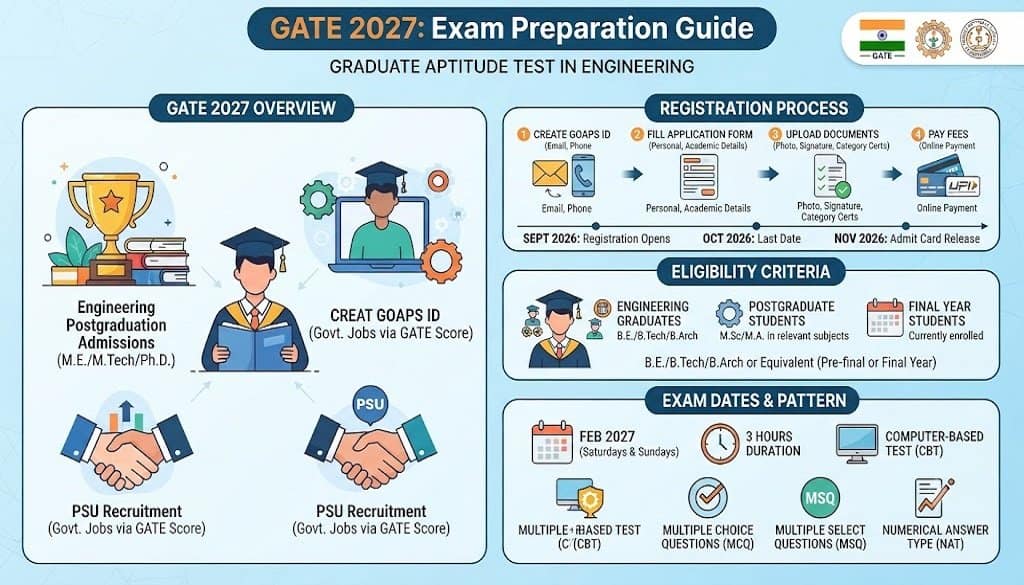
If you’re an engineering student planning your next academic move, GATE 2027 just became the exam to watch. The Indian Institute of Technology Madras has officially opened the registration window on August 27, 2026, on the GOAPS portal, and thousands of aspirants across India are already checking eligibility, fees, and exam dates.
GATE, or the Graduate Aptitude Test in Engineering, is the gateway to M.Tech admissions at IITs, NITs, and IIITs, as well as recruitment at major public sector undertakings. Many students who first crack JEE Main and complete their undergraduate engineering degree eventually appear for GATE as the natural next step in their career journey.
This guide walks you through everything confirmed in the official GATE 2027 notification — registration dates, eligibility rules, the application process, fee structure, exam pattern, and what has genuinely changed this year, including a brand-new Robotics and Automation paper.
GATE 2027 Key Highlights at a Glance
Before we go section by section, here’s a quick snapshot of the exam so you know exactly where things stand.
| Particular | Details |
| Exam Name | Graduate Aptitude Test in Engineering (GATE) 2027 |
| Organizing Institute | IIT Madras |
| Notification Released | 20 July 2026 |
| Registration Opens | 27 August 2026 |
| Registration Closes (no late fee) | 27 September 2026 |
| Late Fee Window Closes | 5 October 2026 |
| Exam Dates | 6, 7, 13, 14, 20 & 21 February 2027 |
| Exam Mode | Computer-Based Test (CBT), 2 sessions/day |
| Total Papers | 30 subjects, including the new Robotics and Automation (RA) paper |
| Result Date | 19 March 2027 (expected) |
| Official Website | gate2027.iitm.ac.in |
GATE 2027 Exam Overview
What Is the GATE Exam?
GATE evaluates a candidate’s understanding of undergraduate-level subjects in Engineering, Technology, Architecture, Science, Commerce, Arts, and Humanities. It’s conducted jointly by IISc Bangalore and the seven IITs on behalf of the National Coordination Board under the Ministry of Education.
Why GATE Matters in India
A good GATE score opens three distinct doors: postgraduate admission at premier institutes, direct recruitment at PSUs like NTPC, ONGC, and PGCIL, and eligibility for PhD programmes with fellowship support. Unlike many entrance exams, your GATE score doesn’t expire immediately — it stays valid for three years for academic admissions.
Who Conducts GATE 2027?
GATE follows a rotation system among IISc Bangalore and the seven IITs — Bombay, Delhi, Guwahati, Kanpur, Kharagpur, Madras, and Roorkee. After IIT Guwahati conducted GATE 2026, the responsibility has now moved to IIT Madras for the 2027 cycle. Each institute typically gets its turn once every eight years.
GATE 2027 Important Dates: Full Schedule
Here is the complete, officially confirmed timeline for GATE 2027. Bookmark this table and check back periodically, since IIT Madras has already revised the registration start date once this year.
| Event | Date |
| Notification & Brochure Released | 20 July 2026 |
| Registration Opens (GOAPS Portal) | 27 August 2026 |
| Regular Registration Closes | 27 September 2026 |
| Extended Registration (with late fee) | 5 October 2026 |
| Application Correction Window | 14 – 21 October 2026 |
| Admit Card Release | Early January 2027 (expected) |
| Exam Dates | 6, 7, 13, 14, 20 & 21 February 2027 |
| Answer Key Release | Late February 2027 (expected) |
| Result Declaration | 19 March 2027 (expected) |
Important note: These dates come from the official brochure, but GATE conducting institutes have revised schedules in the past — as happened with this year’s registration start date. Always verify against the live notice board on the official site before you plan around any date.
GATE 2027 Eligibility Criteria
Educational Qualification Required
GATE 2027 eligibility has been notably relaxed compared to earlier years. You can now apply if you meet any of these conditions:
- Currently studying in the 3rd year or higher of any recognised undergraduate degree programme in Engineering, Technology, Architecture, Science, Commerce, Arts, or Humanities
- Already completed a government-approved undergraduate or postgraduate degree in an eligible discipline
- Enrolled in professional courses recognised by bodies such as UPSC, IES, AMIE, or similar institutions notified by IIT Madras
Age Limit and Number of Attempts
There’s genuinely good news here: GATE 2027 has no upper age limit and no cap on the number of attempts. Whether you’re a fresh graduate or someone returning to studies after a few years of work experience, you remain eligible as long as you meet the qualifying degree criteria.
Nationality
Indian nationals as well as candidates from Nepal, Bangladesh, Sri Lanka, Ethiopia, and the UAE can apply for GATE 2027, since the exam is also conducted at select international centres.
GATE 2027 Registration Process (GOAPS Portal)
All GATE 2027 applications go through the GOAPS (GATE Online Application Processing System) portal. There is no offline application mode, so keep your documents ready in digital format before you begin.
Step-by-Step: How to Apply for GATE 2027
- Visit the official website, gate2027.iitm.ac.in, and click on New Registration.
- Create and verify a DigiLocker account — this is mandatory for all Indian applicants this year.
- Fill in personal details: name, date of birth, category, and contact information.
- Enter your academic qualification details and select your primary test paper.
- Choose a second paper only if it falls under an officially approved two-paper combination.
- Select up to three preferred exam cities, in order of priority.
- Upload your photograph, signature, and category certificate (if applicable) in the prescribed format.
- Pay the application fee online and download the confirmation page for your records.
Common Mistakes to Avoid During Registration
- Waiting until the last week — payment gateways slow down considerably near the deadline
- Uploading blurred or oversized photographs and signatures that don’t match the prescribed specifications
- Skipping DigiLocker verification, which will block form submission entirely
- Selecting a second paper outside the approved two-paper combination list
GATE 2027 Application Fee: Category-Wise Breakdown
The fee structure remains consistent with recent years, and it’s charged per test paper — so candidates attempting two papers under an approved combination pay double.
| Category | Regular Period Fee | Extended Period Fee (with late fee) |
| Female / SC / ST / PwD | Rs. 1,000 per paper | Rs. 1,500 per paper |
| General / OBC-NCL / EWS | Rs. 2,000 per paper | Rs. 2,500 per paper |
| Foreign Nationals (incl. international centres) | Rs. 2,000 / USD equivalent | Rs. 2,500 / USD equivalent |
Payment is accepted only through net banking, debit card, credit card, or UPI. The fee is non-refundable once submitted, so it’s worth double-checking your category, paper selection, and exam city preferences before you pay.
GATE 2027 Exam Pattern
Mode, Duration, and Question Types
GATE 2027 will be a fully online, computer-based test held over six exam days this year — up from four days in GATE 2026 — to accommodate all 30 subject papers, including the newly added Robotics and Automation paper. Each session runs for three hours and includes a mix of Multiple Choice Questions, Multiple Select Questions, and Numerical Answer Type questions.
Marking Scheme and Negative Marking
| Question Type | Marks | Negative Marking |
| Multiple Choice Questions (MCQ) | 1 or 2 marks | 1/3 for 1-mark; 2/3 for 2-mark questions |
| Multiple Select Questions (MSQ) | 1 or 2 marks | No negative marking |
| Numerical Answer Type (NAT) | 1 or 2 marks | No negative marking |
What’s Genuinely New in GATE 2027
- A new test paper: Robotics and Automation (RA)
- Textile Engineering & Fibre Science (TF) is now offered as a sectional paper under Engineering Sciences (XE)
- Revised subject codes within the XE, XH, and XL sectional papers
- Mandatory DigiLocker-based verification during registration
- Exam spread across six days instead of four, to accommodate the expanded paper list
GATE 2027 Preparation Strategy
With registration opening in late August and the exam scheduled for February, most aspirants have roughly five to six months of runway. That’s enough time if you build a structured plan rather than jumping randomly between topics.
A Realistic Month-by-Month Roadmap
- September – October: Finish syllabus coverage for your core subjects; build strong fundamentals rather than rushing through topics
- November: Move into topic-wise previous-year questions and short revision notes
- December: Begin full-length mock tests under timed conditions, at least twice a week
- January: Focus on weak areas identified from mock analysis and revise formula sheets daily
- February: Light revision only — avoid starting new topics in the final two weeks before your exam dates
High-Weightage Areas Across Most Papers
General Aptitude carries a fixed 15-mark weightage across every paper, so don’t ignore it. Engineering Mathematics typically accounts for another 13–15 marks. For core branches like Computer Science, Mechanical, and Electrical Engineering, previous-year trends show consistently heavy weightage in data structures and algorithms, thermodynamics, and electrical circuits respectively — so allocate your revision time accordingly.
GATE 2027 Admit Card
The admit card is expected to be released in early January 2027, roughly a month before the exam. You’ll download it directly from your GOAPS login using your enrollment ID. Carry a printed copy along with a valid original photo ID to your exam centre — entry is not permitted without both.
GATE 2027 Result and Scorecard
How the GATE Score Is Calculated
Your raw marks are normalised using a formula that accounts for differences in difficulty across multiple exam sessions of the same paper. This normalised score, along with your All India Rank, determines your eligibility for admissions and PSU shortlisting.
What Counts as a Good GATE Score?
This varies significantly by branch and by year, since it depends on the difficulty level and the number of candidates. As a general reference, scoring in the top 2–3 percentile typically puts you in range for admission to a top IIT in popular branches like Computer Science, though cutoffs for NITs and IIITs are usually more accessible.
Score Validity
A GATE score remains valid for three years from the result date for M.Tech and PhD admissions. For PSU recruitment, however, most organisations only accept the scorecard from the same year’s exam, so check individual PSU notifications carefully.
What After GATE 2027?
M.Tech and PhD Admissions
A qualifying GATE score is the primary criterion for M.Tech admission at IITs, NITs, and IIITs through centralised counselling processes like CCMT and COAP. Many candidates who explored options through career guidance after 12th years earlier eventually return to this pathway once they’ve completed their undergraduate engineering degree.
PSU Recruitment
Public sector companies including NTPC, ONGC, PGCIL, BHEL, and IOCL use GATE scores to shortlist candidates for engineer-trainee and management-trainee positions, skipping a separate written exam altogether. This has made GATE nearly as valuable for direct employment as it is for higher studies.
PhD Admissions
GATE-qualified candidates are also eligible for PhD programmes at IITs and IISc, often with a monthly fellowship stipend from the Ministry of Education. If you’re weighing this path against other postgraduate options like CUET PG, it’s worth comparing funding support and research opportunities before deciding.
Frequently Asked Questions on GATE 2027
Who is conducting GATE 2027?
IIT Madras is the organizing institute for GATE 2027, following the standard rotation among IISc Bangalore and the seven IITs.
Can a 3rd-year engineering student apply for GATE 2027?
Yes. Students currently in their 3rd year or higher of an eligible undergraduate programme can apply for GATE 2027 under the relaxed eligibility norms.
Is there an age limit for GATE 2027?
No. GATE 2027 has no upper age limit and no restriction on the number of attempts.
What is the GATE 2027 application fee?
The fee is Rs. 1,000 per paper for Female/SC/ST/PwD candidates and Rs. 2,000 per paper for General/OBC-NCL/EWS candidates during the regular registration period.
What is a good GATE score?
This depends heavily on your branch and the exam's difficulty that year. Generally, a percentile in the top 2–3% is competitive for admission to a top IIT in popular branches.
How long is a GATE score valid?
A GATE score is valid for three years for M.Tech and PhD admissions, though most PSUs only accept the current year's scorecard for recruitment.
What's new in GATE 2027 compared to previous years?
The biggest changes are the introduction of a new Robotics and Automation (RA) paper, a six-day exam schedule instead of four, and mandatory DigiLocker verification during registration.
Conclusion: Key Takeaways
GATE 2027 registration is now live, and with a revised six-day exam schedule, a new Robotics and Automation paper, and mandatory DigiLocker verification, this year brings more changes than usual. The core fundamentals, though, remain the same: register early, keep your documents ready, and build a structured study plan around your target papers.
Whether your goal is an M.Tech seat at an IIT, a PhD with fellowship support, or a direct PSU recruitment opportunity, GATE 2027 is worth planning for carefully. For more exam updates and career guidance content, keep checking Insight Study Hub.











Post Comment