Polytechnic Diploma Courses After 12th 2026: Branches, Fees, Admission & Salary Guide
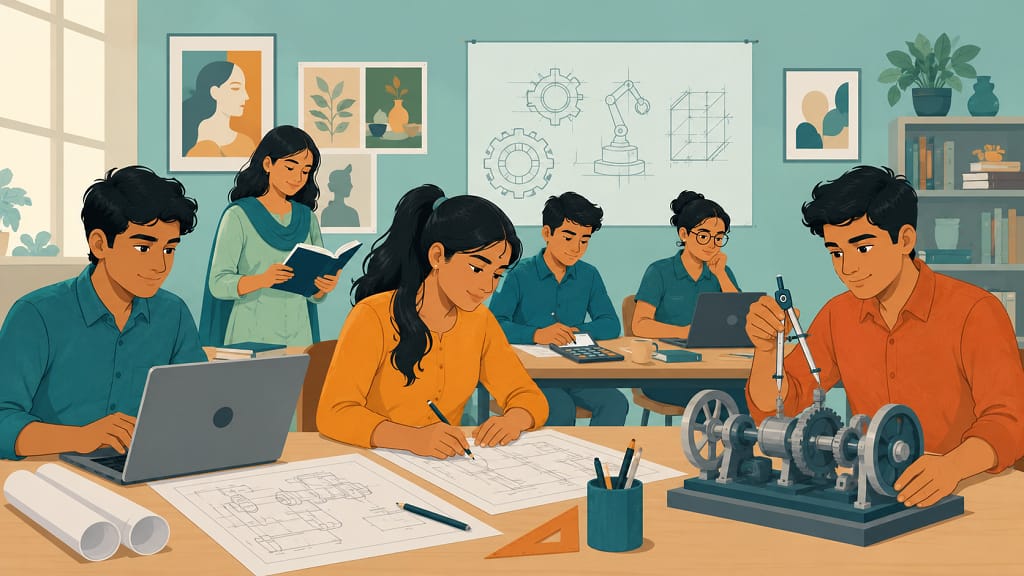
Right after Class 12 results, most students find themselves stuck between two extremes: a long four-year degree or, alternatively, a short certificate course that may not carry much weight. Fortunately, polytechnic diploma courses after 12th offer a practical middle ground by combining shorter study duration with strong job-oriented training. Moreover, these diploma programs are available to students from the Science, Commerce, and Arts streams, making them accessible to a wide range of learners.
Whether your goal is to start working quickly or continue your education later, a polytechnic diploma can provide a solid foundation. In addition, many courses include hands-on training that helps students develop industry-ready skills. As a result, graduates are often better prepared for entry-level jobs or lateral entry into engineering degree programs.
In this guide, you’ll explore stream-wise diploma options, eligibility criteria, admission procedures, course fees, career opportunities, and expected salaries for the 2026 academic session.
Polytechnic Diploma Courses After 12th — Quick Highlights
| Detail | Overview |
| Duration | 2 years (lateral entry) after 12th; 3 years if starting after 10th |
| Eligibility | Passed Class 12 in a relevant stream, usually with 35–50% aggregate |
| Fee Range | Rs 18,000–22,000/year (government); Rs 1–5 lakh/year (private) |
| Admission Mode | State-level entrance exam or merit-based counselling |
What Is a Polytechnic Diploma Course?
A polytechnic diploma is, first of all, an AICTE-approved technical or professional programme, regulated by each state’s Board of Technical Education. Unlike a degree, however, it focuses heavily on hands-on training, so students spend a large share of their time in labs and workshops rather than lecture halls. As a result, this practical bias is exactly why diploma holders are often considered job-ready faster than fresh degree graduates.
Diploma vs Degree vs Certificate Course
| Basis | Diploma | Degree | Certificate |
| Duration | 2–3 years | 3–4 years | Weeks to a few months |
| Depth | Moderate, practical | In-depth, theoretical + practical | Basic, skill-specific |
| Recognition | AICTE approved | UGC/AICTE approved | Varies by provider |
| Best For | Quick technical entry | Long-term specialisation | Add-on skill upgrade |
Polytechnic After 10th vs After 12th — Which Route Applies to You?
3-Year Regular Diploma (After 10th)
To begin with, students who join right after Class 10 complete the full three-year diploma, covering foundational subjects in the first year before moving into branch-specific training.
2-Year Lateral Entry Diploma (After 12th)
Since Class 12 PCM students already have a stronger base in Maths and Science, on the other hand, they are usually allowed to skip the first year and join directly in the second year, thereby completing the diploma in just two years instead of three.
Eligibility Criteria for Polytechnic Diploma After 12th
| Stream | Eligibility Requirement |
| Science (PCM) | Class 12 with Physics, Chemistry, Maths; 35–50% aggregate |
| Science (PCB) | Class 12 with Biology subjects, for select healthcare-linked diplomas |
| Commerce | Class 12 pass in any Commerce stream, no specific subject mandatory |
| Arts | Class 12 pass in any stream; portfolio may be needed for design-based diplomas |
Polytechnic Diploma Courses After 12th — Science Stream
This is, by far, the most popular stream for polytechnic diplomas, largely because it opens the door to core engineering careers.
Engineering Diplomas (PCM Students)
- Diploma in Mechanical Engineering
- Diploma in Civil Engineering
- Diploma in Electrical Engineering
- Diploma in Computer Science Engineering
- Diploma in Electronics and Communication Engineering
- Diploma in Automobile Engineering
Healthcare-Linked Diplomas (PCB Students)
Even so, biology students are not left out — several states, in fact, offer diploma programmes in paramedical and allied health fields that accept PCB backgrounds, giving science students outside the PCM track a technical option too.
Polytechnic Diploma Courses After 12th — Commerce Stream
Commerce students often assume diplomas are only for science students, but, in fact, that is not accurate. On the contrary, business-oriented diploma programmes are widely available and lead into corporate and finance-support roles.
- Diploma in Business Administration
- Diploma in Banking and Finance
- Diploma in Financial Accounting
- Diploma in Retail Management
- Diploma in E-Commerce
Polytechnic Diploma Courses After 12th — Arts Stream
Meanwhile, Arts students have perhaps the widest creative range of diploma options, several of which lead into fast-growing media and design industries.
- Diploma in Fashion Design
- Diploma in Interior Design
- Diploma in Journalism and Mass Communication
- Diploma in Graphic Design
- Diploma in Tourism and Travel Management
- Diploma in Photography
Polytechnic Diploma Courses for Girls
While every diploma programme is open regardless of gender, streams like Fashion Design, Interior Design, and Financial Accounting have, nevertheless, traditionally seen strong participation and placement support for women. In addition, enrolment in core engineering diplomas is also growing as more institutes actively encourage mixed classrooms.
State-Wise Polytechnic Entrance Exams 2026
Generally speaking, admission happens through a state-level entrance exam rather than a single national test, so, consequently, the process depends heavily on where you live.
| State | Entrance Exam | Conducting Body |
| Uttar Pradesh | JEECUP | Joint Entrance Examination Council, UP |
| Telangana | TS POLYCET | State Board of Technical Education, Telangana |
| Andhra Pradesh | AP POLYCET | State Board of Technical Education, AP |
| Himachal Pradesh | HP PAT | Himachal Pradesh Technical University |
| Chhattisgarh | CG PAT | Directorate of Technical Education, CG |
| Bihar | DCECE | Bihar Combined Entrance Competitive Examination Board |
Polytechnic Diploma Fees 2026 — Government vs Private
| Institute Type | Approximate Annual Fee |
| Government Polytechnic | Rs 18,000 – Rs 22,000 per year |
| Private Polytechnic | Rs 1 lakh – Rs 5 lakh per year, depending on branch and location |
As expected, therefore, government institutes remain far more affordable, though, in return, the trade-off is limited seats and correspondingly tougher competition through the entrance exam route.
How to Apply for Polytechnic Diploma Admission 2026 — Step-by-Step
- Visit the relevant state technical education board or entrance exam website
- Register with a valid mobile number and email address
- Fill in academic details and preferred branch or stream
- Upload Class 12 marksheet, photograph, and signature
- Pay the application fee and appear for the entrance exam, if applicable
- Participate in counselling, lock your college and branch choice, and complete document verification
Polytechnic Diploma vs ITI — Which Is Better After 10th?
| Basis | Polytechnic Diploma | ITI |
| Duration | 3 years (after 10th) / 2 years (after 12th) | 6 months to 2 years |
| Focus | Broader engineering theory plus practice | Single trade, hands-on skill |
| Cost | Moderate to high, especially private institutes | Lower, especially government institutes |
| Best For | Students aiming for lateral entry into B.Tech | Quick entry into skilled jobs |
Polytechnic Diploma vs Regular B.Tech — Which Path Makes Sense?
First of all, a diploma is shorter and cheaper, and it gets students into the workforce sooner, which naturally appeals to those who want to start earning early. A regular four-year B.Tech, on the other hand, offers deeper specialisation and, therefore, typically wider access to campus placements with larger companies. Fortunately, though, these paths are not mutually exclusive: diploma holders can join B.Tech directly in the second year through lateral entry, effectively combining both routes without repeating coursework.
Career Scope and Salary After Polytechnic Diploma
Naturally, salary expectations vary a lot depending on the stream, institute reputation, and location. Therefore, here is a realistic entry-level breakdown rather than an inflated placement-brochure number.
Starting Salaries —
Science and Engineering Diplomas
| Branch | Starting Salary (Monthly) |
| Mechanical / Civil / Electrical | Rs 15,000 – Rs 25,000 |
| Computer Science / IT | Rs 15,000 – Rs 28,000 |
| Electronics & Communication | Rs 15,000 – Rs 25,000 |
Commerce Diplomas
| Course | Starting Salary (Monthly) |
| Banking & Finance | Rs 14,000 – Rs 22,000 |
| Business Administration | Rs 13,000 – Rs 20,000 |
Arts Diplomas
| Course | Starting Salary (Monthly) |
| Fashion / Interior Design | Rs 14,000 – Rs 25,000 |
| Journalism & Mass Communication | Rs 13,000 – Rs 22,000 |
Overall, these are entry-level ranges, and graduates from well-placed institutes or those who gain a few years of experience often earn considerably more, particularly once they add certifications or move into supervisory positions.
Top Government Job Opportunities After Diploma
- Indian Railways — Junior Engineer and Technician posts
- PSUs — BHEL, NTPC, ONGC, and similar organisations
- State Electricity Boards — Junior Engineer roles
- Defence technical entries across Army, Navy, and Air Force
Common Mistakes Students Make
- Choosing a trending branch without checking local industry demand
- Skipping the AICTE approval check before enrolling at a private institute
- Missing state-specific counselling deadlines while waiting for a preferred college
- Assuming all diplomas guarantee the same salary regardless of branch or institute
What After Polytechnic Diploma? Higher Study Options
Importantly, diploma holders are not limited to entry-level jobs. For instance, many use lateral entry to join the second year of a B.Tech programme, effectively saving a year compared to students who start after Class 12 directly. Alternatively, others pursue further specialisation diplomas or use their technical background to qualify for government job exams that specifically require a diploma-level qualification.
Frequently Asked Questions
Can Commerce or Arts students do polytechnic diploma courses after 12th?
Yes. Commerce students can pursue diplomas in Business Administration, Banking, or Accounting, while Arts students have options like Fashion Design, Journalism, and Interior Design.
What is the difference between polytechnic diploma and ITI?
A polytechnic diploma covers broader engineering theory alongside practical training over two to three years, while ITI focuses on a single trade with hands-on skill in a much shorter duration.
Can I get direct admission to B.Tech second year after a diploma?
Yes, through lateral entry, diploma holders can join the second year of a B.Tech programme without repeating the first year.
What is the eligibility for polytechnic diploma courses after 12th?
Generally, a Class 12 pass with 35–50% aggregate in a relevant stream is required, though the exact subject requirement depends on the specific diploma.
Is a polytechnic diploma better than a degree course?
Neither is universally better — a diploma gets you into the workforce faster and at lower cost, while a degree offers deeper specialisation and typically stronger placement access at larger companies.
Conclusion
In summary, polytechnic diploma courses after 12th provide a practical and affordable pathway to a technical or professional career, whether you come from the Science, Commerce, or Arts stream. Moreover, these programs focus on hands-on learning, helping students build industry-ready skills in less time than many traditional degree courses. However, admission rules, entrance exams, and counselling schedules differ from one state to another. Therefore, you should always check your state’s technical education board before selecting a branch or institute.
Students who are also considering shorter, trade-specific options should read our detailed ITI Courses List After 10th guide for a side-by-side comparison.
If you want to explore every study option after Class 12, our Top Courses After 12th guide covers a wide range of career paths beyond polytechnic diplomas.
Stay updated with the latest career advice, education news, and admission guides by visiting Insight Study Hub.
Before finalising admission to any private technical institute, always verify its approval status and accreditation through the All India Council for Technical Education (AICTE) .






4 comments