CUET Exam 2026: Full Form, Eligibility, Syllabus, Pattern & Preparation
What Is CUET Exam? (Full Form & Purpose)
The CUET Exam has become one of the most important entrance examinations for students in India who want to pursue undergraduate studies in central and other participating universities. If you are a student or parent trying to understand this exam in simple terms, this section will clearly explain what CUET exam is, its full form, why it was introduced, and how it helps in university admissions.
CUET Exam Full Form
The CUET exam full form is Common University Entrance Test.
As the name suggests, CUET is a common entrance examination conducted at the national level. Instead of giving multiple entrance tests for different universities, students can now appear for one exam and use the score for admission to various universities across India.
This single-test system has simplified the admission process and reduced stress for students.
What Is CUET Test and Why It Was Introduced
So, what is CUET Test exactly?
The Common University Entrance Test is a national-level entrance test introduced to standardize the undergraduate admission process across central universities and other participating institutions. Before CUET, admissions were mainly based on Class 12 board marks, which created problems because different boards follow different marking standards.
To remove this inequality, the CUET exam was introduced with the following goals:
- To provide equal opportunities to students from all education boards
- To create a transparent and merit-based admission system
- To reduce over-dependence on board exam marks
By conducting a common exam, universities can now assess students based on the same criteria, making the selection process fairer and more reliable.
Purpose of CUET for University Admissions
The main purpose of the Common University Entrance Test is to ensure a uniform admission process for undergraduate courses. CUET allows students to apply to multiple universities using a single scorecard, saving time, money, and effort.
Key purposes of Common University Entrance Test include:
- Simplifying the university admission process
- Reducing pressure caused by board exam cut-offs
- Allowing students to compete at a national level
- Giving universities a standard method to evaluate applicants
With Common University Entrance Test, students are judged on their subject knowledge and aptitude, rather than just board exam percentages.
Who Conducts the CUET Exam
The CUET Exam is conducted by the National Testing Agency (NTA).
NTA is responsible for:
- Releasing the CUET notification
- Managing online registration
- Conducting the computer-based test (CBT)
- Declaring results and scorecards
NTA already conducts major national exams, which ensures that the CUET exam process remains transparent, secure, and standardized across the country.
CUET Test Is for Which Courses & Subjects?
The Common University Entrance Test (CUET) is designed to open the doors to a wide range of undergraduate (UG) courses offered by central and other participating universities across India. At the same time, one of the most common questions students ask is which courses the CUET exam is for and what subjects are included in the CUET exam. Therefore, this section explains everything in a simple and student-friendly way, so that students can clearly understand their course and subject options before applying.
Courses Available Through CUET (UG Programs)
The CUET exam is mainly conducted for undergraduate admissions. Through a single CUET score, students can apply to multiple universities and courses, depending on their eligibility and subject combination.
Some of the most popular UG courses available through the CUET Exam include:
| Course Name | Full Form / Description |
| BA | Bachelor of Arts |
| BSc | Bachelor of Science |
| BCom | Bachelor of Commerce |
| BBA | Bachelor of Business Administration |
| BCA | Bachelor of Computer Applications |
| BA (Hons) | Bachelor of Arts (Honours) |
| BSc (Hons) | Bachelor of Science (Honours) |
| BCom (Hons) | Bachelor of Commerce (Honours) |
Each university sets its own course-wise eligibility, but the CUET exam acts as the common entrance gateway for all these programs.
Streams Covered: Science, Commerce, and Arts
One of the biggest advantages of the CUET Exam is that it is open to students from all major streams.
- Science stream: Students can apply for courses related to Physics, Chemistry, Mathematics, Biology, and other science-based programs.
- Commerce stream: Commerce students can target courses like BCom, BBA, Economics, and management-related programs.
- Arts/Humanities stream: Arts students can apply for BA programs in subjects such as History, Political Science, Sociology, Psychology, and more.
This makes CUET a stream-inclusive exam, allowing students from different academic backgrounds to compete fairly.
CUET Exam Subjects List
Understanding the CUET exam subjects list is important while choosing the right paper combination. The CUET exam subjects are broadly divided into three sections:
| Section | Subjects / Options |
| Language Test | English, Hindi, Other regional languages, Foreign languages (as offered by universities) |
| Domain Subjects | Physics, Chemistry, Mathematics, Biology, Accountancy, Economics, Business Studies, History, Geography, Political Science, Sociology, Psychology, etc. |
| General Test | General Knowledge, Current Affairs, Logical Reasoning, Quantitative Aptitude |
Students can select subjects based on the course requirements of the universities they are applying to.
CUET Exam Eligibility Criteria
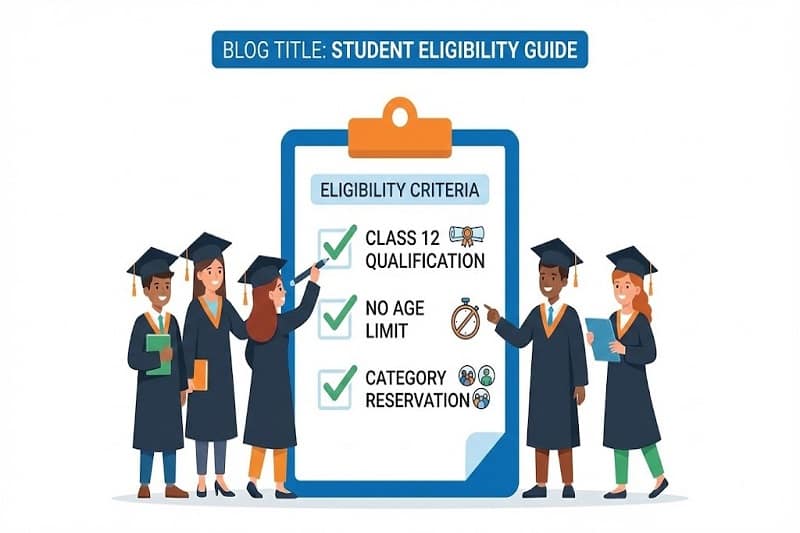
Before applying for the CUET Exam, it is very important for students to understand who is eligible for the CUET exam. The eligibility criteria are simple and student-friendly, but they may vary slightly depending on the university and course chosen. Below is a clear and detailed explanation of the CUET exam eligibility criteria.
Educational Qualification
To appear for the CUET Exam, candidates must meet the following educational requirements:
- The student must have passed Class 12 (10+2) from a recognized board
- Students who are appearing in Class 12 in the current academic year are also eligible to apply
- The qualifying examination must be from a recognized board such as CBSE, ICSE, State Boards, or equivalent
However, minimum percentage requirements (if any) are decided by individual universities and courses, not by CUET itself.
Age Limit (If Any)
One of the most common questions students ask is about the age limit.
- There is no upper or lower age limit to apply for the CUET Exam
- Candidates of any age can appear, provided they meet the educational qualification criteria
That said, some universities may set their own age conditions for specific courses, so students should always check the university-specific eligibility.
Eligibility for General / OBC / SC / ST Categories
The CUET exam eligibility is the same for all categories:
- General
- OBC (Non-Creamy Layer)
- SC
- ST
- EWS
- PwD
There is no difference in basic eligibility based on category. However:
- Reservation benefits are provided during the admission process as per government norms
- Category certificates must be valid and issued by competent authorities
This ensures a fair and inclusive admission process through the CUET Exam.
Eligibility for Different Courses
While CUET sets the basic eligibility, course-specific requirements are decided by the universities. Examples include:
- Science courses (BSc, BSc Hons): Usually require domain subjects like Physics, Chemistry, Mathematics, or Biology in Class 12
- Commerce courses (BCom, BBA): May require Accountancy, Economics, or Mathematics as domain subjects
- Arts courses (BA programs): Generally flexible but may require specific domain subjects related to the course
Students must choose CUET domain subjects carefully based on the course eligibility criteria of their preferred university.
CUET Exam Pattern Explained
Understanding the CUET exam pattern is essential for effective preparation and smart time management. The exam follows a standardized structure, allowing students from different boards to compete on an equal platform. Below is a detailed and easy-to-understand explanation of the CUET Exam pattern.
Mode of Exam (CBT)
The CUET Exam is conducted in Computer-Based Test (CBT) mode.
- The exam is held online at designated exam centers
- Questions appear on a computer screen
- Students select answers using a mouse or keyboard
- This mode ensures transparency, accuracy, and faster result processing
Sections of CUET Exam
The CUET Exam is divided into multiple sections, and students can choose sections based on their course and university requirements.
CUET Exam Sections:
| Section | Description | Details / Examples |
| Section IA & IB – Language Test | Tests language skills like reading comprehension, grammar, and vocabulary | Languages: English, Hindi, Regional languages |
| Section II – Domain-Specific Subjects | Tests knowledge of subjects relevant to the chosen course | Subjects: Physics, Chemistry, Mathematics, Biology, Economics, History, Political Science, Business Studies, Sociology, Psychology, etc. |
| Section III – General Test | Tests overall aptitude and awareness | Topics: General Knowledge, Current Affairs, Logical Reasoning, Quantitative Aptitude |
Number of Questions & Marking Scheme
The CUET exam pattern follows an objective-type format:
- Multiple Choice Questions (MCQs)
- Each correct answer: +5 marks
- Each incorrect answer: –1 mark (negative marking)
- Unattempted questions: 0 marks
Typical Question Distribution:
- Each test paper usually contains 40–50 questions
- Candidates must attempt a fixed number of questions as per instructions
(Exact numbers may vary slightly depending on the subject and year.)
Duration of Exam
- Each section of the CUET Exam is conducted in a fixed time slot
- Generally, each test paper is allotted 45–60 minutes
- Total exam duration depends on the number of sections chosen by the candidate
Time management plays a key role, as no extra time is provided beyond the allotted duration.
CUET Exam Syllabus (Subject-Wise Overview)
A clear understanding of the CUET exam syllabus is the foundation of smart and focused preparation. Since the syllabus is closely aligned with the Class 12 curriculum, students who plan strategically can score well without unnecessary stress. Below is a subject-wise overview of the CUET Exam syllabus, explained in a simple and student-friendly manner.
Language Section Syllabus
The Language Test in the CUET Exam checks a candidate’s reading and communication skills rather than rote learning.
Key topics included:
- Reading Comprehension (factual, narrative, and literary passages)
- Vocabulary (synonyms, antonyms, word meanings)
- Grammar and sentence correction
- Verbal ability and usage
- Rearranging sentences and paragraphs
👉 The focus here is on understanding, accuracy, and speed, making regular reading and practice essential.
Domain Subject Syllabus
The Domain Subjects syllabus is based entirely on the NCERT Class 12 syllabus.
Examples of domain subjects:
- Science: Physics, Chemistry, Biology, Mathematics
- Commerce: Accountancy, Business Studies, Economics
- Arts/Humanities: History, Geography, Political Science, Sociology, Psychology
Important points to remember:
- Only Class 12 topics are included
- NCERT textbooks are the primary and most reliable source
- Concept clarity is more important than memorization
General Test Syllabus
The General Test evaluates a student’s overall awareness and reasoning ability.
Topics covered:
- General Knowledge & Static GK
- Current Affairs (national & international)
- Logical and Analytical Reasoning
- Quantitative Aptitude (basic mathematics)
- Numerical ability and data interpretation
This section is especially important for courses where the General Test is mandatory.
Tips to Understand the CUET Syllabus Smartly
- ✔ Download the official CUET syllabus PDF from the exam authority
- ✔ Match each topic with NCERT chapters
- ✔ Prioritize high-weightage topics first
- ✔ Avoid unnecessary reference books
- ✔ Practice mock tests based strictly on the syllabus
Smart syllabus planning saves time and increases accuracy.
CUET Exam Date 2026 & Important Schedule
Knowing the CUET exam date 2026 and its complete schedule helps students plan their preparation, revision, and mock tests in a stress-free way. While the official notification is released by NTA, based on previous years’ trends, we can clearly understand the expected CUET 2026 timeline.
Expected CUET Exam Date 2026
As per past exam patterns, the CUET Exam 2026 is expected to be conducted in:
- 📅 May to June 2026
- Mode: Computer-Based Test (CBT)
- Conducting body: National Testing Agency (NTA)
The exam is usually held in multiple shifts over several days, depending on the number of registered candidates.
CUET 2026 Registration Start Date (Expected)
The CUET exam registration process generally begins around:
|
👉 It is highly recommended to apply early to avoid last-minute technical issues.
CUET Exam 2026 Registration Last Date
Based on previous years, the CUET exam date 2026 registration last date is expected to fall around:
- ⏳ March–April 2026
After this date:
- No new applications are accepted
- Correction window may open for limited changes
Missing the deadline means waiting another full year, so marking this date is crucial.
Admit Card & Result Timeline
Here’s the expected timeline after registration:
- 🎫 CUET Admit Card 2026:
Released 10–15 days before the exam - 📊 CUET Result 2026:
Declared within 3–4 weeks after the exam - 🏫 University Counselling & Admissions:
Starts soon after results, depending on each university’s process
How to Prepare for CUET Exam (Beginner-Friendly Guide)
Preparing for the CUET Exam can feel overwhelming at first—especially if you’re a beginner. But with the right strategy, clear concepts, and consistent practice, cracking CUET is absolutely achievable. This section breaks down CUET exam preparation into simple, actionable steps that students can actually follow.
Study Plan for CUET Exam (Step-by-Step)
A well-structured CUET study plan is the foundation of success. Instead of studying randomly, divide your preparation into clear phases:
1️⃣ Understand the Exam First
- Go through the CUET exam pattern and syllabus
- Identify your selected language + domain subjects + general test
2️⃣ Set a Realistic Timeline
- If you have 6–8 months → focus on concept building + practice
- If you have 3–4 months → focus on revision + mock tests
3️⃣ Subject-Wise Planning
- Language section: daily reading + vocabulary practice
- Domain subjects: revise NCERT basics first
- General test: quantitative aptitude, reasoning, GK
👉 Study 2–3 subjects per day instead of everything at once.
Best Books & Resources for CUET Preparation
Choosing the right resources saves time and boosts confidence.
📘 Recommended Study Material
- NCERT textbooks (Class 11 & 12) – MUST for domain subjects
- CUET-specific guide books (latest edition)
- Previous year CUET/sample questions
🌐 Online Resources
- Free YouTube lectures for concept clarity
- Online mock tests & quizzes
- Government portals and exam prep platforms
💡 Tip: Avoid too many books—quality > quantity.
Online vs Offline CUET Preparation – Which Is Better?
Both methods work well—it depends on your learning style.
✅ Online Preparation
- Flexible schedule
- Affordable/free resources
- Best for self-motivated students
✅ Offline Preparation (Coaching)
- Structured discipline
- Personal guidance
- Good for students needing routine
👉 Many toppers follow a hybrid approach:
Online content + self-study + mock tests.
Daily Timetable Tips for CUET Aspirants
A simple daily routine can make a big difference.
🕒 Sample Daily Study Plan
- 1–1.5 hours → Domain subject
- 45 minutes → Language practice
- 30–45 minutes → General test
- 30 minutes → Revision or mock questions
Smart Tips:
- Study when your mind is fresh
- Revise weekly, not monthly
- Practice MCQs daily
- Take short breaks to avoid burnout
Consistency matters more than long hours.

Which Course Is Best After CUET Exam?
One of the most common questions students ask is: “Which course is best after CUET exam?”
The answer depends on your stream, interest, and long-term career goals. CUET opens doors to top central, state, and private universities across India, offering a wide range of undergraduate programs.
Let’s break it down stream-wise so you can choose wisely.
Best Courses After CUET for Science Students
Science students have some of the most diverse and high-demand options after CUET.
Popular Courses:
- B.Sc (Physics, Chemistry, Mathematics)
- B.Sc (Biology, Biotechnology, Microbiology)
- B.Sc Computer Science / Data Science
- BCA (Bachelor of Computer Applications)
- B.Tech (in select universities through CUET)
Career Scope:
- Research & higher studies (M.Sc, PhD)
- IT & software roles
- Healthcare & biotech industries
- Government exams & technical jobs
👉 Best for students who enjoy logic, experiments, and technology.
Best Courses After CUET for Commerce Students
Commerce students benefit greatly from CUET as it offers access to top universities like DU, BHU, and others.
Top Courses:
- B.Com (Hons / General)
- BBA / BBM
- BMS (Business Management Studies)
- BA (Economics / Finance)
Career Scope:
- Chartered Accountant (CA)
- MBA & management roles
- Banking & finance sector
- Corporate jobs & entrepreneurship
👉 Ideal for students interested in business, finance, and management.
Best Courses After CUET for Arts Students
Arts students now have equal opportunities through CUET-based admissions.
Popular Courses:
- BA (English, History, Political Science, Sociology)
- BA (Psychology / Philosophy)
- BA Journalism & Mass Communication
- BA Economics
Career Scope:
- Civil services & government jobs
- Media, content, and communication fields
- Teaching & academia
- Social sector & NGOs
👉 Perfect for students passionate about humanities, writing, and social sciences.
Career Scope After Common University Entrance Test
CUET itself is not a career—it’s a gateway. Your future depends on:
- Course selection
- University reputation
- Skills you build during graduation
After CUET, students can aim for:
- Higher education in India or abroad
- Competitive exams (UPSC, SSC, Banking)
- Corporate & private sector jobs
- Skill-based careers (digital, tech, analytics)
AQs About CUET Exam
This section answers the most frequently asked questions about the CUET Exam, based on what students and parents commonly search online. These FAQs will help clear doubts and give you a quick, confident understanding of CUET.
What is the CUET exam for?
The CUET exam is conducted for admission to undergraduate courses in central, state, deemed, and private universities across India.
Its main purpose is to provide a single, standardized entrance test, ensuring equal opportunities for students from different education boards.
Who is eligible for CUET exam?
Any student who has:
- Passed or is appearing in Class 12 (10+2) from a recognized board
- Meets the course-specific eligibility criteria of the chosen university
There is no common age limit for CUET, but individual universities may have their own rules.
Is CUET harder than NEET?
No. CUET is not harder than NEET.
- CUET tests Class 12-level knowledge, aptitude, and subject understanding
- NEET is a highly competitive medical entrance exam with deeper conceptual difficulty
CUET focuses more on breadth of subjects, while NEET focuses on depth in science (PCB).
Which course is best after CUET?
The best course after CUET depends on your stream and interest:
- Science: B.Sc, BCA, Computer Science, Biotechnology
- Commerce: B.Com, BBA, Economics
- Arts: BA (English, History, Political Science, Psychology)
There is no single “best” course—the right choice is the one that matches your career goals.
Is CUET compulsory for central universities?
Yes. For most undergraduate admissions, CUET is compulsory for central universities like:
- Delhi University (DU)
- Banaras Hindu University (BHU)
- Jawaharlal Nehru University (JNU)
- Aligarh Muslim University (AMU)
Without CUET scores, students cannot apply for UG admissions in these universities.
Conclusion
The CUET Exam has emerged as a game-changer in undergraduate admissions across India. It levels the playing field for students from diverse educational boards, ensuring fair evaluation and equal opportunity. Here’s a quick wrap-up for aspirants:
Why CUET Exam Is Important for Students
- Provides a standardized platform for university admissions
- Opens doors to top central, state, and private universities
- Encourages merit-based selection rather than board-specific advantages
- Boosts career and higher-education prospects in the long term
Final Preparation Advice
- Focus on concept clarity over rote memorization
- Stick to the official syllabus and NCERT books for domain subjects
- Practice mock tests, previous year questions, and timed quizzes
- Revise regularly and track your progress to identify weak areas
Encourage Early Planning
- Begin preparation at least 6–8 months before the exam
- Set a daily study timetable and follow it consistently
- Early planning ensures confidence, better time management, and stress-free preparation
Remember, the CUET Exam is not just an entrance test—it is a gateway to your dream course and future career. For more exam guides, career advice, and student-focused educational content, visit Insight Study Hub and stay updated with reliable and easy-to-understand resources.









7 comments