Net Run Rate in Cricket (NRR) Explained – Formula, Calculation & Importance
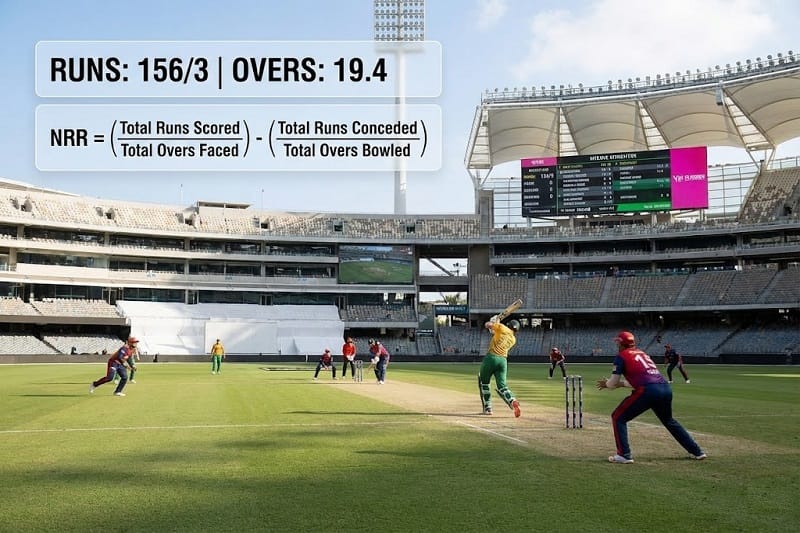
If you’ve ever checked a cricket points table and wondered why one team sits above another despite having the same number of wins, the answer is often Net Run Rate (NRR). It’s one of those cricket metrics that quietly decides qualifications, semi-final spots, and heartbreaks—yet many fans find it confusing.
At its core, net run rate cricket is about how efficiently a team scores runs compared to how efficiently it concedes them. Think of it as a performance balance sheet: not just what you scored, but how fast you scored it—and how well you restricted the opposition. In modern limited-overs cricket (T20s and ODIs), where margins are tight and schedules packed, NRR provides a fair, math-backed way to separate teams beyond simple win–loss records.
In this guide, we’ll start with the basics—what NRR actually means, how it differs from run rate, and why it was introduced—using plain English, practical analogies, and real match context.
What Is Net Run Rate (NRR) in Cricket?
Meaning of net run rate in cricket
Net Run Rate (NRR) measures a team’s overall scoring speed minus the scoring speed it allows opponents across matches in a tournament. In simpler terms:
NRR = How fast your team scores – How fast opponents score against you
If your team consistently scores quickly and bowls economically, your NRR rises. If you score slowly or concede quickly, your NRR drops—even if you win some games.
Unlike a single-match stat, NRR is calculated across all matches in a competition. That’s why one heavy loss or a dominant win can noticeably shift a team’s position on the table.
Difference between run rate and net run rate
This is where many fans get tripped up. The two sound similar, but they’re used very differently.
- Run Rate (RR): Measures how many runs a team scores per over in one innings or match.
Example: 180 runs in 20 overs = 9.00 run rate. - Net Run Rate (NRR): Compares your team’s run rate to the opponents’ run rate across a tournament.
Example: If you score at 9.00 per over overall but concede at 8.20, your NRR is +0.80.
A helpful analogy:
- Run rate is your speed in a single race.
- Net run rate is your average speed compared to everyone else across the season.
This comparison aspect is exactly why NRR is so useful for rankings.
Why NRR was introduced in cricket
Cricket tournaments often involve multiple teams finishing on equal points. Earlier methods—like head-to-head results or total runs—weren’t always fair or practical, especially in round-robin formats. NRR was introduced to bring balance and objectivity.
Here’s what NRR solves:
- Fair separation: Rewards teams that win convincingly, not just narrowly.
- Consistency check: Reflects performance across the whole tournament, not one-off results.
- Strategic clarity: Encourages teams to manage chases and defenses smartly (without promoting unsporting play).
That’s why NRR is now standard in major competitions such as IPL, World Cups, and most domestic leagues.
A beginner-friendly way to think about NRR
Imagine two teams both finish with 8 points:
- Team A wins matches by chasing targets quickly and bowls tightly.
- Team B wins the same number of matches but scrapes through close finishes and concedes heavily in losses.
NRR ensures Team A is ranked higher because, overall, they played more dominant cricket. It’s not about punishing Team B—it’s about recognizing efficiency.
Why Net Run Rate Is Important in Cricket
In modern limited-overs cricket, winning matches is essential—but how you win (or lose) matters just as much. This is where net run rate cricket becomes crucial. NRR acts as the tournament’s built-in fairness meter, separating teams that may look equal on points but very different in performance quality.
Below, we’ll break down why NRR matters, how it shapes points tables, and why it often becomes the headline number in leagues like the IPL and World Cups.
Role of NRR in Points Tables
In most cricket tournaments, teams earn:
- 2 points for a win
- 0 points for a loss
- Shared points in abandoned or tied matches (depending on rules)
When two or more teams finish with the same points, the points table needs a secondary measure to rank them. That measure is almost always Net Run Rate.
NRR reflects:
- How efficiently a team scores runs across matches
- How effectively it restricts opponents
This makes it a stronger indicator than just total runs or wickets. A team that dominates games convincingly will naturally sit higher than a team that scrapes through close wins.
In short:
Points tell how many matches you won.
NRR tells how well you played overall.
How NRR Decides Team Rankings
When teams are level on points, rankings are usually decided in this order:
- Net Run Rate (NRR)
- Head-to-head results (in some tournaments)
- Other criteria (like wickets taken or fair-play points)
Because NRR aggregates performance across all matches, it rewards consistency rather than one-off results.
Simple example:
| Team | Points | NRR |
| Team A | 8 | +0.82 |
| Team B | 8 | +0.15 |
Even though both teams won the same number of matches, Team A ranks higher because it scored faster and/or conceded runs more slowly over the tournament.
This is why commentators often say things like “They need to win by 40 runs to go top of the table.” That statement is entirely about improving NRR.
Importance of NRR in IPL, World Cups, and League Cricket
| Cricket Level | Why Net Run Rate Matters | Real Impact on Matches |
| IPL & Franchise Leagues | Short seasons mean fewer matches, so NRR quickly becomes a key separator when teams are tied on points. | A single heavy defeat can significantly damage NRR, forcing teams to chase targets faster or win by large margins in later games. Captains often promote aggressive batters or attack early purely to protect or improve net run rate. |
| ICC World Cups & Global Events | With many teams and limited qualification spots, multiple sides often finish with equal points. | Rain-affected matches and abandoned games increase dependence on NRR. Semi-final or knockout qualification can depend on tiny decimal differences, leading teams to calculate exact winning margins needed to advance. |
| Domestic & Amateur Leagues | NRR provides a simple, fair ranking method when points are equal, even in smaller competitions. | Widely used in club tournaments, school and college leagues, corporate events, and local cricket to rank teams consistently without complex tie-breakers. |
Its simplicity and fairness make it easy to apply at every level of the game.
Net Run Rate Formula in Cricket
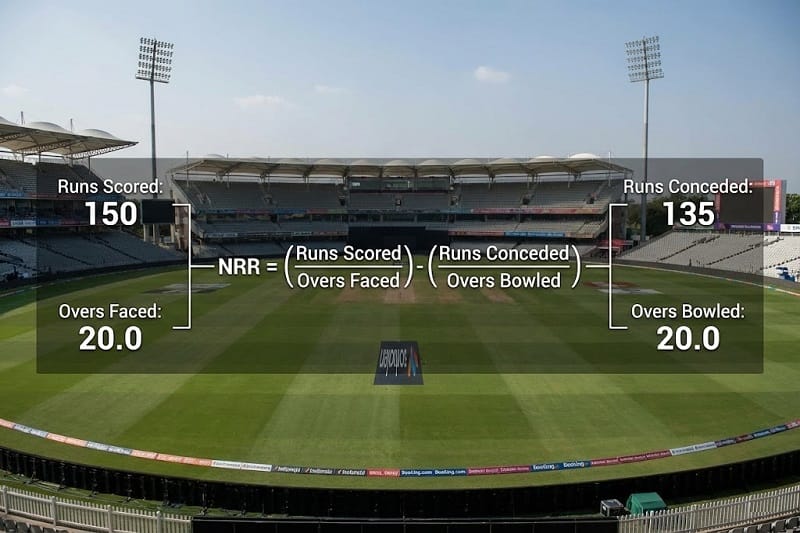
Understanding the net run rate cricket formula is the moment when NRR stops feeling confusing and starts making sense. Once you know what numbers are included—and how overs are treated—you can calculate NRR confidently for any match or tournament.
Let’s break it down step by step, in plain English.
Official Net Run Rate (NRR) Formula
The official formula used in cricket tournaments is:
Net Run Rate (NRR) =
(Total runs scored ÷ Total overs faced) − (Total runs conceded ÷ Total overs bowled)
That’s it. No hidden tricks. No advanced math.
NRR is simply the difference between how fast your team scores and how fast it allows the opposition to score, calculated across all matches in a tournament.
Breaking Down Each Part of the Formula
To really understand NRR, you need to know what each component means—and how it’s counted.
Runs Scored
- The total runs your team scores across all matches
- Includes all completed innings in the tournament
- Super Overs are not included unless tournament rules say otherwise
Also read: What Is a Super Over in Cricket
Overs Faced
- The total number of overs your team actually batted
- Important rule:
If your team gets all out early, the full quota of overs is still counted
Example:
If a team is bowled out for 120 runs in 17.3 overs of a 20-over match, it is counted as 20 overs faced, not 17.3.
This prevents teams from gaming the system by batting recklessly.
Runs Conceded
- The total runs your team gives away while bowling
- Includes all matches played
- Extras count just like normal runs
Overs Bowled
- Total overs your team bowls to the opposition
- If the opposition is all out early, the full scheduled overs are still counted
This keeps the calculation fair and consistent.
How Overs and Decimals Are Treated in NRR
This is one of the most common sources of confusion.
In cricket:
- 0.1 overs = 1 ball
- 0.5 overs = 5 balls
- 0.6 overs does NOT exist
But for NRR calculations:
- Overs are converted into fractions of an over
- 1 ball = 1/6 of an over
Example:
- 18.4 overs = 18 + (4 ÷ 6) = 18.67 overs
- 19.2 overs = 19 + (2 ÷ 6) = 19.33 overs
Using correct decimal conversion is critical. Even a small mistake can change NRR rankings—especially in tight tournaments like the IPL or World Cup.
Simple NRR Formula Example
| Category | Value |
| Total Runs Scored | 360 |
| Total Overs Faced | 40 |
| Total Runs Conceded | 340 |
| Total Overs Bowled | 40 |
Calculation:
- Scoring rate = 360 ÷ 40 = 9.00
- Conceding rate = 340 ÷ 40 = 8.50
- NRR = 9.00 − 8.50 = +0.50
A positive NRR means your team is outperforming opponents overall.
A negative NRR means the opposite.
Practical Tips to Avoid NRR Calculation Mistakes
- Always count full overs when a team is all out
- Convert balls to decimal overs correctly
- Use tournament totals, not single-match figures
- Don’t confuse run rate with net run rate
If you follow these rules, your NRR calculations will match official points tables every time.
Why Knowing the Formula Matters
Understanding the net run rate formula helps you:
- Read points tables accurately
- Understand captaincy decisions during chases
- Predict qualification scenarios late in tournaments
It turns confusing post-match discussions into clear, logical outcomes.
In the next section, we’ll apply this formula to real match scenarios, including chases, early all-outs, and rain-affected games—so you can see exactly how NRR changes in practice.
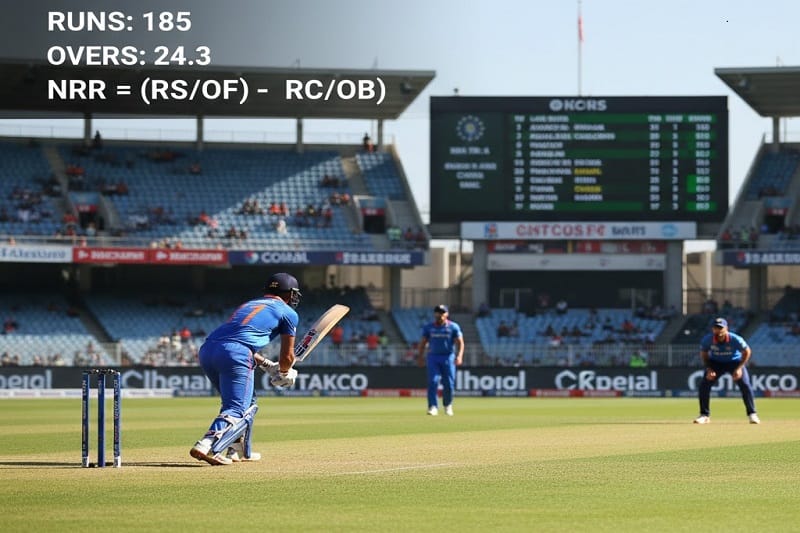
How to Calculate Net Run Rate in Cricket
Calculating net run rate cricket becomes straightforward once you understand how different match situations are treated. The key idea is consistency: tournaments want a fair comparison, so special rules apply when games end early.
When Both Teams Play Full Overs
This is the simplest case.
- Use the actual runs scored and overs faced by each team.
- Apply the standard NRR formula across matches.
Tip: This is common in completed T20 and ODI matches with no interruptions.
When the Team Batting Second Wins Early
If the chasing team reaches the target before using all its overs:
- Overs faced = actual overs used
- Overs bowled = actual overs delivered
This rewards efficient chases. Winning in fewer overs boosts your scoring rate and, therefore, your NRR.
When a Team Gets All Out Before Full Overs
This is where many mistakes happen.
- If a team is bowled out, it is considered to have faced the full quota of overs (20 in T20s, 50 in ODIs), even if it happened earlier.
- The same applies when bowling the opposition out early.
This rule prevents teams from inflating NRR by batting recklessly.
Net Run Rate Calculation – Simple Match Example
Let’s walk through a clean, beginner-friendly example.
Step-by-Step Example
Match type: T20
- Team A: 160 runs, all out in 18.2 overs → counted as 20 overs
- Team B: 161 runs in 18.0 overs
Table-Style Breakdown
| Team | Runs Scored | Overs Faced | Runs Conceded | Overs Bowled |
| Team A | 160 | 20.0 | 161 | 18.0 |
| Team B | 161 | 18.0 | 160 | 20.0 |
Final NRR Explained Simply
- Team A scoring rate = 160 ÷ 20 = 8.00
- Team A conceding rate = 161 ÷ 18 ≈ 8.94
- NRR (Team A) = −0.94
- Team B scoring rate = 161 ÷ 18 ≈ 8.94
- Team B conceding rate = 160 ÷ 20 = 8.00
- NRR (Team B) = +0.94
Even though the win margin was just one run, Team B’s quicker chase gives it a strong positive NRR.
How Net Run Rate Works in Different Formats
Net Run Rate in T20 Cricket
- Most sensitive to big wins and losses due to short matches
- One heavy defeat can drastically reduce NRR
- Teams often chase faster late in tournaments to protect standings
Net Run Rate in ODI Cricket
- More stable because of longer innings
- Still crucial in group stages of World Cups
- Rewards consistent dominance across matches
Why Net Run Rate Is Not Used in Test Cricket
Test matches:
- Don’t have fixed overs
- Can end in draws
- Are influenced by time rather than run speed
Because of this, NRR has no practical or fair application in Test cricket.
Also read: Ultimate Guide to Test Cricket Rules
Net Run Rate in Rain-Affected Matches
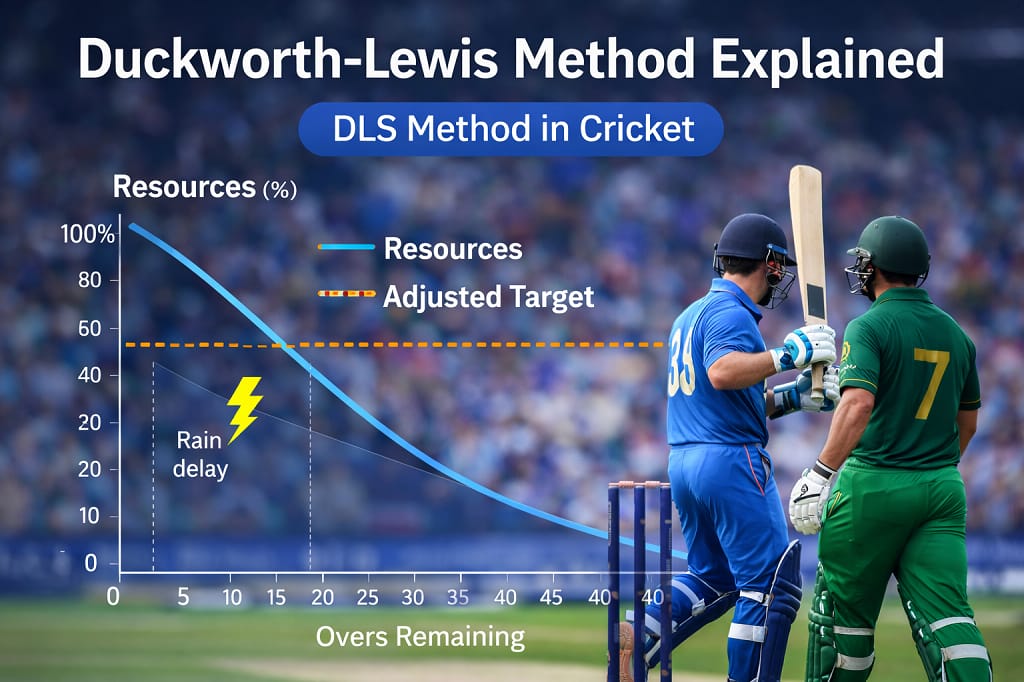
Effect of the DLS Method on NRR
When rain interrupts a match:
- Revised targets are set using DLS
- NRR calculations still use runs and overs actually played, not the original schedule
Reduced Overs and Revised Targets
- If a match is shortened to, say, 12 overs, those 12 overs become the full quota
- Teams are not penalized for rain-related reductions
Common Misconceptions Clarified
- DLS affects the target, not the NRR formula
- NRR is calculated normally using adjusted overs
What Happens If Net Run Rate Is Equal?
When teams finish level on both points and NRR:
- Head-to-head results are often considered next
- Some tournaments look at number of wins
- Others may use fair-play points or boundary counts
Exact rules vary by competition, but NRR is almost always the first separator.
Common Mistakes in Net Run Rate Calculation
Avoid these frequent errors:
- ❌ Ignoring full overs when a team is all out
- ❌ Confusing single-match run rate with tournament NRR
- ❌ Incorrect conversion of balls into decimal overs
A small decimal mistake can change rankings—especially in tight leagues.
Net Run Rate Calculator – Is It Necessary?
Manual vs Calculator Calculation
- Manual calculation helps you understand the logic
- Calculators save time during tournaments
When Using a Calculator Is Helpful
- Multi-match tournaments
- Rain-affected schedules
- Tight qualification scenarios
Accuracy Tips for NRR Calculators
- Always enter full overs for all-out innings
- Double-check decimal conversions
- Use tournament totals, not single-match stats
FAQs About Net Run Rate in Cricket
Do wickets affect net run rate?
No. Only runs and overs matter.
Can net run rate be negative?
Yes. It means a team concedes runs faster than it scores.
How can a team improve its NRR?
By chasing targets quickly and limiting opponents efficiently.
How is NRR calculated in IPL?
Using the same official formula across all league matches.
Conclusion – Understanding Net Run Rate in Cricket
Net run rate is more than a mathematical rule—it’s a reflection of overall dominance in limited-overs cricket. By accounting for scoring speed and bowling efficiency across matches, NRR ensures fair rankings when points are tied. Whether you’re following the IPL, a World Cup, or a local league, understanding net run rate in cricket helps you read the game beyond wins and losses—and appreciate the strategy behind every over.
👉 For more easy and student-friendly cricket rules and sports guides, visit Insight Study Hub – Cricket Rules & Sports Guides








1 comment